Custom Hologram Master: 2D/3D vs Dot Matrix
Imagine a buyer likes a dramatic moving demonstration but cannot tell the receiving team what to look for on the final small seal. Paying for another effect does not settle that question. Choose a proposal the intended viewer can inspect under relevant conditions, and keep decoration a legitimate option.
The short answer: choose 2D/3D when layered logo depth and clear graphic separation are central; choose dot matrix when dynamic motion, color travel or angle-switching effects matter. A hybrid master can combine them, but only when each feature has a verification purpose.
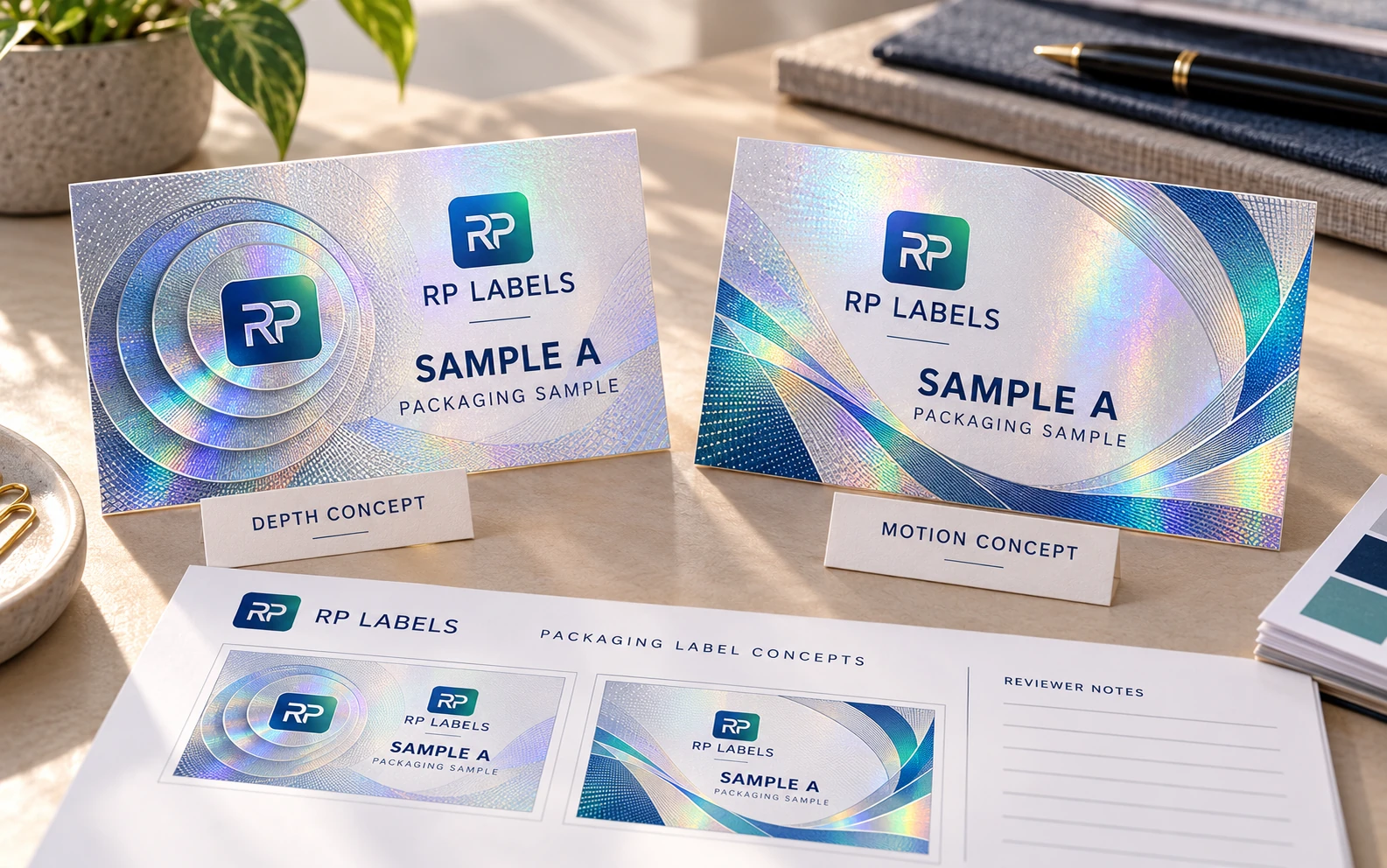
AI-generated packaging illustration. Fictional RP demonstration samples; not an actual order, completed test, authentication or approval record. Any displayed checks or codes are illustrative.
A buying decision based only on an effect name remains incomplete. “3D,” “laser” and “rainbow” are used loosely in the market. Ask what is originated inside the master, what is merely printed on top, and what a viewer should see when the label tilts.
What 2D/3D origination does well
A 2D/3D master commonly separates supplied artwork into visual planes. The logo can appear forward, a wordmark can sit behind it, and a repeating background can occupy another level. The result is organized depth without requiring a physical three-dimensional model.
This route suits recognizable brand marks, seals, text and geometric layers. It is especially useful when sales staff or customers need a simple instruction such as “tilt the seal and confirm the logo sits above the background.”
What dot matrix adds
Dot-matrix origination controls small diffraction areas to create movement, color shifts, kinetic sweeps and angle-dependent changes. The visual response can feel more active than a layered 2D/3D composition and can support fine optical structures that are difficult to communicate in a flat image.
That strength can become clutter. If every part moves in a different direction, the viewer may only see a bright sticker. The effect should guide the eye toward one or two deliberate checks.
Buying rule: write the verification instruction before choosing the effect. If the instruction is confusing, the master is probably trying to do too much.
Security comes from layers, not one dramatic flash
A visible optical feature helps quick checking, but it does not prove authenticity by itself. Stronger programs combine overt features with less obvious microtext, fine-line structures, hidden images or controlled numbering, plus a distribution and record system that tells the owner which codes should exist.
A serial number or QR code printed on top is trackable data, not automatically an optical feature. It can still be valuable when the database, code generation and duplicate-handling process are controlled. The hologram and the data layer should be designed as one verification experience.
A screen proof cannot approve diffraction
A PDF can confirm logo shape, text, approximate planes, serial zone, die line and printed colors. It cannot faithfully show brightness, movement, depth or how the effect changes under warm shop light versus daylight. Approve a physical sample before production where the optical result matters.
Separate the optical master from printed artwork
Clarify which elements are embedded during origination and which are added later by ink, white backing, QR or serial printing. Selective white ink can hold text and codes steady while leaving chosen areas reflective. Too much opaque ink can hide the optical work that justified a custom master.
Ask for an artwork map showing holographic zones, white-ink zones, normal print, variable data and die cut. This makes revisions safer and helps future buyers understand why the file contains several layers.
Master ownership and reorders belong in the quote
Before paying an origination charge, confirm who controls the master, how it is identified, whether it is used exclusively for your orders, how long files or tooling are retained, and what happens if the label size changes. Also ask whether a reorder uses the same master or requires new origination.
For sensitive projects, define how source artwork, master files, overruns and waste are handled. No hologram supplier should promise that a label is impossible to copy. The practical goal is to raise replication difficulty and make genuine labels easier to check.
Custom-master approval checklist
- Define the person who will verify the label and where
- Write one simple tilt-and-check instruction
- Map 2D/3D depth planes or dot-matrix motion zones
- Separate optical, white ink, normal print and variable data
- Reserve readable contrast for QR and serial fields
- Approve the effect on a physical sample under several lights
- Document master ID, ownership, exclusivity and retention
- Record the exact construction for controlled reorders
Give the viewer an instruction before buying the effect
The worked optical-observation brief, blank brief and field guide compare proposed depth and motion concepts. These are requests for demonstration, not measurements of the illustrated cards. No still image in this article proves diffraction, a genuine master or security performance.
Ask the intended viewer to describe the required observation without borrowing the supplier's effect name. The supplier then identifies what the offered sample actually represents and what remains different from the buyer's proposed master. Record actual size, package, viewing conditions and any printed layer that can cover the optical feature. A larger demonstration card can explain a direction while leaving the final-size decision unresolved.
If the effect is attractive but the inspection instruction remains confusing, simplify the proposed observation or reconsider whether the job is decorative. A quiet, recognizable feature can deserve the order over a busy concept. A decorative buyer can also choose expressive motion without calling it authentication. Neither route should claim that a particular effect name makes copying impossible.
Keep master identification and actual commercial control terms with the chosen proposal. A screen approval of the printed wordmark does not release the optical result. Send RP Labels the observation brief, artwork, intended label size, quantity and package reference. Ask what proposed origination and relevant sample scope can be offered, with unresolved optical evidence explicitly held.