Peel, Tack and Shear: Compare Label Adhesive Data Without Picking the Biggest Number
Do not rank two label adhesives from the largest value on their data sheets until the test, specimen and conditions match. Peel, tack and shear describe different loading questions. Even two peel values can be unsuitable for a direct comparison if the surface, angle, speed, dwell, width or construction differs.
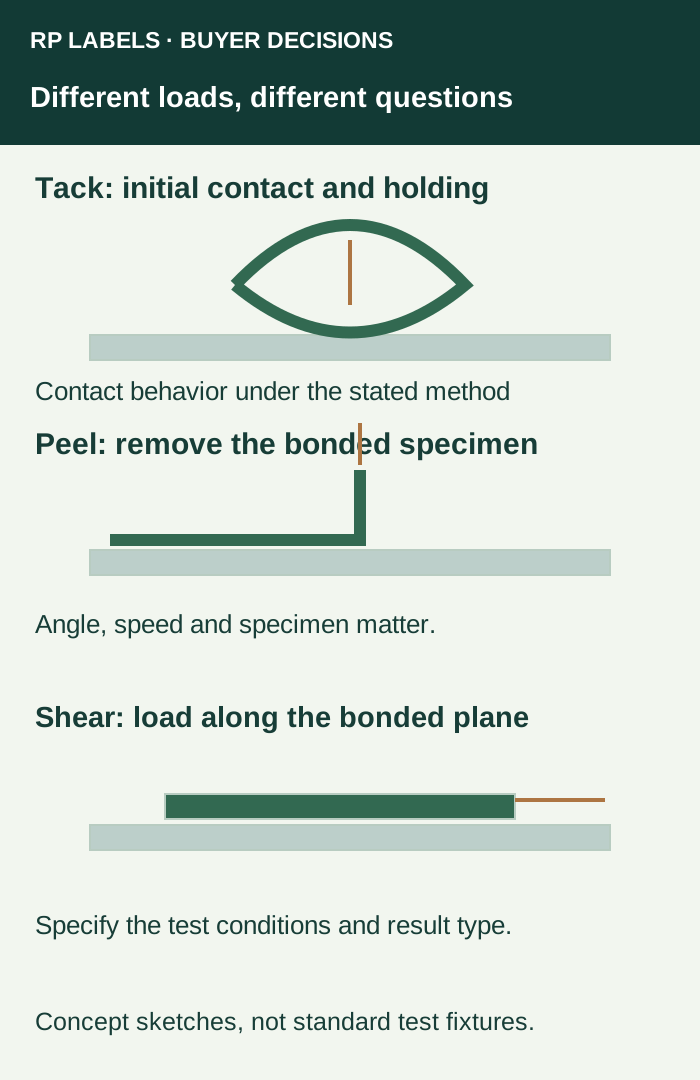
Ask what the reported value actually measures
Initial tack concerns contact and early holding behavior. Peel data concerns removing a bonded specimen under a specified setup. Shear concerns resistance to a load acting along the bonded plane, under the method’s stated conditions. A low result in one test is not automatically cancelled by a high result in another.
Avery Dennison’s adhesive glossary distinguishes initial tack, peel adhesion, shear resistance and bond development. Those definitions help identify the question; the proposed material’s own method and data still need to be supplied. Do not treat a glossary as an approval of an unidentified adhesive on your bottle.
For a small vial, ask which behavior matters in the real sequence. Initial application, a curved edge held over time and removal from a flat laboratory panel are related to adhesion but are not the same observation. The vial adhesive guide covers the actual application and edge-lift investigation. This page is about whether the numerical evidence being compared is commensurate.
Read the method and conditions beside the number
Keep the material or adhesive reference and the document revision. Then identify the test method, test panel, application and conditioning details, time before measurement, test speed, peel angle where relevant, specimen width and units. Record which face stock or finished construction was tested.
Avery Dennison’s discussion of peel geometry and speed explains that changing these conditions changes the measured response. It explicitly cautions against translating a result from one angle/speed setup into another. Do not apply its particular laboratory results or dwell time as a specification for an RP label.
Unit conversion can resolve a unit difference when the underlying quantities and specimen basis are equivalent. It cannot repair a different method, panel or conditioning history. A value stated as force and a value stated as force per width also need their actual definitions before anyone makes an arithmetic comparison.
Use a mismatch to request information, not to choose a winner
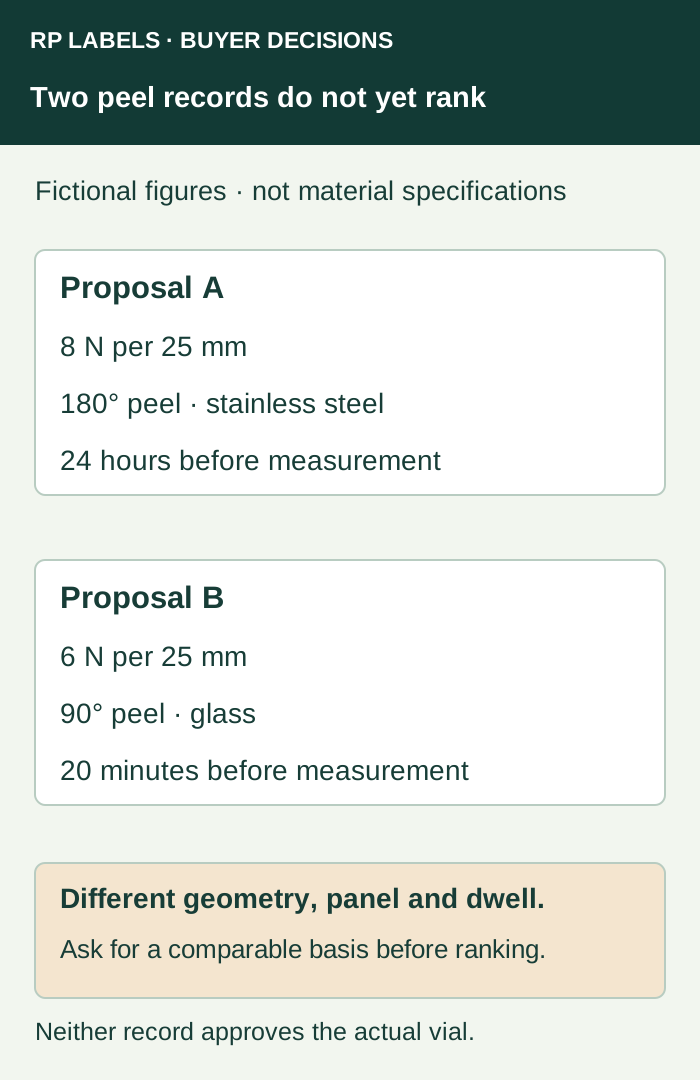
Suppose fictional Proposal A reports 8 N per 25 mm from a 180-degree peel on stainless steel after 24 hours. Proposal B reports 6 N per 25 mm from a 90-degree peel on glass after 20 minutes. The larger A number does not establish that A will hold a label better on the buyer’s vial. Several inputs changed together.
The useful next request is a comparable test basis or an explicit explanation of the limits. The supplier may have relevant additional data, may propose a matched evaluation, or may only have the published data. Record the answer. Missing comparable data is not proof of poor performance, but it does prevent the spreadsheet from supporting the claimed ranking.
| Mismatch | Next action |
|---|---|
| Different test panels | Ask for relevant surface evidence; identify the actual container surface separately. |
| Different peel angle or speed | Request results on the same defined basis or keep the values separate. |
| Different time before measurement | Identify what each result represents and the time available in the actual process. |
| Different face stock or finished layers | Identify the tested construction and whether it represents the proposed printed label. |
Connect a fair data comparison to the physical purchase
Comparable laboratory values can inform material selection. They do not establish every aspect of an applied label on a curved, coated, damp or otherwise different container. Agree a representative sample question for the actual package and handling route where that evidence is needed.
A stable repeat order may already have relevant accepted evidence for its unchanged construction and route. A new material, container or exposure should identify which part needs reopening. Do not request a completely new test program merely because two data sheets use different layouts; ask first whether the existing evidence answers the actual decision.
For vial, supplement or seal labels, prepare an RP inquiry with the bottle or carton reference, proposed material references, relevant data sheets and the property being compared. Mark the non-matching conditions and ask what available evidence or sample scope can address them. The request is more actionable than “please supply the strongest glue.”