Removable vs Permanent Peptide Vial Labels: Choose by Workflow
Imagine a buyer asks for the strongest adhesive, then learns the internal sample vial must be relabeled at a controlled later step. Another buyer needs its original identity to stay attached through distribution. These hypothetical routes deserve different specifications even when the artwork looks identical.
The short answer: use a permanent vial label when identity must remain attached through handling, shipping and storage. Consider a removable construction when the label has a defined temporary job and the vial must be relabeled, returned or reused. In both cases, test the adhesive on the actual glass after the real dwell time and temperature cycle.
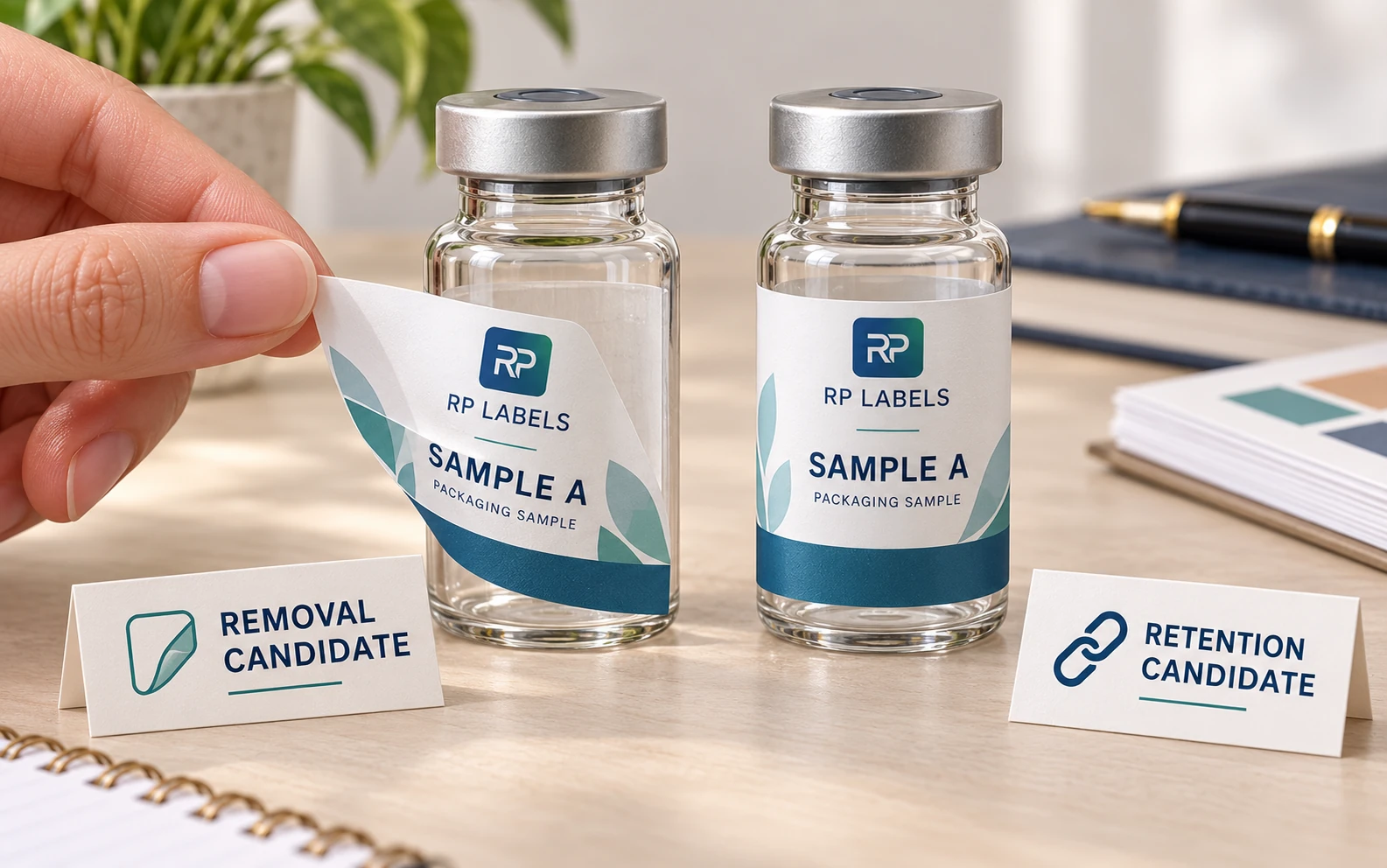
AI-generated packaging illustration. Fictional RP demonstration samples; not an actual order, completed test, authentication or approval record. Any displayed checks or codes are illustrative.
There is no heroic adhesive that wins every order. The supplier who treats permanent as automatically premium is selling force instead of function.
What removable and permanent should mean in your order
| Removable | Designed for a specified removal window and surface, with controlled peel and acceptable residue. It is not a promise of clean removal from every glass after every storage period. |
|---|---|
| Permanent | Designed to build and retain bond for durable identification. It can still fail if applied to moisture, contamination, a tight curve or below its intended application temperature. |
| Repositionable | Allows limited correction during application. It should not be confused with a label intended to peel cleanly weeks later. |
| Tamper-evident | Designed to show interference through fracture, transfer or another visible change. Strong adhesion alone is not tamper evidence. |
The prototype buyer and the shipping buyer
Consider a hypothetical buyer building short evaluation kits. Vials are used internally, the contents change and the glass may return to a controlled cleaning process. The label needs to stay flat for several days, tolerate normal handling and then come away without turning removal into a separate production department. A tested removable adhesive can be the professional choice.
A contrasting hypothetical buyer ships small research vials through multiple warehouses. The label carries the product code, lot and QR reference. Nobody downstream is supposed to remove it. Clean peel has no commercial value there. Bond, readable life and consistent placement matter more.
Both buyers may order the same white BOPP rectangle. On a screen, the labels look identical. The business risk sits underneath the face stock.
Why glass does not behave like a specification sheet
Vial glass can arrive with dust, release residue, fingerprints or surface treatments. The usable straight wall may be smaller than the nominal bottle height. A narrow diameter creates memory in a stiff film, pulling the closing edge away from the surface. Cold glass can carry invisible moisture before obvious condensation appears.
Adhesive also changes with time. Initial tack describes the early grab. Final bond develops after pressure and dwell. A label that repositions neatly after one minute may hold firmly after a day. A removable construction that peels cleanly after 24 hours may behave differently after three months in cold storage.
Buying rule: define when the label must hold, when it may be removed, and what condition the vial should be in afterward. "Removable" without a time and surface is only a hopeful adjective.
What a useful sample test looks like
- Choose vials from the same supplier and surface condition expected in production.
- Clean them using the real operating method and let the surface dry.
- Apply labels at the planned temperature with repeatable pressure.
- Inspect the closing edge at agreed relevant points using applicable material guidance.
- Run the expected room, refrigerated or frozen storage cycle.
- Remove samples at the earliest and latest planned removal times.
- Record peel force subjectively, tearing, adhesive transfer, print damage and residue.
A sample that survives on a clean room-temperature vial for one afternoon is not evidence for a three-month cold-storage program. It is evidence for one afternoon. Use it only within that scope when deciding what evidence is still needed.
Where suppliers and buyers both get caught
The supplier can overpromise because the label stock performed well on a standard panel. The buyer can change the workflow after approval: labels are suddenly applied after refrigeration, staff handle the adhesive edge, or the vial supplier changes. Then everyone points at the same approved PDF, which contains none of those facts.
Put the workflow into the quote notes. It is less elegant than another glossy mockup, but it survives the production meeting. For repeat orders, keep the vial source, label construction and application method together as one controlled specification.
What belongs in the adhesive brief
- Vial material, supplier, diameter and usable label height
- Reason for removal, if removal is required
- Minimum and maximum time before removal
- Acceptable residue, tearing and cleaning method afterward
- Application and storage temperatures
- Condensation, alcohol wiping and handling exposure
- Label size, face stock, finish and application method
- Quantity per artwork version and repeat-order plan
Decide who may remove it before comparing peel
The worked end-state record, blank record and field guide compare temporary and retaining workflows. The first row asks when the buyer permits removal and how identity is handed over. The second asks how long the original identity must remain. Actual observations stay blank; the examples authorize no removal, cleaning or reuse.
For the temporary route, define the earliest and latest relevant removal point, actual surface and acceptable condition afterward. For the retaining route, define the intended handling and storage life. Obtain candidate-specific application and evaluation guidance rather than treating the names permanent and removable as measured results. HERMA's removable adhesive range illustrates that suppliers offer different adhesion profiles; it does not establish compatibility for an RP label on your vial.
The buyer who needs controlled short-term removal should not pay for unnecessary cleanup simply because another buyer values stronger retention. The shipping buyer should not accept a convenient peel that contradicts the required identity life. If both needs exist at different steps, document the handoff and obtain relevant evidence for that exact route. Repositioning during initial application is another question; it does not prove clean removal later.
Send RP Labels this end-state brief, actual vial, quantity, artwork and required identity/removal timing. Ask for identified candidate construction and sample scope. The responsible buyer retains the decision about use, cleaning and release.
Sources and scope
Demand layer: competitor and process pages linked here, including Avery, HERMA or OnlineLabels where cited, illustrate buyer language and process topics only. They do not supply RP minimum quantities, lead times, prices, certifications or materials. Authority layer: an RP number is backed only by a factory datasheet, a signed quote or proforma, confirmed product data, or a fact kept on the About page. The March 2026 proforma there is one production-run example, not a standing offer. RP shipping and planning pages describe what to confirm on a quote. Worked figures on this page are fictional unless an authority source is named for them.