Serialized Hologram Labels: Reconcile Every Number Before Shipment
A carton can contain the right number of labels and still contain the wrong serials. For a security job, the packing list is only half the handover.
Reconcile identities, not just quantities. A serialized hologram-label order should account for accepted labels, rejects, retained samples, reprints and unused identifiers. The shipment manifest must connect the physical rolls to the approved serial records. A holographic effect and a QR graphic do not create that control by themselves.
If I were buying a security-label run, I would ask what happens to a spoiled number before approving the rainbow effect. The optical sample is visible and easy to discuss. The rejected strip beside the finishing line is less glamorous, but its status can matter just as much.
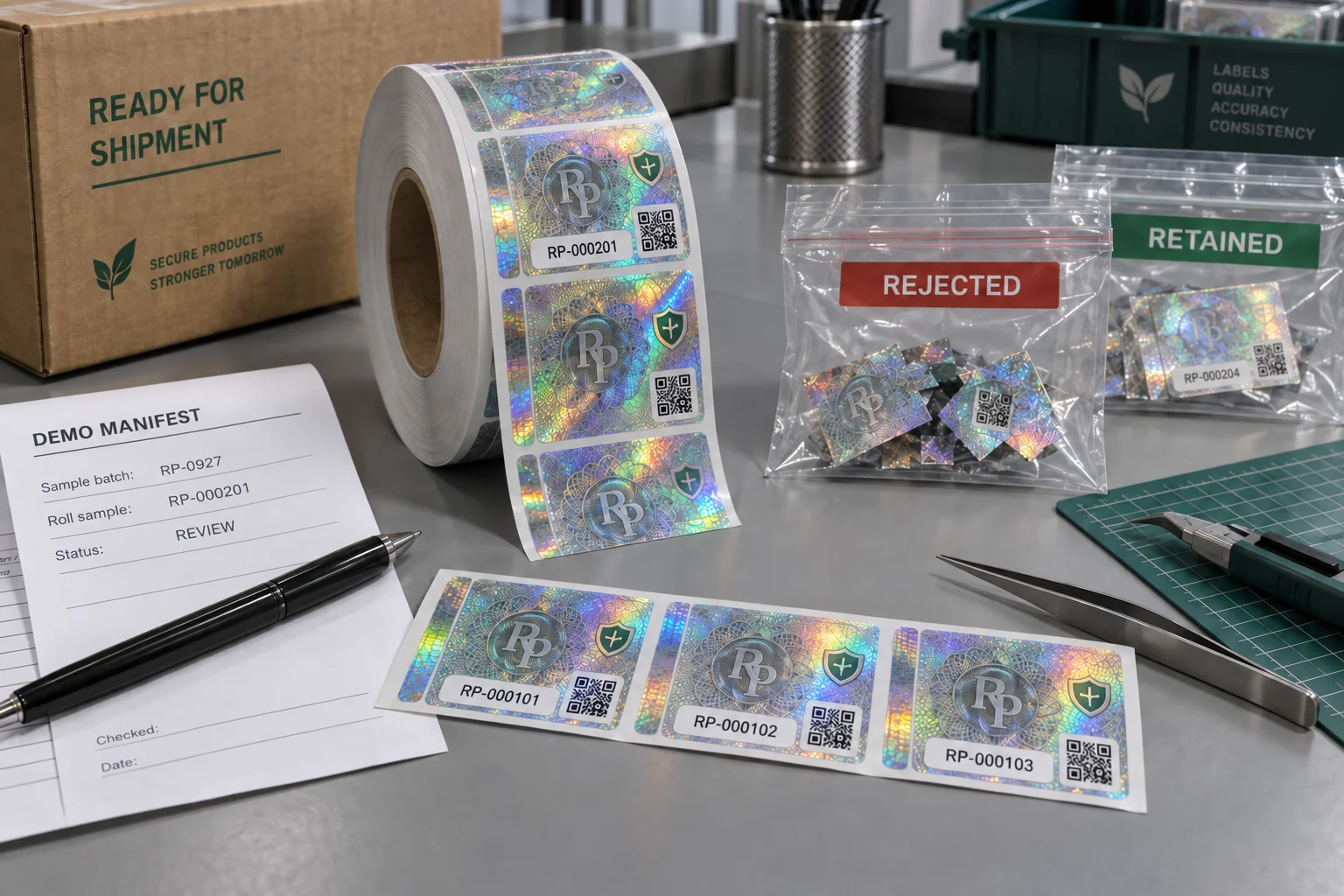
AI-generated workflow illustration with demonstration serials and a demo manifest. It is not a production reconciliation record, a working authentication system or evidence of a security certification.
Decide who owns the numbers
Write down who generates the identifiers, who approves the data file, who can authorize replacements and who maintains any verification system. Confirm whether the printer is receiving a fixed list or generating codes within an agreed namespace. Those are different responsibilities.
Preserve leading zeros and field formats when transferring files. Do not let a spreadsheet silently convert an identifier into a number or scientific notation. Ask both parties to approve a small data sample before processing the full file, then keep the approved file revision traceable. For the earlier CSV handoff, our related CYJ Labels site explains how to inspect the exported file and preserve leading zeros before reconciling printed serials.
Serialization platforms can associate unique identifiers with product information and event history, and may activate identifiers through production-line integrations. OpSec describes those as system functions, not merely printing effects. The workflow below is a suggested purchasing control, not a claim that RP supplies a deployed authentication platform or an OpSec service. OpSec's traceability overview.
The arithmetic is necessary, but it is not enough
Here is a simplified accounting example. A job allocates 10,000 unique identifiers. At closeout, 9,940 are accepted for shipment, 35 belong to rejected labels, 15 are retained as reference samples and 10 remain unprinted. The total is 10,000. These are illustrative numbers, not RP production results or a permitted waste allowance.
The counts balance, but that does not prove the sets are correct. A duplicate in the shipment could hide a missing identifier while leaving the quantity unchanged. The list of accepted identifiers must match the physical shipment, and every allocated identifier must have a documented status.
For the example, define the four states as mutually exclusive at closeout. Real systems may use a more detailed event history. What matters is that the agreed report does not count one identifier as both shipped and rejected without explaining a controlled reprint.
| Final state | Count | Evidence to agree |
|---|---|---|
| Accepted for shipment | 9,940 | Serial list linked to rolls or cartons |
| Rejected | 35 | Reject record and controlled disposition |
| Retained sample | 15 | Sample register and custody record |
| Unprinted | 10 | Unprinted or cancelled status in the approved record |
| Total allocated | 10,000 | No unexplained identifiers |
Try a balanced count that still fails
The ID-set checker includes a small worked demonstration. Load the valid example: eight allocated DEMO identifiers have five shipped, one rejected, one retained and one unprinted. Then load the duplicate example. The four counts are unchanged, but the shipped list repeats DEMO-0001 and omits DEMO-0002.
The checker reports the duplicate and the missing identity. It also flags identifiers outside the allocation and an identity assigned to more than one final state. It compares the exact text supplied, preserving case and leading zeros. This is a local planning aid, not a physical-label inspection or production certification. A clean supplied list cannot establish that the right labels are on the rolls.
Download the valid and invalid fixtures and use notes to discuss the required report with the data owner. Resolve discrepancies against original records; do not delete a duplicate row merely to produce a green result.
A reprint needs a rule before a printer needs a replacement
Two approaches are possible: replace a spoiled label using the same identifier under controlled conditions, or issue a new identifier and retire the old one. The right choice depends on the customer's system. Do not let an operator make that decision informally to finish a roll.
If the same identifier is reprinted, the defective physical copy needs controlled disposition and the event needs an audit trail. If a new identifier is used, update the shipment and system records accordingly. In either case, the buyer should receive a clear exception history rather than discovering an unexpected code during packing.
Do not reuse demonstration artwork serials, including those in this article's generated image. They illustrate placement only. Production identities need a controlled source and a defined relationship to the product record.
Retained samples are not invisible inventory
A printer may keep samples for color, optical appearance or dispute resolution. That can be useful. Decide how those samples are identified, stored and excluded from saleable stock. If a sample contains a live code, its digital status also needs an agreed treatment.
Ask how rejected material is segregated and how its final disposition is recorded. The exact destruction or retention method should fit the material and the agreed security requirements. A photo of a rubbish bin is not automatically adequate evidence, and an unsupported promise of zero waste is not a useful control.
Continuous ranges can conceal gaps
A roll described as running from one serial to another may contain exceptions after inspection and rework. Decide whether the handover requires an explicit accepted-code list, a range with an exception file, or another machine-readable record. Document the order of labels where the packing workflow depends on sequence.
Link the data to physical roll IDs. If two visually identical rolls are swapped between cartons, a correct spreadsheet alone will not repair the mismatch. For a higher-risk job, ask what inspection coverage is available, what was actually checked and how rejected readings were resolved. Sampling cannot establish that every individual serial is unique and correctly associated.
Not every buyer needs the same security system
Consider a decorative hologram used only for visual branding. A complex activation platform may add work without serving the brief. Now consider a product whose buyer expects code-level status checks. That project needs agreement on the database, status messages, maintenance and exception handling as well as the printed label.
These are contrasting planning cases, not testimonials. They are why I would scope the intended check before choosing features. KURZ lists optical decoration and digital identifiers among available label-security approaches; that combination still has to be designed for the customer's use. KURZ label-feature overview.
A readable unique code can be copied. A repeated scan may deserve investigation, but it is not by itself proof of counterfeiting. Set the consumer message and escalation process carefully, and avoid claiming that a hologram or a serial makes a product impossible to copy.
The handover I would ask to review
Before shipment, request the approved artwork and data revision, accepted identifier record, roll manifest, reject and reprint history, retained-sample record and any agreed inspection evidence. Confirm who signs off unresolved discrepancies and who maintains the verification destination after delivery. Send RP Labels the proposed identifier format, quantity, roll requirements and reconciliation handoff so the quotation can identify the print scope and unresolved data responsibilities.