Alcohol-Resistant Peptide Vial Labels: What to Test Before Printing
Imagine approving the printed brand panel, then watching a later-written lot field lose definition during the planned wipe check. The label is still attached. Procurement nevertheless has an unresolved information problem. Decide which part must survive before accepting a material description.
The short answer: specify an alcohol-resistant vial label as a complete construction, then test it using the same liquid, wipe pressure, storage cycle and handling sequence expected in use. Evaluate the proposed face stock, print protection and adhesive together on the actual vial; do not assume any one layer covers the whole route.
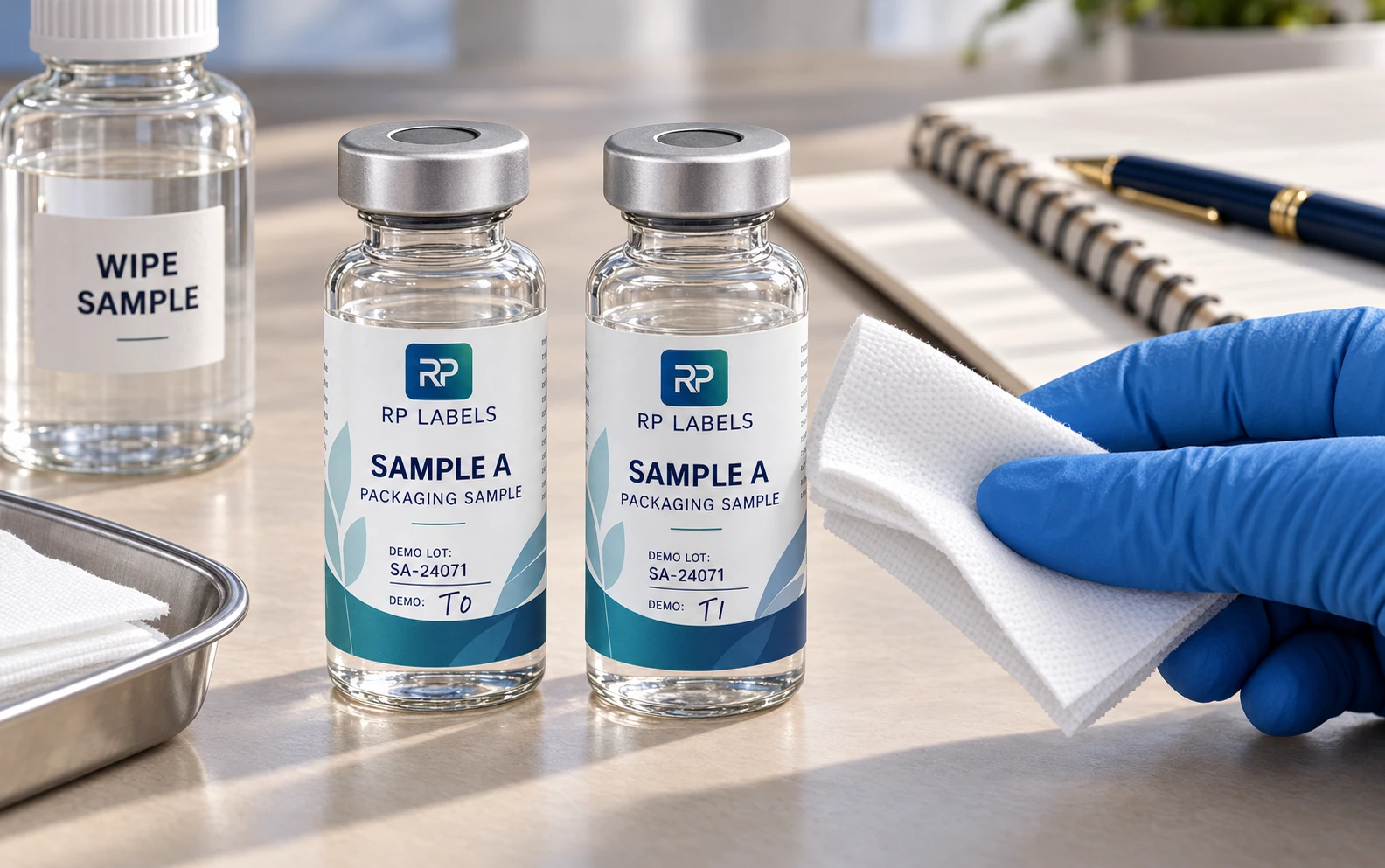
AI-generated packaging illustration. Fictional RP demonstration samples; not an actual order, completed test, authentication or approval record. Any displayed checks or codes are illustrative.
Asking about the actual liquid and sequence can feel slow when the buyer wants a price. A quick material answer leaves the approval scope unresolved. But if the label carries a QR code, batch field or tiny concentration line, the first failure is not always the label falling off. Sometimes the label stays perfectly attached while the information turns soft and gray.
Alcohol resistance has four separate failure points
| Face stock | Paper can absorb liquid and swell. Synthetic BOPP or PET is usually a better starting point where moisture and wiping are expected. |
|---|---|
| Printed image | Ink or toner can rub, fade or transfer unless the print system and protective layer match the exposure. |
| Variable information | A handwritten date, thermal-transfer line or downstream code may behave differently from the factory-printed artwork. |
| Adhesive and edge | Liquid reaching a poorly bonded edge can accelerate lifting, especially on a narrow curved vial or after condensation. |
This is why a supplier saying "the material is waterproof" may still be telling the truth while answering the wrong question. The material is only one layer of the finished result.
Two clean-looking samples, two different risks
Consider a hypothetical repeat 5 ml vial label in white BOPP. The buyer applies it to room-temperature glass, stores the vial cold and wipes only the cap area during normal handling. The artwork is fully printed and laminated. That is a manageable route: confirm the existing construction, run a representative wipe test and move quickly.
In a contrasting hypothetical route, consider a clear label with selective white ink, a small QR code and a blank field that staff write on after filling. The vial may already be cold when labeling begins. The buyer is not purchasing one test; they are purchasing four. Clear-film appearance, white-ink opacity, code scanning and the handwritten field each need their own pass or fail rule.
Waterproof is not the same as wipe resistant
Water usually sits, beads or runs. A wipe adds friction. Alcohol can also interact with unprotected print, coatings and marker ink in ways that water does not. A label can survive condensation overnight and still lose a fine black line after repeated rubbing.
Lamination is a strong option when the printed image needs protection, but it should not become a magic word. The cut edge remains exposed. The overlap or seam still has geometry. Any writable area must remain writable. If the protective film makes the entire surface too slick for the intended marker or downstream printer, one problem has simply been traded for another.
Buying rule: protect the fixed artwork, specify the variable field separately, and test the label after it has been applied and stored as the real vial will be.
A practical vial wipe test
- Use production-equivalent samples. Match the face stock, adhesive, print method and laminate or varnish.
- Use the actual vial. Diameter, glass coating and straight-wall area affect edge stress and bond.
- Clean and dry the surface. Record the cleaning method rather than relying on "normal preparation."
- Apply at the real temperature. If labels are normally applied before chilling, do not test only on an already-cold bottle.
- Allow defined dwell time. Pressure-sensitive adhesive develops bond over time; test the same timing used in production.
- Run the storage cycle. Include refrigeration, freezing or condensation where relevant.
- Wipe consistently. Define liquid, wipe material, stroke count, pressure and pass criteria for print, code, handwriting and edge lift.
What belongs in the wipe brief
- Vial diameter, usable straight-wall height and a clear bottle photo
- Target label width, height and overlap or gap preference
- Application temperature and whether the glass is dry at application
- Storage temperature, condensation and freeze-thaw exposure
- Cleaning liquid or alcohol concentration used by the buyer
- Expected wipe frequency and required readable life
- QR, barcode, batch or writable fields that must survive
- Roll or sheet format, quantity and hand or machine application
A label can stay attached and still fail its job
Imagine the brand panel looks unchanged after wiping, while a handwritten lot is no longer readable. Reordering the same protected artwork does not answer that second failure. The buyer needs to identify where that later mark was applied, which tool made it and how long it had before the next handling step. Conversely, a readable lot does not release an edge that lifted from the actual vial.
The worked wipe-sequence record, blank record and field guide separate those observations. Two hypothetical rows distinguish fixed artwork from a route that includes later marking. They propose evidence to collect; no wipe has been performed for this article.
Have the workflow owner supply the actual liquid reference, concentration where relevant, wipe material and sequence. The label supplier identifies the candidate construction and relevant guidance. Agree the evaluation with the responsible technical owner rather than copying a stroke count from an unrelated label. Record the method and any difference from intended use. If the project needs a formal test, obtain the appropriate project-specific method and evidence.
A controlled repeat may reasonably retain an existing construction when its applicable evidence covers the same workflow. A changed cleaner, marker or storage route deserves a focused review of the affected layer. That can be more useful than buying a stronger-sounding face material and leaving the later data unexamined. See the marker-specific comparison for the writing-surface decision.
Send RP Labels the wipe-sequence brief, artwork, quantity, actual vial and later-marking details. Ask what identified printed construction and sample scope can be quoted, with the unresolved handling evidence stated.