Hand-Writable Peptide Vial Labels: Test the Marker Before You Order
Imagine the operator writes the lot neatly, then grips the same field while moving the vial into its tray. The proof had enough space; the work cycle did not allow the mark to settle. The surface and the time before the next touch belong in the same buying decision.
The question is not whether the proof has room for a lot number. It is whether the person at the bench can write it on the finished label, read it later, and keep it there through normal handling. A tiny vial makes that surprisingly easy to overlook.
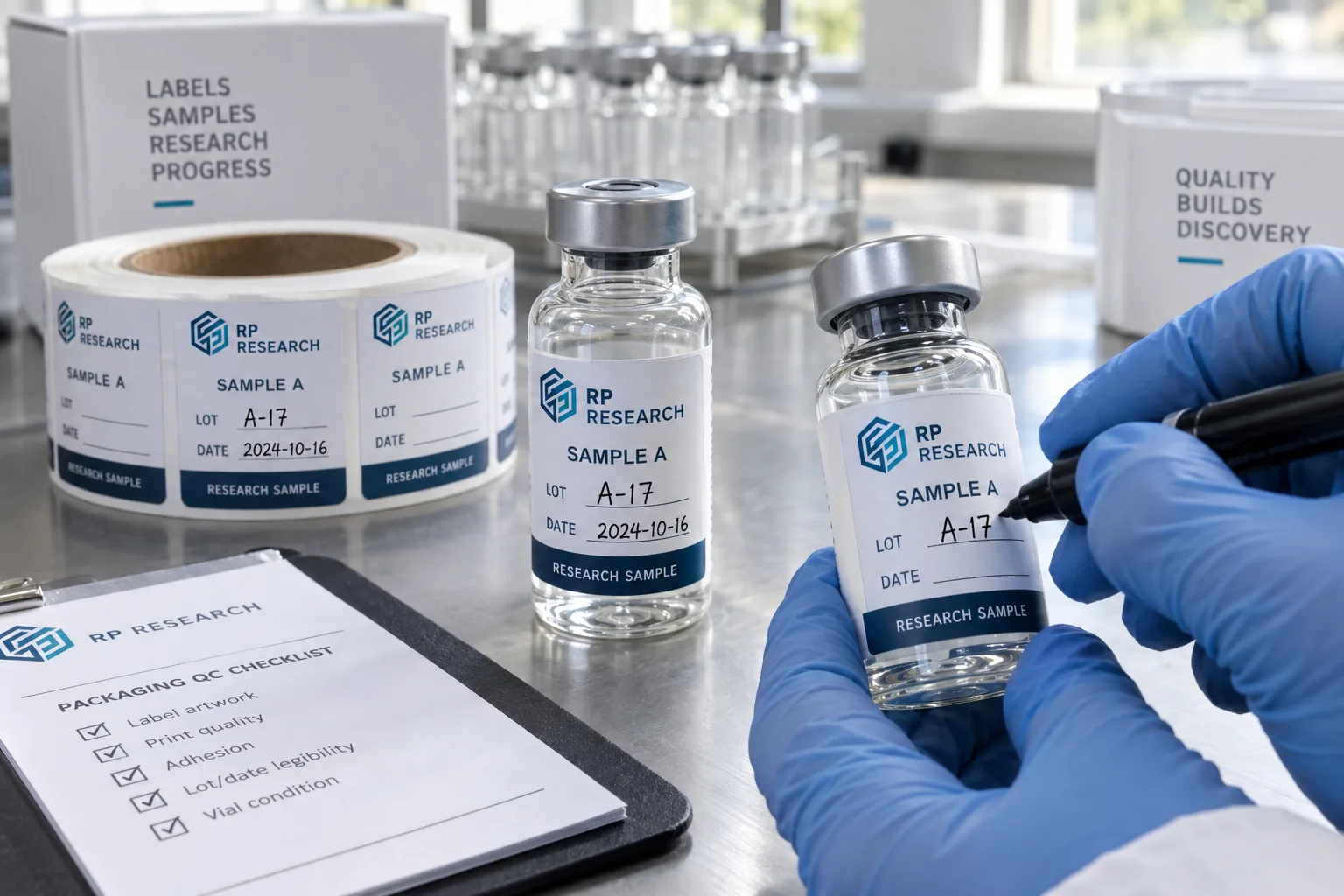
AI-generated packaging illustration. Fictional RP demonstration samples; not an actual order, completed test, authentication or approval record. Any displayed checks or codes are illustrative.
I would start with the actual marker and the actual vial, not a generic promise that a film is "writable." The face stock, varnish or laminate, pen chemistry, hand pressure and time before the vial is touched all affect the result. The printable artwork and the write-on field are two different surfaces to approve.
Reserve a field someone can actually use
Put the handwritten field where a gloved operator can reach it after the label is applied. Leave room for the longest expected lot or date string, including a correction or a second line if your procedure permits one. Do not make a narrow gap between a QR graphic and a seam the only available writing space.
Before choosing a finish, make a full-size print and ask the operator to write the longest realistic entry. The bottle should be held the way it will be held in the packing workflow. If the marker rides over the curve or into the overlap, the problem is geometry, not ink. The size chart and gap-versus-overlap guide help set that geometry before proof approval.
Why a glossy protective finish may change the answer
A protective laminate can make the printed brand panel more robust, but it does not automatically make the label a good writing surface. Avery's guidance for its overlaminated products says permanent marker is easiest across that range, while ballpoint and pencil are recommended only on its matte versions. That is product-specific guidance, not a guarantee for another converter's film.
Avery also warns that gel and rollerball pens can have poor writeability and long dry times on its printed labels. I would treat that as a reason to test, not as a reason to ban every pen. Ask for two candidate constructions and compare them with the exact marker the team already uses. A printed matte patch within an otherwise protected design may be a better compromise than removing protection from the entire label.
Run a small, repeatable marker trial
Write a short field and the longest expected field on each construction. Record the marker brand and tip, the approximate wait before touching, and whether the vial was clean and dry. Then handle the vial as usual, place it in its carton or tray, and inspect for transfer, feathering, smudge and lost readability. If cold storage or condensation is part of your real route, repeat the trial after that exposure. Do not invent a cold test when the product never sees one.
Compare the handwritten mark with the preprinted product identity. A bold lot field is useful only if it does not obscure the vial's name, warning or other approved copy. It also needs a clear instruction for who writes it and when. A blank write-on field is not a substitute for an approved variable-data printing workflow when every vial needs a controlled identifier; see the variable-data release checklist for that case.
Write the purchase specification around the use case
| Decision | Information to send | Acceptance question |
|---|---|---|
| Field | Longest sample entry and exact position on vial | Can a gloved operator complete it without crossing the seam? |
| Writing tool | Marker make, tip and ink color | Does it dry and stay readable after normal handling? |
| Construction | Preferred film, finish and protected areas | Can the write-on patch coexist with the printed panel? |
| Route | Tray, carton, temperature and handling conditions | Does the finished mark survive the actual route? |
My approval point is a labeled vial and a short roll sample, not a screenshot of a blank field. Send RP the vial size, intended copy, marker and handling route. Ask for a candidate construction and a proof that leaves the write-on area usable in practice.
Make the wait part of the purchase decision
Consider two hypothetical benches. On one, a worker writes the entry and leaves the vial in an identified tray before the next operation. On the other, the vial is immediately gripped and packed. A marker that works in the first routine has not automatically earned approval for the second. The difference may be the handling window rather than the size of the blank field.
The worked marker-window record, blank worksheet and field guide compare two proposed surfaces with the same exact marker and long demonstration entry. There are no invented drying times or successful test scores. The bench owner fills the real window and observations after reviewing the actual samples.
If a candidate transfers ink at the required next step, decide which constraint can change. Another identified surface or marker may be suitable; a controlled waiting position may also be reasonable if the workflow permits it. Do not quietly add waiting labor after procurement approved a unit price. If manual entries become too numerous or require tighter data control, an appropriate printed-data route deserves a fair comparison through the thermal-transfer guide.
Keep the operator's usable field and readable identity together in the review. This worksheet addresses writing, not authorization to invent or change the contents of a lot record. Send RP the actual marker reference and handling window with the inquiry, so a proposed surface can be evaluated against the work rather than an empty box on the PDF.
Sources and scope
Demand layer: competitor and process pages linked here, including Avery, HERMA or OnlineLabels where cited, illustrate buyer language and process topics only. They do not supply RP minimum quantities, lead times, prices, certifications or materials. Authority layer: an RP number is backed only by a factory datasheet, a signed quote or proforma, confirmed product data, or a fact kept on the About page. The March 2026 proforma there is one production-run example, not a standing offer. RP shipping and planning pages describe what to confirm on a quote. Worked figures on this page are fictional unless an authority source is named for them.