Automatic Supplement Label Rolls: Get the Packer to Sign the Roll Brief
The label dimensions are right, yet the trial roll reaches the applicator with the wrong edge leading. This hypothetical problem is expensive to solve after the whole order is finished. A machine-ready order starts with the packer's roll requirements and a shared view of how the first label enters the line.
Purchasing wants to close the order. The packer wants a roll that loads without a special afternoon of adjustments. I would let the packer win this argument early: send one annotated web-path photograph and get the converter's interpretation back. A familiar winding number is convenient shorthand only after both sides agree what the picture means.
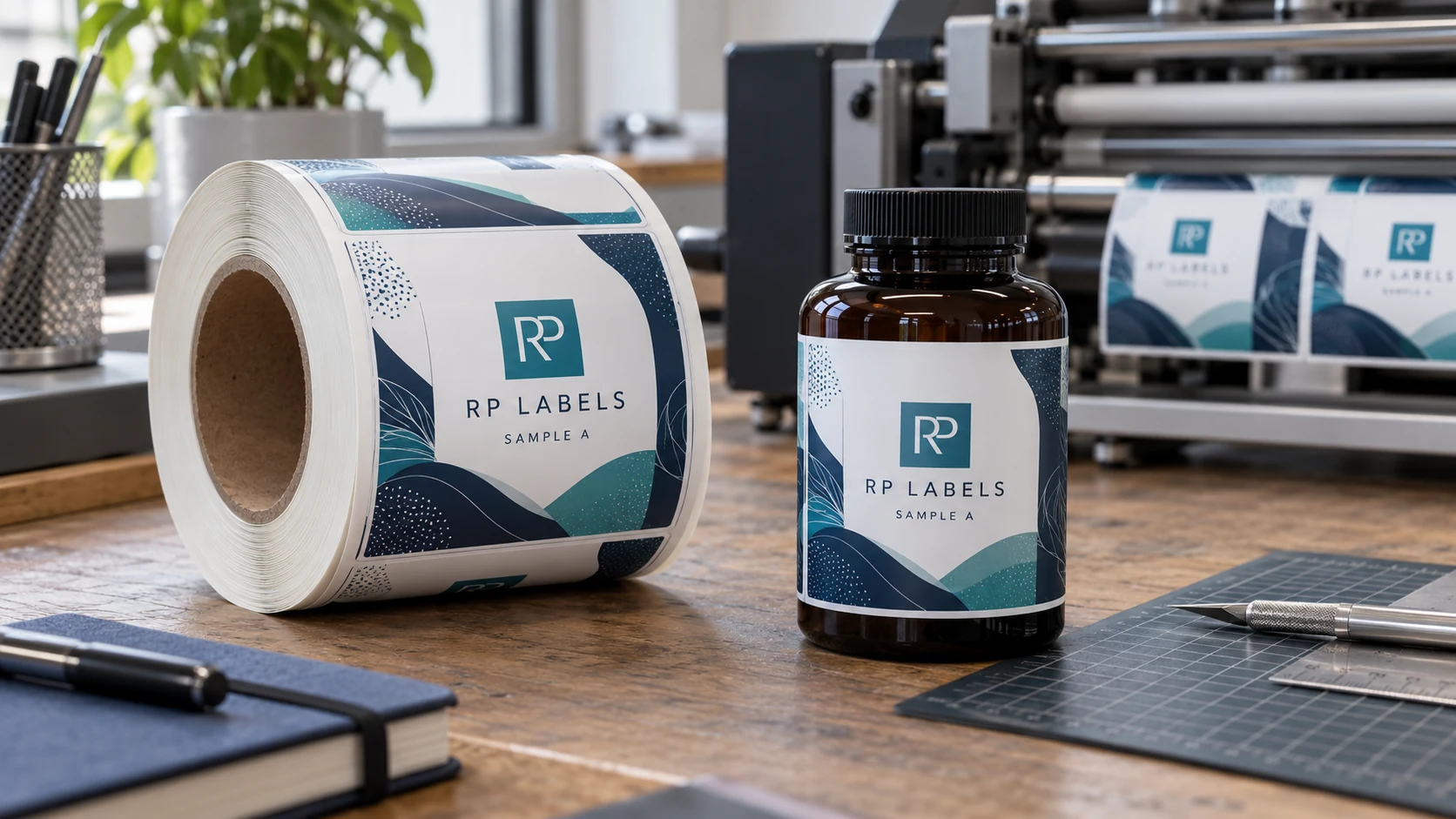
AI-generated packaging illustration. Fictional RP samples show the proposed decision; no physical test or customer order is documented.
Make one handoff drawing carry the orientation
Ask the packer to supply the equipment reference and an annotated photograph of the web path. Put the label face, liner side and leading artwork edge on the same drawing. A winding number by itself can be ambiguous across suppliers' diagrams. The converter should return its interpretation for the packer to confirm before the production specification is released.
The worksheet separates what the equipment allows from what this order requests. Maximum roll diameter is a machine constraint; the proposed labels per roll is an order choice that must fit it. Record core, web width, gap, label pitch and weight constraints using the equipment owner's information. Do not infer that a familiar core size guarantees the rest of the roll will fit.
A production-equivalent trial should include the intended liner and finished construction. Have the line owner record loading, sensing, dispensing, start-stop behavior and placement observations. If the trial needs a new setting or an adaptor, record it explicitly. The commercial decision may be to accept that change, request a different roll build or keep the previously qualified format.
For an established repeat program with unchanged equipment and materials, a controlled reference to the accepted roll brief can reduce unnecessary exchanges. A new sensor, liner or packing contractor is a reason to reopen the affected fields. That review need not redesign the visible label.
Send RP Labels the packer's confirmed diagram, artwork orientation, machine constraints and quantities per design. The order should arrive at the line with its assumptions already resolved, rather than asking an operator to discover which convention the quote used.
The roll specification the artwork cannot show
| Core inside diameter | Must fit the machine mandrel or adaptor without excessive play or forced handling. |
|---|---|
| Maximum outside diameter | The finished roll must fit the unwind area and remain within the equipment's weight and tension capability. |
| Web width | Includes the label and liner margins that guide tracking through the machine. |
| Gap and pitch | Support repeat sensing and determine how the machine locates each label. |
| Winding and orientation | Define whether labels face in or out and which artwork edge enters the applicator first. |
| Liner and sensor | Affect dispensing, web tension and whether the machine can detect the label position. |
The startup machine and the contract packer
As a hypothetical example, a startup buys a semi-automatic round-bottle applicator after approving the label artwork. The machine accepts two core options, but the maximum roll diameter is smaller than the roll the printer normally supplies. The labels are correct. Half the roll has to be rewound before it can enter production.
In a contrasting hypothetical example, a contract packer sends a one-page specification before asking for price. Core, roll diameter, label orientation, gap, material and quantity per roll are already fixed. Their request looks more demanding, yet it is the easier order. The factory is not being asked to imagine the machine.
Core and roll diameter are different decisions
The core is the tube that fits the unwind shaft. The outside diameter is the full wound roll. A correct core does not guarantee the roll fits inside the machine guard or clears nearby controls.
Labels per roll affect diameter, weight, changeover frequency and handling. More labels per roll reduce changeovers but may exceed the equipment limit or become awkward for operators. Fewer labels make a lighter roll but create more stops and more partial inventory. Choose the count with production, not only purchasing.
Unwind direction is artwork plus mechanics
The label can lead with the top, bottom, left or right edge, depending on winding. The printed face may point inward or outward. The correct combination depends on the web path and how the bottle reaches the application point.
Do not approve a number or arrow you do not understand. Send a diagram from the machine manual, photos of a working roll from both sides or a short video showing the web path. The supplier can translate that physical evidence into the production winding note.
Buying rule: "roll labels" describes a supply format. A machine-ready roll is a measured specification. We supply labels on rolls for automatic applicators and in sheets or individual pieces when that format is a better fit. Roll direction, core size, liner, and spacing are specified to the machine information you provide.
Gap, liner and sensor behavior
Many applicators detect the gap between labels using an optical sensor. Clear labels, clear liners, dark materials or unusual constructions may not create the contrast that a standard sensor expects. A registration mark or different sensor approach may be required.
The liner also carries tension and releases the label around the peel plate. It must be strong enough for the web path and compatible with the converting process. A label that peels nicely by hand can still release too early, too late or inconsistently at line speed.
The bottle still matters
Roll specifications get the label to the application point. Bottle geometry decides whether it lands well. Measure diameter, taper, straight-wall height and surface condition. Bottles should arrive consistently spaced and stable enough to rotate without wobble.
Label stiffness, adhesive and size affect wrapping. If the bottle tapers, a rectangular label may skew or wrinkle even when the machine is perfectly adjusted. Equipment cannot remove geometry from the package.
Run a production-condition trial
- Load the trial roll without adaptors or rewinding not planned for production.
- Confirm web tracking, sensor detection and label stop position.
- Run at startup speed, then at the expected production speed.
- Measure placement variation across a meaningful sample of bottles.
- Inspect wrinkles, bubbles, skew, seam position and edge lift.
- Stop and restart the line to check changeover and tension behavior.
- Record the accepted machine settings and approved roll construction.
Worked roll machine handoff record
The rows below are hypothetical planning examples. Empty observation or commercial fields must be completed from the actual project; no sample has been tested for this article. Use the worked CSV and blank worksheet with the field guide. Keep the example references separate from production records.
| roll spec revision | equipment reference | leading edge reference | face in or out | machine constraints | trial observation | packer confirmation |
|---|---|---|---|---|---|---|
| DEMO-R1 | Actual machine required | Attach annotated web-path image | Confirm with diagram | Core OD width weight: actual values | PENDING | |
| DEMO-R2 candidate | Same machine or stated change | Converter returned orientation drawing | Confirm physical trial roll | List differences from approved baseline | PENDING |
Bring this decision into the print inquiry
Contact RP Labels with the completed roll machine handoff record, the actual packaging reference, approved artwork and quantity per design. State which fields remain unresolved so the print specification and any relevant sample scope can be discussed against the same decision.
Related buying guidance: Custom supplement labels; Batch and expiry printing; Roll direction guide; Bottle label application problems.