Supplement Bottle Labels Wrinkling or Lifting? Collect the Clues Before Reordering
The same printed roll went onto two bottle lots. On one, the label lies flat. On the other, the upper edge starts to lift after the bottles leave the line. The buyer is asked to order a stronger adhesive before the next packing slot.
That is a hypothetical incident, but it shows the risk of treating the visible symptom as a diagnosis. A different adhesive may eventually be the right purchase. So might a shorter label, a change in bottle preparation or a correction to the application setup. Without the comparison details, the next order is a guess.
Start by protecting a representative affected sample and recording where and when the change appeared. Then compare it with an unaffected sample, if one exists. The job of the first review is to decide what to investigate, not to issue a universal cure from a photograph.
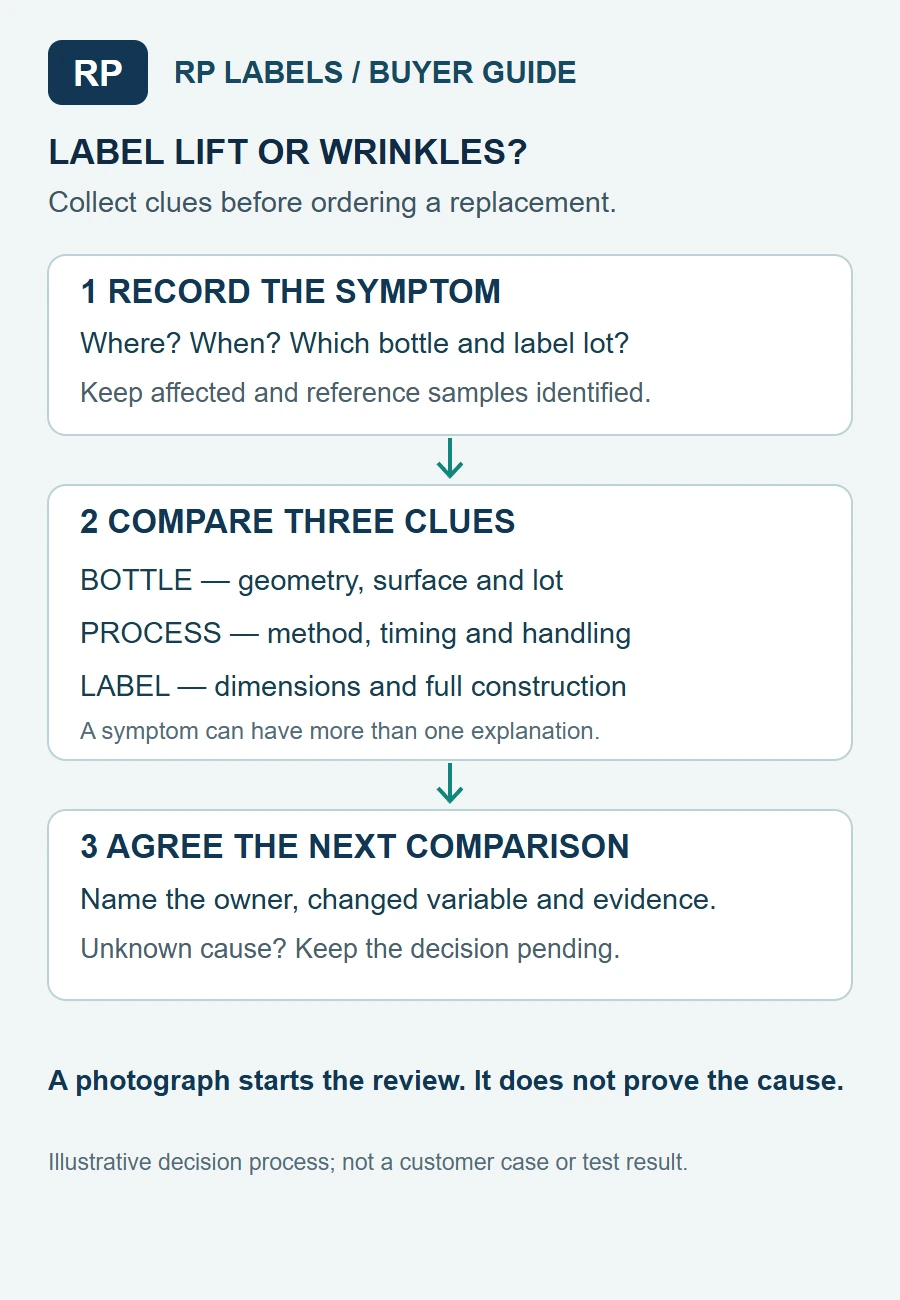
Illustrative purchasing workflow. This is not a customer case, diagnosis or test result.
A symptom is a starting point, not a cause
A diagonal wrinkle can suggest a placement or bottle-shape question. A bubble can raise questions about contact, trapped air or the surface. An edge lifting after storage raises different questions from an edge that never made contact during application. Each pattern can have more than one explanation.
Ask the line or packaging owner to mark the affected location on the bottle, the direction of the label, and when the condition was first noticed. Record whether it appears across the whole batch or in a subset. If there is no unaffected sample, say so; do not invent a control.
Avery Dennison's discussion of real-substrate testing explains why results on one surface do not necessarily represent another. Its examples are not evidence of RP's adhesive performance or this hypothetical supplement bottle.
Three questions narrow the next check
First, does the problem follow the bottle? Record the actual bottle reference, material, supplier and lot. Look at shape, seams and the proposed straight-wall area. A label forced across a shoulder may need a dimension review before a new adhesive is considered.
Second, does it follow the process? Compare application method, setup, position, surface condition, timing and handling. A roll applied by hand does not recreate a particular machine setting. If the product is filled before labeling, ask whether residue or condensation is possible; do not assume it occurred.
Third, does it follow the construction or order? Identify the actual face, adhesive, finish, liner and label dimensions. Keep the approved artwork and order references. If a specification is missing, ask the converter for the completed construction before attributing an edge problem to “film” as a whole.
These questions are not mutually exclusive. The same symptom may depend on the interaction of the bottle, material and application. A clean photograph tells the team where to look; it cannot establish the root cause on its own.
Compare one change at a time where practical
Suppose the first sample sits near the bottle's shoulder and the second sits lower. If the team also changes the adhesive, the finish and the application method, a difference between the samples cannot be attributed confidently to any single change.
Have the packaging owner and converter agree what can be held constant and what observation would affect the next decision. Document any variable that cannot be controlled. The sample size, handling, acceptance criteria and safe process belong to the responsible team; this guide does not prescribe a universal trial.
For a clearly identified packaging geometry concern, an applied-size proof on the actual bottle may be the most useful next purchase. If the geometry is already acceptable and the issue only appears after a defined exposure, a construction comparison may be more relevant. The cheaper-looking option is the one that answers the open question—not necessarily the one with the lowest quoted material price.
Make the comparison record travel with the samples
Give each physical example an unambiguous reference. Link it to the bottle lot, label order, artwork revision and application method. Photograph the same location at the same angle where practical. Write down the observation and its time; leave unobserved fields blank.
An unaffected sample can be a helpful reference, but a perfect-looking bottle does not prove long-term performance. If a decision requires a specific durability or compliance result, agree the relevant method and evidence with the qualified party responsible for it.
The worked symptom record gives an affected example and an apparent reference separate identities. Both are fictional; the observation time and application details remain unresolved. Use the blank record and field guide to prepare the actual handoff. A blank field is a request for information, not a pass.
Decide what should remain on hold
The first review may uncover a specific missing fact rather than a material choice. Perhaps the container supplier has not confirmed the bottle reference, or the application owner cannot identify when the lifted edge first appeared. Give that question to the person who can answer it and keep the proposed correction separate from the unconfirmed cause.
If a comparable reference and identified samples support a narrowly defined next trial, the team can move forward with that trial while broader claims remain open. Purchasing does not need certainty about every possible failure to ask a useful sample question. It does need enough traceable evidence to explain why that sample is the next one being bought.
The label-size guide helps prepare a geometry brief. The softgel oil-contact guide separates front and edge exposure where oil is a plausible route. Those guides address particular questions; neither replaces this first symptom-to-evidence handoff.
Send the printer enough to make the next proposal useful
For custom supplement labels, send RP Labels the affected and reference sample details: bottle reference and lot, full-bottle and close-up photographs, label dimensions, construction if known, application method, timing, and the conditions before the symptom appeared. Include what has already changed between the samples.
Ask the converter to identify missing information and propose the next comparison. If the cause is still uncertain, say that in the record. The immediate result is a more useful sample brief—not a promise that a stronger adhesive will repair every lifting label.
Sources and scope
Demand layer: competitor and process pages linked here, including Avery, HERMA or OnlineLabels where cited, illustrate buyer language and process topics only. They do not supply RP minimum quantities, lead times, prices, certifications or materials. Authority layer: an RP number is backed only by a factory datasheet, a signed quote or proforma, confirmed product data, or a fact kept on the About page. The March 2026 proforma there is one production-run example, not a standing offer. RP shipping and planning pages describe what to confirm on a quote. Worked figures on this page are fictional unless an authority source is named for them.