Custom vs Stock Hologram Labels: What Are You Paying For?
Imagine two quotes both include a custom logo, but one proposes printed artwork on an existing pattern and the other proposes a brand element within the optical design. Procurement cannot compare their prices fairly until the offered layers and sample scope are identified.
The short answer: choose a stock holographic pattern with custom printing when the goal is visual impact, short-run branding or a low-entry decorative seal. Choose a custom master for 3D holographic labels when the optical image itself must carry the logo or defined inspection features. If the project also requires opening evidence or item-status checks, specify those separately with their operating owners.
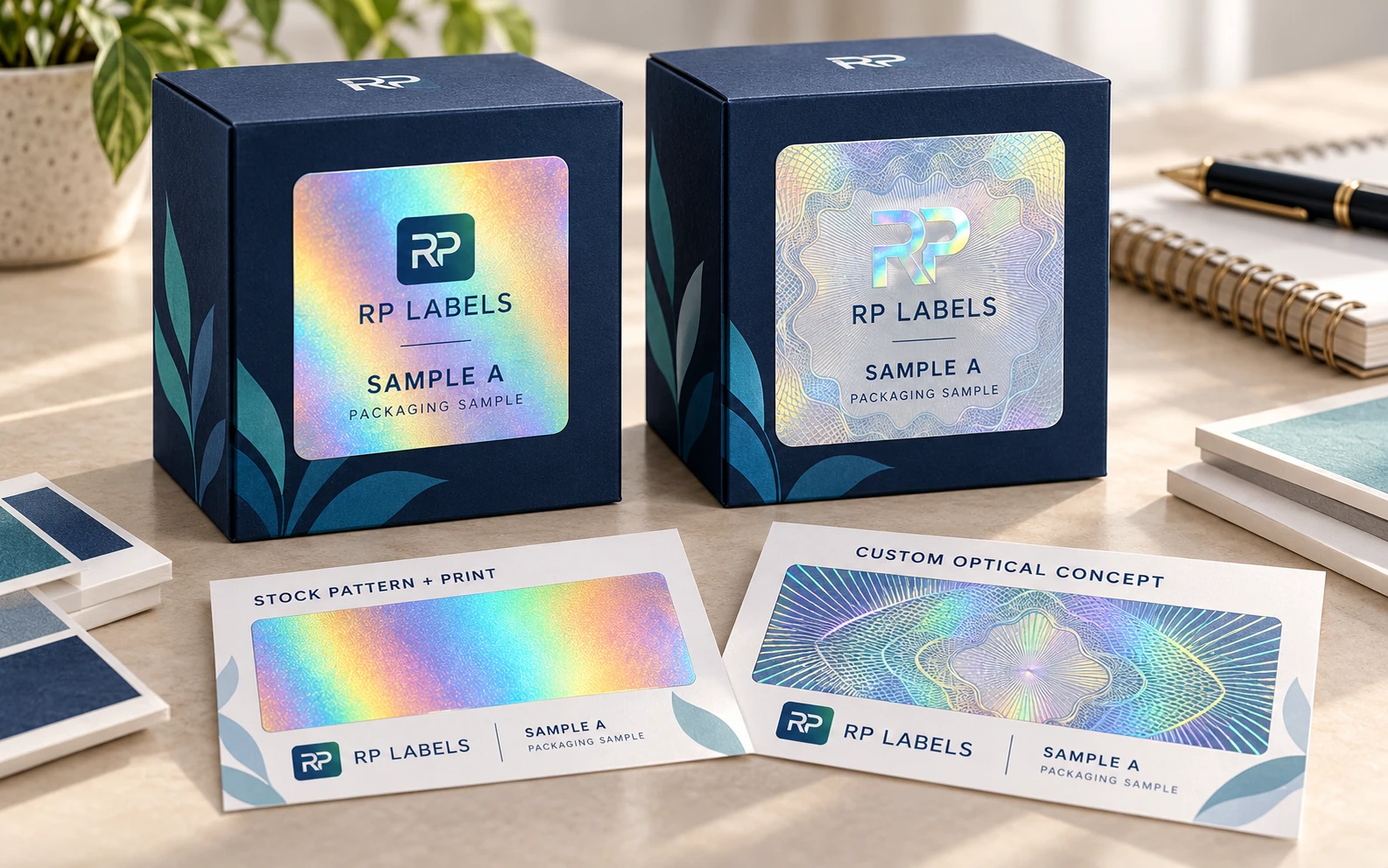
AI-generated packaging illustration. Fictional RP demonstration samples; not an actual order, completed test, authentication or approval record. Any displayed checks or codes are illustrative.
Hologram quotations can look identical in a spreadsheet: size, shape, quantity and a line saying "custom logo." The samples arrive, and one shows the logo printed in black over a generic rainbow pattern. The other shows the logo changing, moving and appearing within the diffractive structure.
The first supplier did not necessarily cheat. The buyer and supplier used the same word for two different products. This is where a cheap quote wins on paper and loses when the label is tilted under light.
What a stock-pattern hologram is
Stock material uses an existing holographic pattern: broken glass, dots, pillars, rainbow prisms or another repeating design. The converter can print a logo, product name, QR code or serial number over it and cut the label to a custom shape.
This can be an effective decorative label. It is fast to understand, often easier to start and gives metallic movement that ordinary white film cannot. The important limitation is that the underlying optical pattern may be available to other buyers.
What changes with a custom master
Custom origination creates a diffractive master for the buyer's design. The logo, text, depth, movement or hidden element becomes part of the optical image. Depending on the process, the design may include 2D/3D layering, dot-matrix movement, microtext, guilloche lines or angle-dependent images.
That requires setup, artwork development and approval. The value is not just brighter rainbow color. It is a repeatable optical identity linked to the brand.
Buying rule: ask whether the logo is printed on the hologram or originated inside the hologram. Request a tilt video and physical sample that show the exact quoted construction.
The cosmetics buyer and the warranty buyer
Consider a hypothetical cosmetics startup that wants a reflective round seal on 500 launch boxes. The seal should carry its logo and make the unboxing look more premium. A stock holographic film with controlled white ink and custom print may solve the job honestly.
A contrasting hypothetical industrial-parts brand wants distributors to recognize a specific moving shield, inspect microtext and compare a serial number with shipment records. A generic prism film with a printed logo is not enough. That buyer needs custom optical design, data control and a tamper construction matched to the carton.
Neither buyer should purchase the other's solution. Security features without an inspection process become expensive decoration; decorative material sold as high security creates false confidence.
Overt, fine and data features
| Overt feature | A visible color shift, moving logo, depth or angle change that staff and customers can inspect without tools. |
|---|---|
| Fine feature | Microtext or guilloche detail checked with magnification or a trained inspection method. |
| Data feature | Serial number, barcode or QR code connected to controlled records and defined scan behavior. |
| Physical feature | VOID transfer, destructible film or another construction that shows attempted removal. |
A strong project gives each layer a job. More features are not automatically better if nobody knows how to inspect them.
White ink and printed design still matter
On holographic material, unbacked process colors allow the rainbow substrate to influence the artwork. Opaque white ink can block selected areas so a logo, barcode or small text remains controlled. A white-ink map should be part of the artwork approval.
Do not cover the entire hologram with white and then wonder where the effect went. Decide where the optical movement should show, where brand color must stay stable and where scanning needs a quiet high-contrast field.
Setup, MOQ and repeat orders
Stock patterns avoid custom optical origination, so they can be practical for smaller or faster projects. Custom masters add setup and lead time, but repeat orders may use the approved master under agreed control.
Ask who owns the master, how long it is retained, whether another converter can use it, what changes require new origination and how unused security labels are handled. These questions matter more than saving a few cents on the first order.
Do not call one shiny feature complete authentication
No label should be sold as impossible to counterfeit. A custom optical proposal needs relevant evidence and an inspection purpose; its name alone does not establish resistance to imitation. Tamper evidence makes transfer harder. Unique data can reveal invalid or repeated codes. Distribution control reduces opportunities for leakage.
The useful result comes from layers and operating discipline. If the company only wants shelf impact, say so and buy a good decorative label. If it wants authentication, document what a genuine label looks like and what staff should do when the check fails.
Approve motion, not a still image
A PDF can confirm dimensions and printed layers but cannot represent optical movement. Review a video under changing light and, for important projects, a physical sample. Check the label at final size because fine features that look impressive enlarged on a monitor may disappear on a 20 mm seal.
Apply samples to the actual box, cap or bottle. Test removal, residue, fracture and visibility against the package color. A security design only works when the finished package allows people to see and use it.
Hologram RFQ checklist
- Decorative, tamper-evident or authentication objective
- Stock optical pattern or custom master requirement
- Logo, movement, depth, microtext and hidden features
- Printed CMYK, spot color and white-ink areas
- Serial, barcode or QR data ownership
- VOID, destructible or permanent construction
- Application surface, label size and placement
- Master ownership, MOQ, lead time and reorder terms
Make the two offers answer the same question
The worked optical-scope comparison, blank comparison and field guide contain two hypothetical offers. One proposes print over an existing pattern. The other proposes a custom optical element. Both leave prices, master control and sample evidence unknown until the supplier replies. No amount or exclusivity is invented.
Ask the supplier to mark which part of the brand element belongs to each layer. Then connect that statement to the exact sample being offered. A generic demonstration from another project may explain a process direction, but it cannot approve your logo's optical result. Obtain a clear statement of differences and the evidence required before final release.
The brand that needs only an attractive printed launch seal has a reason to retain the stock-pattern option. It should not buy origination merely because the adjective custom sounds more exclusive. A buyer with a defined optical inspection requirement has a reason to request an originated feature, provided the proposal and actual approval evidence cover it. Neither decision establishes authenticity by itself.
Keep proposed origination and repeat-order terms in separate fields. A setup line does not automatically transfer ownership or grant reuse rights. If a master change is proposed, identify it before treating the next order as a repeat. Send RP Labels the offer comparison, artwork, quantities, pack reference and required visible feature; request an itemized scope and applicable sample route.