Label Plate and Die Charges: What Carries Over to Your Next Order?
Custom die-cut shapes and certain print or foil processes may require tooling or plate/die charges. Whether a charge applies, how it is billed, and whether it can be reused on a reorder is confirmed on the written quote.
The label looks right. The bottle fits. Then the quotation arrives with a separate line for plates, a cutting die or “setup,” and the first order suddenly costs more than the unit price suggested.
For a supplement brand preparing repeat bottle runs, the useful question is what that charge will save on the next order. Before approving label printing plate and die charges, ask the printer to identify the item, explain its reuse conditions and confirm what happens if you change suppliers. A paid setup line is too vague to build a reorder budget around.
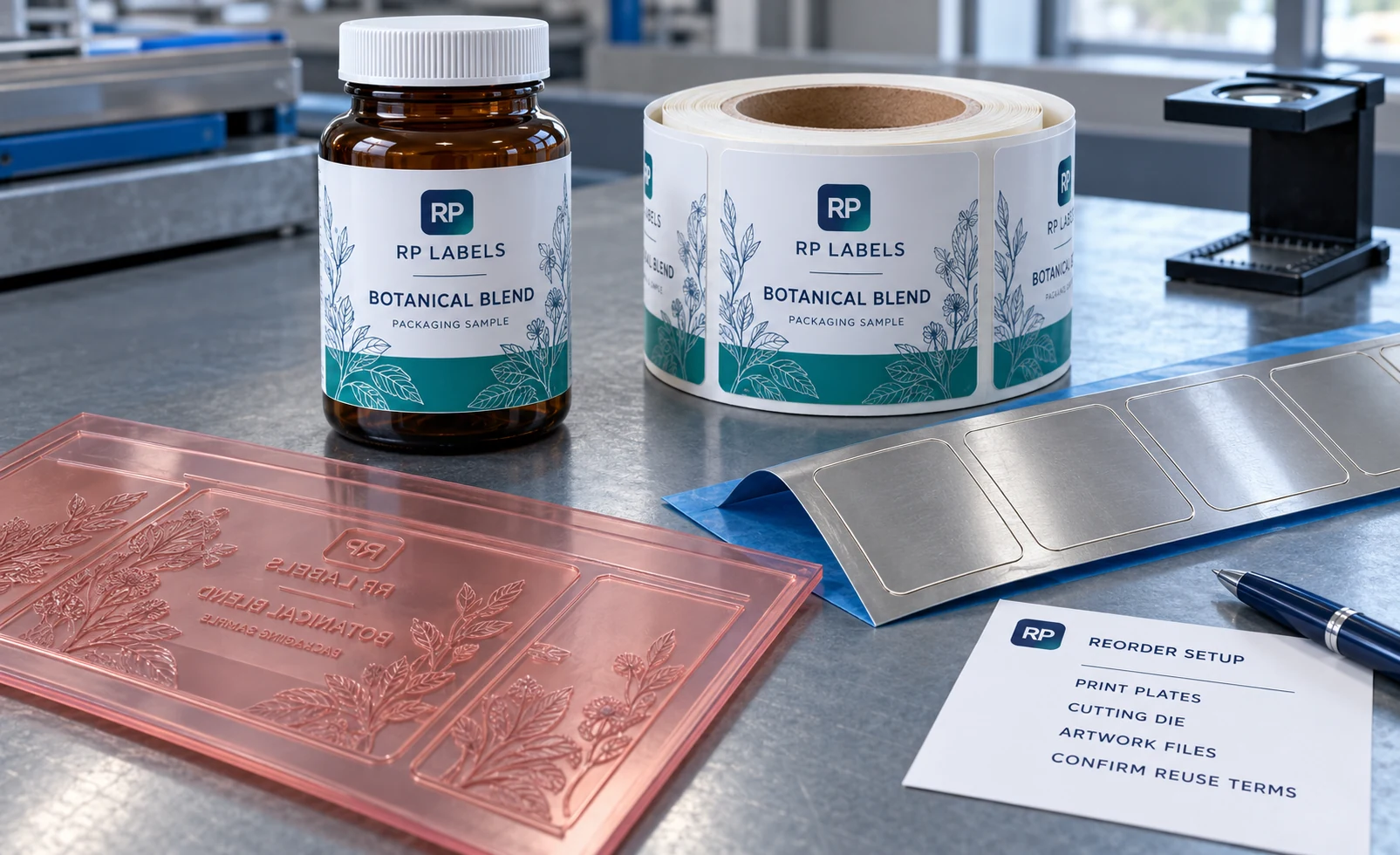
AI-generated packaging illustration. Tooling and label artwork are illustrative; this is not an RP customer order or a production compatibility test.
Separate the plate, the die and the files
These items can appear on the same quotation, but they do different jobs.
| Item | What it does | What to ask about the next order |
|---|---|---|
| Artwork and prepress | Prepares the approved design for production | Which files are supplied, in what formats, and what changes trigger new preparation? |
| Printing plates | Carry the image in a conventional flexographic printing route | Which artwork and production conditions allow the existing plates to be reused? |
| Cutting die | Cuts the label shape in the specified construction | Can the same tool cut the repeat job, and what size, material or equipment changes require review? |
| Run setup | Covers work needed to prepare that production run | Which activities and charges recur even when existing tools are reused? |
An unchanged label outline does not mean unchanged printing plates. A shared bottle size can let several SKUs use the same cut shape while each design still needs its own print preparation. Ask for the actual production route rather than guessing the tool count from the number of products.
A digital printing stage can avoid conventional image plates, but finishing still matters. Mark Andy describes digital hybrid systems that combine digital printing with flexo and converting. Treat “digital” as the start of a process discussion, not a promise that every tooling or setup charge disappears.
A fee does not explain what you can take away
The invoice tells you a charge exists. It may not explain ownership, storage or release.
I would ask for the actual ownership and handover arrangement before using a paid setup line in a second-source plan. A fee on the invoice does not, by itself, answer which tools or files the supplier will retain or release. Put those questions beside the quotation and ask for written confirmation.
Separate four questions: who owns the physical tool; who keeps it; how long it is retained; and whether it can be released. Then ask separately about artwork files. A final approval PDF, an editable design file and press-ready production files are different deliverables. Confirm access to each and any relevant third-party font or image permissions before depending on them for another printer.
“We keep it for your reorders” still leaves a gap. Ask when the retention period starts, whether inactivity can lead to disposal, and whether you receive notice before that happens. Do not insert an assumed storage period into your purchasing plan.
Make the repeat quote specific enough to compare
Ask for two prices against the same specification: the first order and an unchanged repeat order. State the quantity per artwork, material construction, finish, roll format, packing and delivery basis for both.
The repeat quote should identify which initial charges fall away and which remain. Reusing a die does not remove the work of preparing a press, checking the job, slitting or rewinding finished rolls. Nor does it freeze future material prices. Confirm the quotation's validity and conditions rather than treating a repeat estimate as a permanent tariff.
Consider an example, not a customer case. A brand has three bottle designs. The container and label shape are settled, but two formulas may change after launch. Paying more for reusable print preparation might make sense for the stable design. The other two need a comparison that includes likely artwork changes and possible new plate charges. A lower first-order setup cost can win if those changes are genuinely expected.
That gives a competing supplier a fair chance. One printer may offer an attractive unchanged reorder; another may be better for a launch still being revised. Compare the work you expect to buy, including changes, rather than rewarding whichever quote hides setup inside the unit price.
The existing low-MOQ supplement label guide explains why small quantities and SKU splits affect cost. Here, the extra check is which preparation survives between orders.
Check compatibility before paying to move tools
Even an agreed release does not establish that the receiving printer can use the tool. Send the tool specification before arranging freight.
Compatibility can exist. Mark Andy's Digital Series HD brochure lists compatibility with its Performance Series tooling and most rotary die tooling. That is a defined equipment example, not a guarantee about every press or every die. The receiving converter should confirm the particular tool, machine and label construction together.
For a die, request its identification, finished dimensions, layout, repeat and relevant cylinder or clearance information from the current printer. Let the receiving technical team specify what else it needs. For printing plates, ask it to assess the plate specification and production files before promising reuse.
If making new tooling is the practical route, a controlled handover of the approved artwork, dieline, material specification and physical colour reference may be more valuable than moving the old hardware. Keep the accepted label sample too. The replacement printer still needs to demonstrate the intended result on the actual construction.
The worked tool and file record separates a fictional print plate, cutting die and artwork delivery so they cannot disappear into one setup line. Start your order with the blank version, using the field guide. Leave fees and ownership unanswered until the supplier confirms them. A shared record is useful because the next buyer can see which arrangement survives an artwork change.
Put the reorder arrangement beside the approved proof
Keep one record for each label design and tool combination. Include the supplier's job or tool ID, approved artwork revision, label size, material and finish, tooling charges, reuse conditions, retention arrangement and any agreed release procedure. Record who pays when a tool wears out, is damaged or needs replacing after a specification change.
Ask the supplier to confirm that record with the quotation or order acknowledgement. A note in your own spreadsheet is useful internally; it does not establish that the printer accepted the arrangement.
Before sending a repeat purchase order, compare it with that record. A new bottle, liner, finish, artwork revision or production route deserves a review. The old job number is a reference, not approval for an undefined change.
For your next custom supplement label order, send RP Labels a quotation brief with the label size, artwork versions, quantity per design, material and finish, application method and expected reorder pattern. Ask for first-order charges and unchanged-repeat charges separately, with tooling reuse, retention and file handover confirmed for your project. The next order should begin with a known specification, not a debate over what “setup” meant last time.