Low MOQ Supplement Labels: Before You Buy More Than You Need
Imagine you are ordering labels for your first supplement range. Three artwork files are ready. Your quantity sheet says 100 for Design A, 250 for B and 150 for C. Five hundred altogether, with most of the order going toward the product you expect to sell first.
Now suppose a printer confirms a minimum of 200 labels per design and accepts your other quantities without further rounding. Its quote covers 200 A, 250 B and 200 C. Total: 650.
The 200-per-design figure in that hypothetical quote is not RP Labels' published minimum. Digital printing for many custom label jobs can start at 100 pcs, including test runs such as a new skincare line. Foil stamping, matte black materials, and other special finishes may have a different minimum, confirmed on the written quote. The quantity on the written quote is the order minimum for that job.
Your filling plan still calls for 500 bottles. The label order has grown by 150.
That is where I would pause the price negotiation. Those extra labels might be a sensible purchase. They might also sit in a drawer while you pay to revise the artwork. Until you know which, a lower unit price is only part of the answer.
With low MOQ supplement labels, settle what you are buying for each design before deciding whether the price is good.
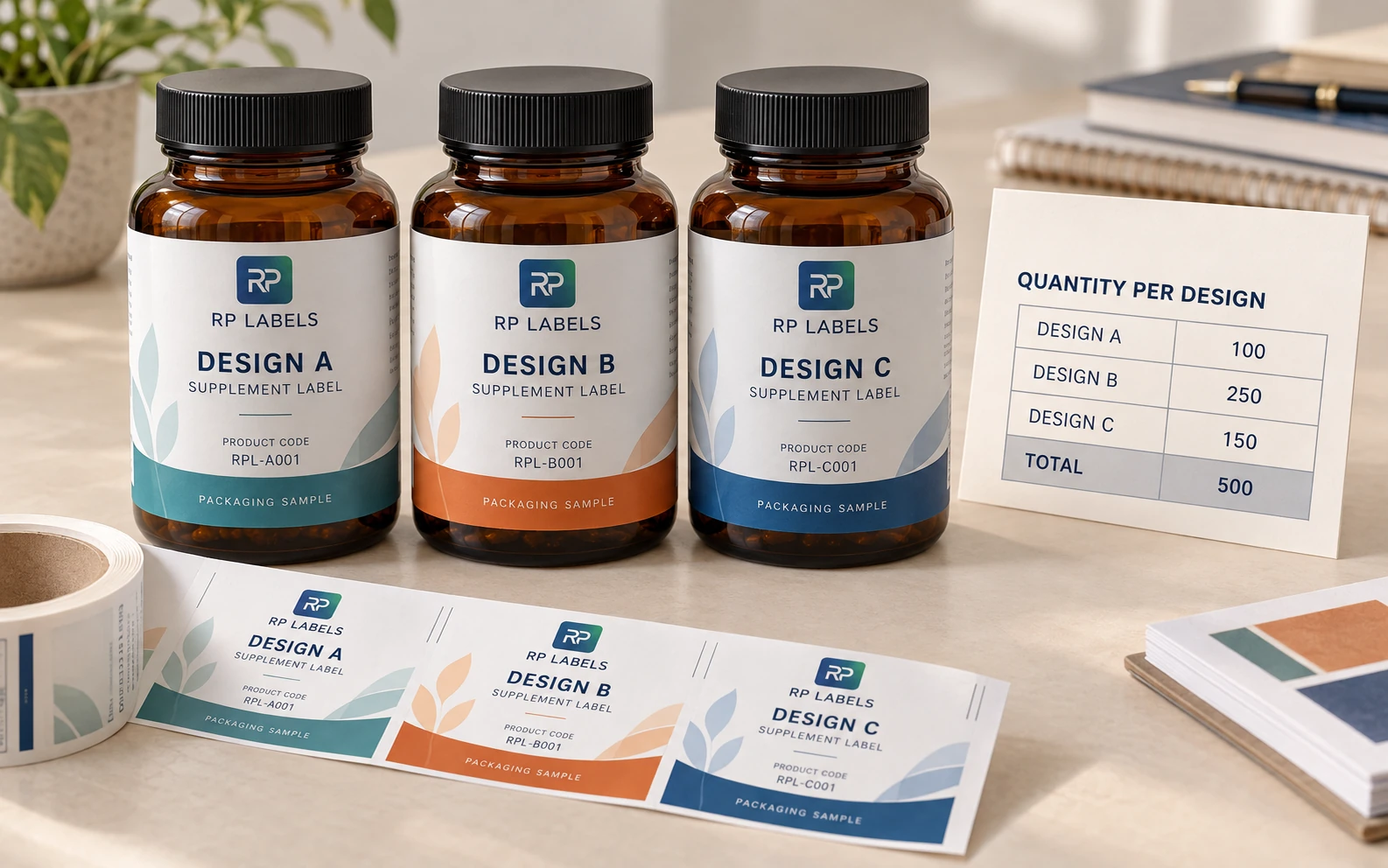
AI-generated packaging illustration. The 100, 250 and 150 quantities in this illustration are an example request, not a customer order. Digital printing for many custom label jobs can start at 100 pcs, including test runs such as a new skincare line. Foil stamping, matte black materials, and other special finishes may have a different minimum, confirmed on the written quote. The quantity on the written quote is the order minimum for that job. The strip shows the design family; it does not specify how rolls will be supplied.
Why 500 labels can mean different things
From the brand owner's chair, this looks like one small launch: three products, one bottle style, one payment to arrange. It is natural to add the quantities together and start shopping for a 500-label price.
The printer needs a different view. Are these three artwork versions on the same label construction? Does one need a different size or finish? Does the minimum apply to each design, a matching group, or the entire order?
That last question can change the purchase before anyone has discussed a discount.
Some printers allow designs to share an order under stated conditions. Sttark's FAQ, for example, permits this when size, material and laminate match. That is its published rule, not RP's. Multiple designs in the same size can be quoted and produced, including orders such as 500 pcs each for several designs. When the process allows, jobs may share setup or be combined. Any saving is stated on the written quote and is not a fixed percentage.
So I would send the split early: A, 100; B, 250; C, 150. Then ask the supplier to put its accepted quantity beside each number. Keep your original request visible. If you replace 100 with 200 as soon as the quote arrives, you have already hidden the stock decision inside the spreadsheet.
Would you actually use the extra 150?
Consider two buyers looking at that same hypothetical 650-label quote.
The first is reordering a settled range. Bottle, artwork and product mix are staying put, and the next production run is already planned. Another 100 labels for A and 50 for C may have a clear use. For that buyer, I would compare the complete cost, check the planned use and storage requirements, and consider accepting the larger run.
The second is testing a first range. B is the main launch; A and C are smaller trials. The designer still has changes waiting for approval. Ordering more of the trial labels just to bring down the average unit price is harder to defend. The extra stock depends on both the products and the current artwork surviving the test.
Same quantity. Different buying decision.
For the second buyer, a printer that accepts 100, 250 and 150 could deserve the order even at a higher unit price, provided the construction and delivery terms also meet the brief. Compare what you will actually pay for the usable mix. A low price printed beside a larger quantity can pull your attention away from the total payment.
There is another option: launch fewer designs. It is reasonable if C is optional and the test still answers your business question. If all three products are already committed to a launch, cutting C simply to fit a printer's minimum creates a different problem. I would take that decision back to the person responsible for the range.
Check what you can simplify without spoiling the label
Before changing printers, look at the specification. In our example, suppose all three designs have been checked for the same bottle and are proposed as 120 × 60 mm rectangular white BOPP labels with matte lamination. Those are example specifications, not a recommended size for every supplement bottle.
They give the supplier something concrete to assess together. Matching artwork colors alone would not.
Now change B to a gloss finish. You may still think of it as the same label with a different look. Ask the printer whether that difference changes the grouping, minimum or price. If the finish is optional, a common finish is worth discussing. If it is part of an approved packaging requirement, changing it needs approval too.
The same care applies to an adhesive selected for a different container or application condition. A cheaper shared construction only helps if it still does the required job. Ask for confirmation and an appropriate sample where needed; appearance on a screen cannot settle suitability.
If the dimensions themselves are uncertain, organize the measurements with the label quote planner first. Agreeing on a common size is little comfort when it does not fit the bottle.
Also say how the labels must arrive. If your packing table needs separate, identified rolls for A, B and C, put that in the request. Being priced together does not mean the designs should be mixed on one delivered roll.
Send three clear lines, then compare the replies
You do not need a long purchasing document to start. This is the useful part of the example:
| Artwork revision | Labels needed | Supplier's quoted quantity |
|---|---|---|
| A-v1 | 100 | To confirm |
| B-v1 | 250 | To confirm |
| C-v1 | 150 | To confirm |
| Total requested | 500 | Awaiting reply |
Use revision names that the designer and printer can both identify. “The green one” becomes unreliable as soon as a second green file arrives.
Send the same brief to each supplier. Ask what the minimum applies to, which designs can be grouped, and whether any quantity increments change your split. Get the supplied format and the full quoted scope written down too, including any separate proof, finishing, packing or delivery charges that apply.
The worked quote sheet has space for those answers. Use the blank sheet for your own order; the field guide explains the columns if you need it. An unanswered supplier field should stay open until it is confirmed.
Once the replies come back, put the totals beside the quantities you can use. That is when a price comparison becomes useful. You can see whether you are paying for your requested mix, buying planned stock ahead of time, or funding an experiment you have not decided to run.
For a custom supplement label quote, send RP Labels your bottle dimensions, artwork revisions and quantity per design, along with the proposed material and finish, application method and delivery destination. Mark anything still undecided so it can be discussed in the quote review.
Keep the original 100, 250 and 150 on the page. If the order becomes 650, make buying the extra 150 a decision you can explain.