A Label Supplier's ISO Certificate: Verify the Organization, Site and Scope
A management-system certificate can be useful in supplier qualification. Before relying on it, check which organization, location and activities it covers, who issued it and whether its current status can be verified. Then keep the actual label specification and order evidence separate. An ISO 9001 certificate is not a test report for your adhesive, printing or delivered rolls.
RP's website invites buyers to ask about factory quality records. That invitation is not a claim that RP holds a particular ISO certificate. Use the same evidence questions for any supplier you are assessing, including the supplier publishing this guide.
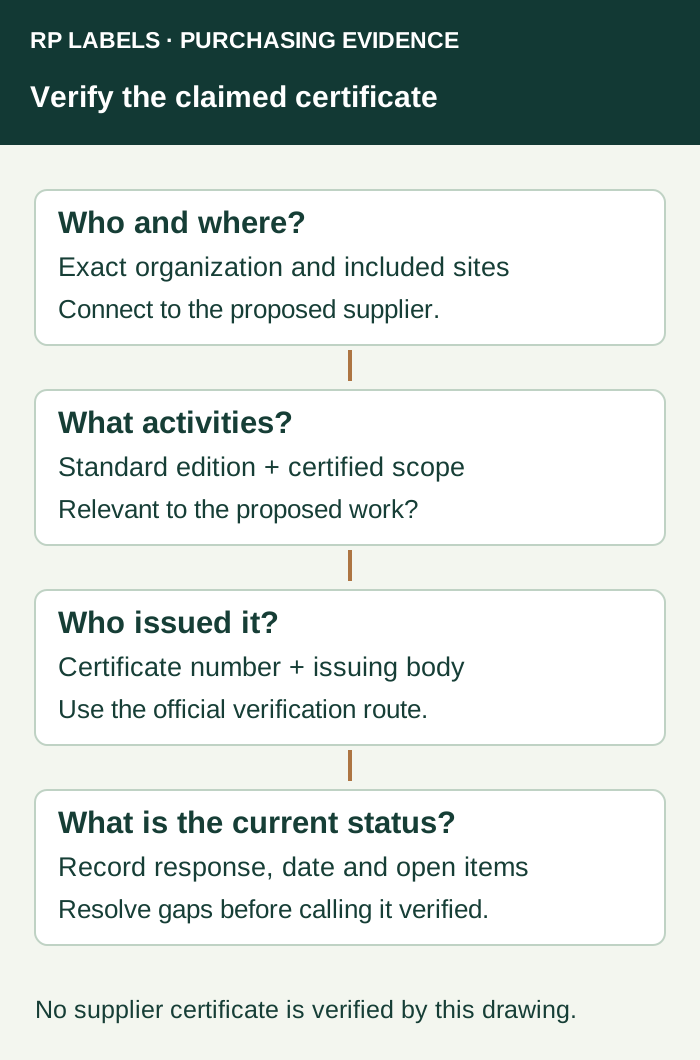
Start with the claim being made
Ask for the actual certificate and any annex identifying included sites. Record the standard and edition stated, certificate number, certified entity, addresses, scope, issuing body and dates. “Our group is ISO certified” is not enough to connect the record to the production arrangement on your quote.
ISO distinguishes certification, testing and inspection and states that it does not itself provide certification. A third-party certificate should identify the body that issued it. A generic ISO logo in a sales presentation is not a substitute for that record.
Do not interpret a management-system scope as a list of proven product performance claims. A certificate covering label printing does not establish that a proposed label survives your cold cycle or that a barcode meets the order's verification requirements.
Connect the entity and site to the proposed order
Compare the certificate's organization and site information with the supplier's explanation of where the work will be performed. A sales office, a trading entity and a manufacturing location may have different roles. Ask the supplier to explain the connection rather than assuming that a shared brand name covers every location.
Check whether the stated activities are relevant to the proposed printing and finishing work. If the order includes work at another site or an external provider, ask how that arrangement fits the supplier's quality-management scope and your purchasing requirements. The answer may be acceptable, but it should be identified.
In a fictional example, a buyer receives a certificate for Entity A's distribution activities while the quote proposes manufacture at Entity B. The buyer should resolve which record supports the manufacturing arrangement. This mismatch is a question to investigate, not proof that either entity has supplied false information.
Verify current status through a reliable route
ISO's certification guidance describes checking accredited certifications through an appropriate database or contacting the relevant certification or accreditation body. Use independently obtained contact details or the issuer's official verification service. Keep the certificate number and exact entity name with the inquiry.
If an online search does not return a result, do not immediately label the certificate fraudulent. The data may be incomplete, the search terms may differ or the record may require direct confirmation. Ask the issuing body to resolve the status and scope, and record the response before treating the supplier as verified.
Record the standard edition on the certificate and have the issuer explain any applicable transition or validity question. Do not infer validity only from an expiry date on an old PDF, or reject a certificate solely because a newer edition of a standard has been published.
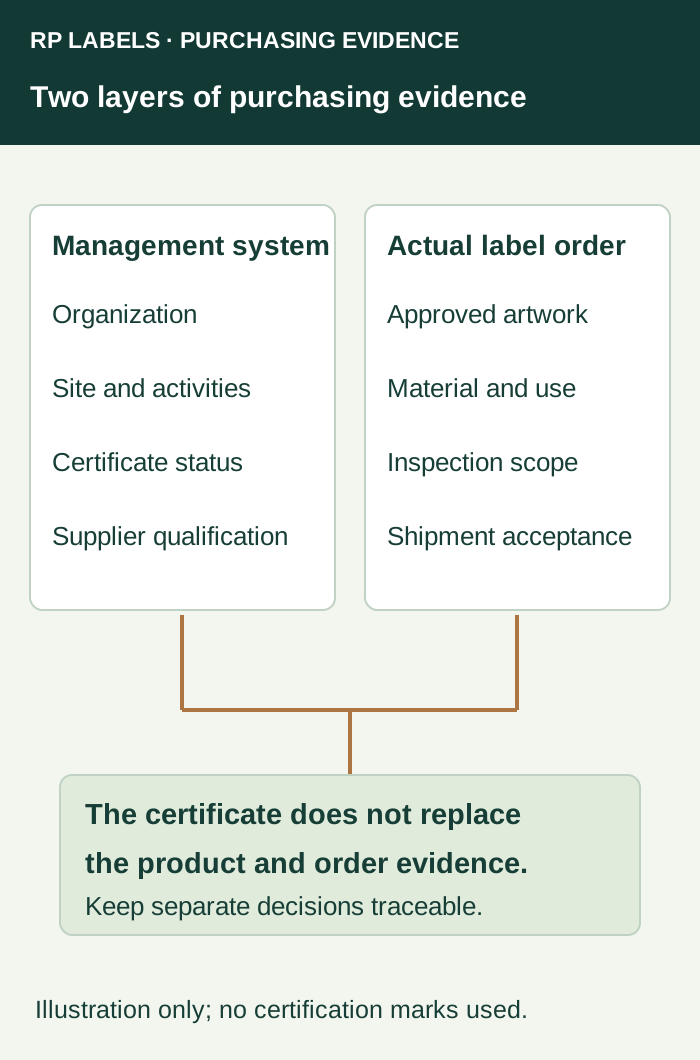
Keep the order's acceptance evidence visible
ISO's supplier-focused ISO 9001 guidance explains that management-system conformity does not replace product or service conformity. The booklet's old edition-transition dates are historical; use the current issuer and standard information for status questions.
For a custom-label purchase, retain the approved artwork, construction references, container and application requirements, accepted quantities and supply format. Agree any physical sample, inspection or report required for the actual order. The inspection-scope guide helps define the features and coverage instead of relying on a general quality slogan.
A supplier without the certificate requested by your onboarding policy may need another agreed qualification route, or may not meet that policy. The procurement owner should decide that explicitly. Good appearance on one sample does not replace a mandatory certificate, while a certificate does not replace the sample's actual approval task.
Make the qualification record usable for the next buyer
- Record the exact claim, certificate and relevant site or scope annex.
- Keep the official status-check date and response or database reference.
- Connect the record to the actual supplier and proposed production arrangement.
- List separate product and order requirements that remain to be approved.
- Assign a reviewer for future changes in site, scope, status or customer policy.
For supplement labels or vial labels, prepare an RP inquiry naming the supplier-qualification record your purchasing process requires and the actual project scope. Ask what evidence is available. A precise requirement lets the supplier answer directly and keeps an unverified certification claim out of your approval file.