Label Inspection Scope: Define What the Check Can Actually Find
“The labels were inspected” leaves the buyer with four unanswered questions: which labels, which features, by what method and against which acceptance rule? Before paying for an inspection service or relying on a report, define those items. A selected good-looking strip is useful for showing an appearance reference; it does not establish the condition of every roll in the shipment.
Start with the consequence that matters to your packing operation. A missing label, the wrong artwork version, an unreadable identifier and an unacceptable optical effect need different checks. A report about one of them should not silently approve the others.
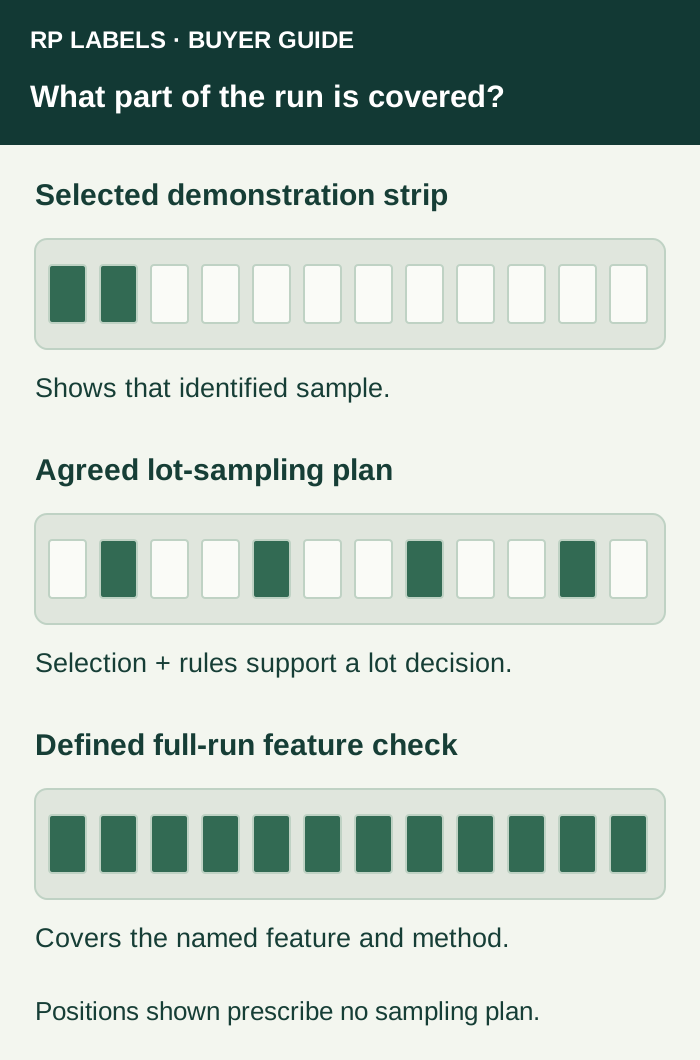
Distinguish a reference sample from a lot decision
A supplier-selected sample can help the buyer understand the intended print or finish. Ask how it was selected and which construction and revision it represents. It may be an appropriate appearance reference without supporting a decision about the complete shipment.
An acceptance-sampling plan is a defined method for taking samples and using their results to decide the disposition of a lot. NIST explains that lot acceptance sampling primarily supports an acceptability decision, rather than estimating the lot's quality. Its sampling-plan overview describes plans as sampling schemes with decision rules.
A few samples from convenient positions are not automatically a statistical acceptance plan. If the project needs one, the buyer's quality owner and supplier should agree the lot definition, selection method, sample sizes, acceptance rules and response to rejection. This article supplies no AQL value or universal sample count.
A full-run check still needs a named feature
A request for 100% inspection should say what is observed on every unit and how that observation is used. A system looking for a missing label does not necessarily read the product name. Reading a QR symbol does not necessarily verify that its destination is authorized or that the material will adhere to the bottle.
Ask the provider to describe the actual detection capability and its limits, with evidence relevant to the proposed configuration. Record the reference artwork or expected data, the features checked, the run coverage, how interruptions are handled and how rejected material is separated. “Every label passed a camera” is a description of movement until the detection and decision scope are defined.
For variable identifiers, use the serial reconciliation guide to check the resulting ID sets. For printed barcode quality, the verification-report guide explains a separate report scope. These should be explicit line items if the order needs them.
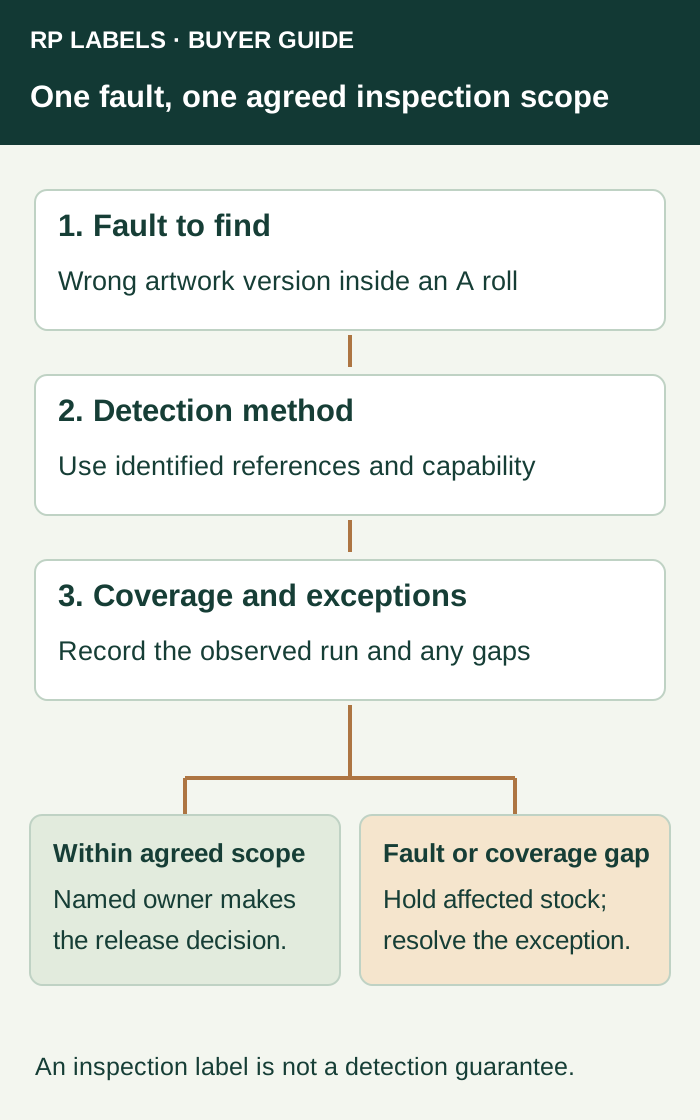
Write one inspection requirement around one fault
Consider a fictional order containing Design A and Design B. The buyer is concerned that a short section of B could be mixed into an A roll. A useful requirement identifies the correct artwork reference and the distinguishing feature to check, rather than asking only for a general visual inspection.
The buyer and provider then agree how the proposed method detects that wrong version, which parts of the run it covers and what happens after a detected or unresolved event. Where an automated system is proposed, a controlled challenge using known examples can help establish its actual response. The multi-SKU inspection guide covers that challenge task in more detail.
A different buyer may be comparing a holographic effect with an approved physical reference. That task can require controlled viewing conditions and a defined observer judgment. A camera configured to detect version A is not automatically a solution to that appearance question. Compare methods against the required decision rather than choosing the most impressive inspection label.
Read the report's boundaries before its conclusion
- Identity: order, artwork revision, construction and rolls or lot covered.
- Method: feature, reference, instrument or observer procedure and relevant settings.
- Coverage: selected positions, agreed samples or the defined full-run scope, including any unobserved intervals.
- Result: actual observations and exceptions, distinguished from assumptions.
- Disposition: who can accept, hold, rework or reject the affected material under the agreement.
If the report names the wrong artwork revision or omits part of the run, ask the provider to resolve the coverage gap. A positive result from the identified sample may remain useful. It must not be expanded into an acceptance of material that was never covered.
After rework, request the evidence that applies to the reworked material and its current identity. Keep rejected, retained and saleable quantities distinguishable. An inspection record and a quantity reconciliation should support each other without turning an uncounted sample into a shipped piece.
Ask for a scoped inspection option with the quote
For vial labels, supplement labels or hologram labels, prepare an RP inquiry identifying the fault you need to detect, the approved reference, quantities, application process and consequence of an escape. Ask which inspection scope and record can be offered, with any price or timing effect. Confirm availability and responsibilities before treating the requested check as part of the order.