Peptide Vial Label Revisions: Keep Old and New Rolls Apart
A corrected file is not enough if yesterday's roll is still sitting next to today's vial line.
Consider a hypothetical artwork revision: the logo moves, the lot field changes and the PDF is approved. The questions below are planning guidance, not a reported RP changeover.
For custom research-vial labels, I would treat an artwork revision as a physical inventory change. A printer can reproduce the approved file, but the brand or packer has to decide when V1 stops being eligible for use. That decision needs a version name, a cutover rule and a way to identify each roll without opening and unspooling it.
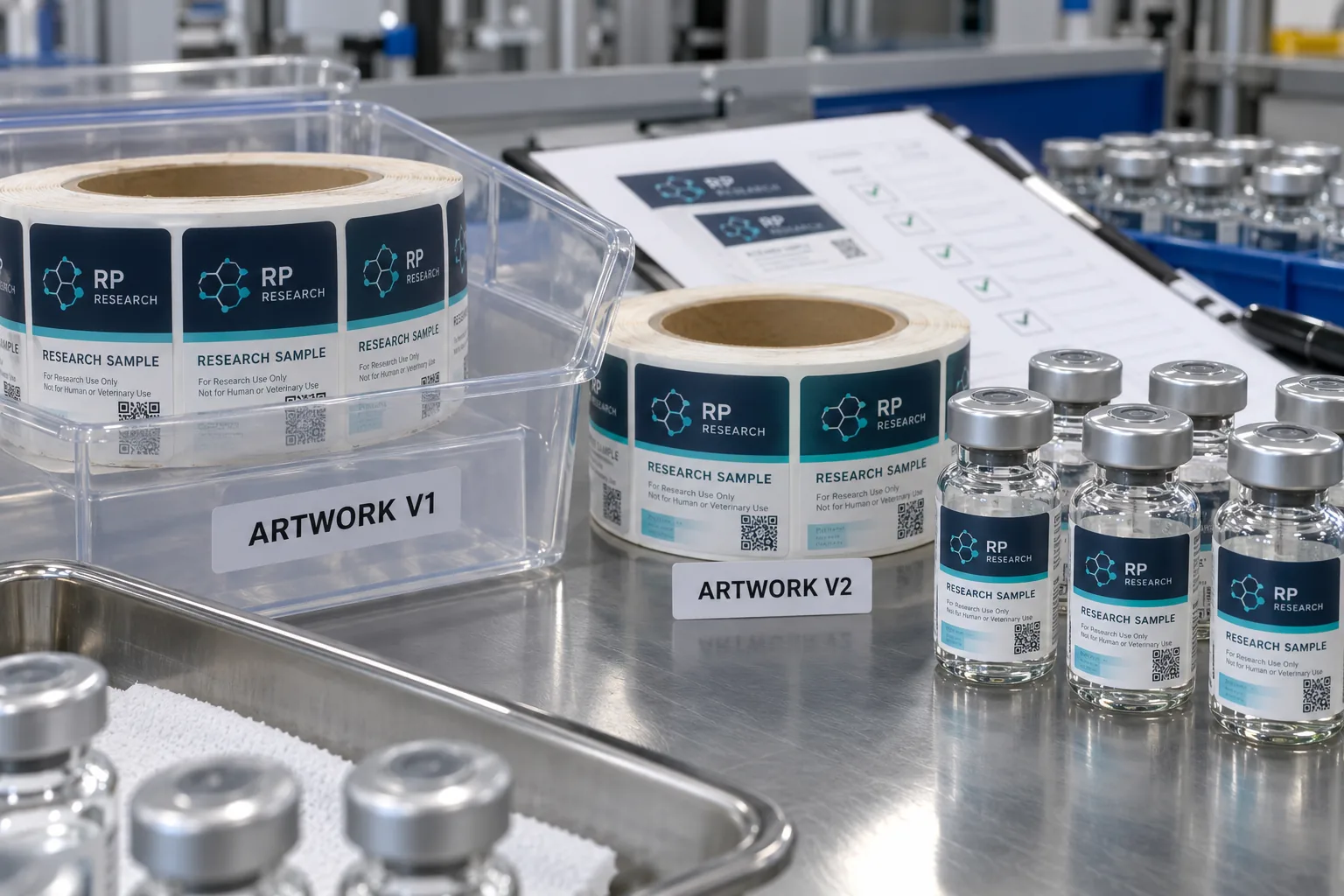
AI-generated changeover illustration, not an RP production record. Vial names, version marks and roll identifiers are fictional examples.
Give the version an identity outside the PDF
Put a stable artwork identifier and revision date on the approval sheet and roll carton. Do not rely on a filename such as final-final-2.pdf or the color of a vial cap. The roll label should match a release record that names the SKU, die size, material, adhesive, quantity, artwork version and any variable-print template. If the same brand sells several visually similar vial products, use both the human-readable name and the internal SKU.
Ask the printer to provide a photo or physical proof of the first finished label from the revised file. Compare it with the approved master, not only with yesterday's production. If the revision touches a barcode, QR-like code or data field, confirm the data separately. A new logo can coexist with an old destination or the wrong lot-field mapping; the visual update alone proves little.
Decide what happens to old rolls before the new ones arrive
There are several legitimate cutover patterns. A brand may finish a known production run with the old version, hold it for a defined internal use, or remove it entirely. I cannot decide which is appropriate without the product and market context. I would, however, require the brand's quality owner to write the disposition and stop the old roll from drifting back onto the line later. A quarantined tray is easier to understand than an unlabeled shelf.
Run a changeover check a packer can actually use
Before applying V2, identify the last V1 vial produced, remove V1 labels from the work area, verify the new roll carton and visually compare the first applied V2 vial with the released sample. Look at the vial and carton together if both carry the brand. A first-off check is more useful when it includes the container, because the printed roll alone cannot show skew, obscured text or a label placed on the wrong bottle.
Keep the rejected first-offs and damaged labels separate from approved stock. If codes are serialized, reconcile which identifiers were printed, rejected or released; the variable-data checklist covers that different problem. Record who released the changeover. I would not pretend a handwritten tick alone makes the process foolproof, but it gives the next shift a verifiable starting point.
Make the cutover a stock decision
The worked cutover record, blank version and field guide show two hypothetical transitions. SKU A proposes holding V1 stock when V2 becomes eligible. SKU B asks the buyer to decide whether a defined V1 run may finish first. Neither row authorizes use of old stock or invents a clearance result.
The difference belongs with the responsible product and release owners. A graphic designer can identify the changed artwork but cannot silently decide that yesterday's label remains suitable for tomorrow's packing. Write the effective condition as an identifiable run boundary or other agreed trigger, and name the owner who can authorize an exception. If the change affects mandatory or controlled copy, obtain the appropriate project-specific review rather than relying on a generic inventory rule.
Warehouse staff should be able to connect a roll to that decision after the shipping carton is opened. Record roll identities and storage status, then inspect the work area before the change. The first applied V2 reference should be identified with the released file and the actual vial. A photograph of a revised PDF does not show whether old rolls were removed from the bench.
If a hold is unresolved, identify its location and owner in the handoff to the next shift. If approved old use has a defined boundary, record when that boundary is reached and what happens to the remainder. Keep records for quantities and disposition through the buyer's actual process. The worksheet is a place to connect those records, not a replacement inventory or quality system.
What to put into the reorder brief
Send the old and new artwork IDs, a marked comparison of exactly what changed, the effective production date, expected old-stock disposition, roll format and application method. Specify whether the earlier die can be reused; a field moving closer to the edge may require a fresh physical proof even if the cut shape is unchanged. Ask whether the carton and roll core labels can carry the revision clearly enough for warehouse staff to distinguish them.
My buying judgment is simple: if the proposed transition cannot be explained in one short handoff note, it is not ready for a rush print. Use the custom vial-label inquiry to send both versions, the cutover brief, quantity and real vial reference. The answer should be a production-ready version specification, not just a prettier PDF.