Single-Lane or Multi-Lane Label Rolls? Specify the Delivered Web
Ask how many labels will sit across the delivered liner, not how many fit across the printer’s press. A two-across production layout may be slit into separate single-lane rolls. It may also remain two-across on one wider carrier. Those are different supplies for the next operation, even when the individual label artwork is identical.
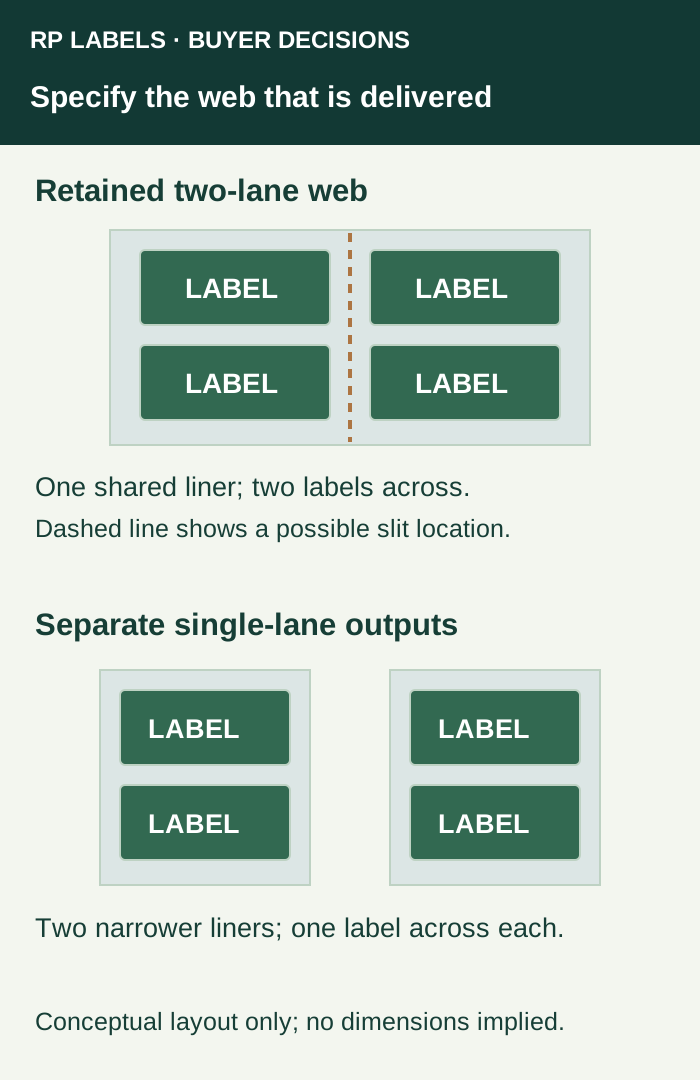
Start at the operation that consumes the labels
For a supplement packer applying one bottle label at a time, the relevant question is what the applicator accepts at its unwind and peel point. For a buyer adding variable information with a label printer, it is the printer’s supported material layout and output handling. A hand-packing station may have a different preference again.
A wide roll is not automatically a productivity improvement. The downstream operation may need separate narrow rolls, or may not be equipped to handle two labels across. Conversely, an operation deliberately designed around multiple lanes needs that layout preserved. Have the equipment owner identify the intended route before asking RP Labels whether the corresponding finished format can be supplied.
Separate a converting layout from an order specification
“Two-up” can describe a design arrangement on a production sheet or web without defining the rolls that leave the converter. Replace that shorthand with an annotated finished-web drawing. Show the number of lanes across the liner, the direction of travel, the individual label dimensions, the gaps and the total carrier width. Then show whether the web remains intact or is slit into separate outputs.
If the quote assumes single-lane finishing, confirm the number of finished rolls and the quantity per roll. If it assumes a retained multi-lane web, confirm the downstream owner accepts that exact carrier. Slitting, rewinding, inspection and packaging belong in the agreed scope when relevant; this article does not imply a particular charge or a service offered on every order.
Count labels and rows separately
In the fictional drawing below, two lanes contain eight rows. That gives sixteen label positions, assuming every position is present and usable. Calling this “eight labels” would understate the quantity; calling it “sixteen rows” would describe a different length. State whether a quoted or machine-reported count means individual labels, web rows or finished rolls.
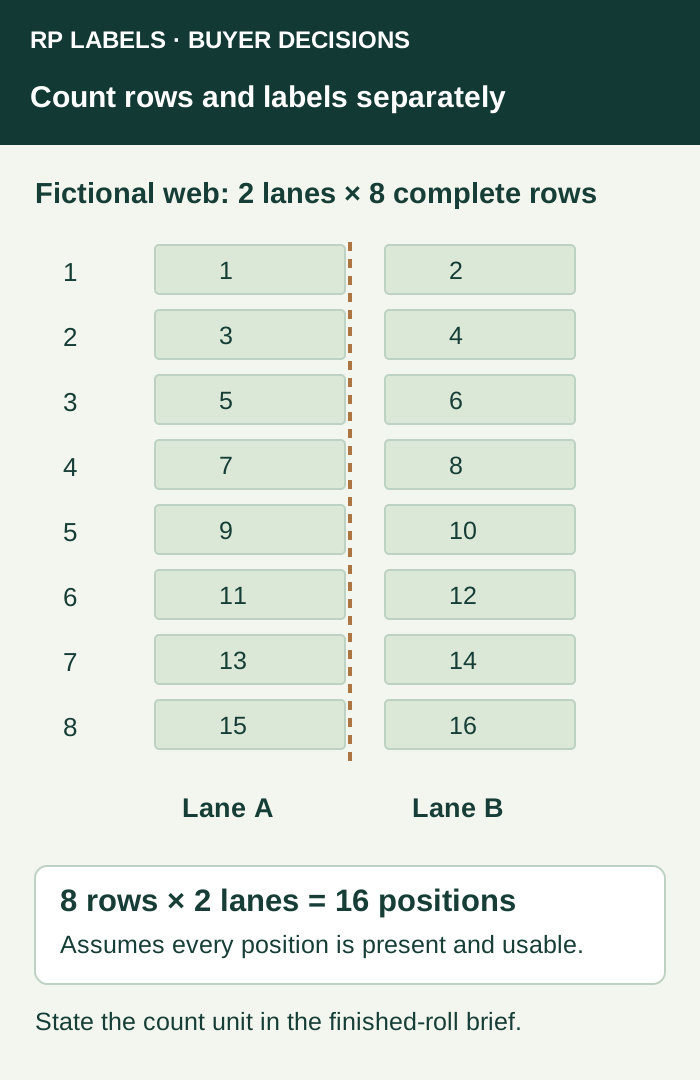
Where lanes contain different SKUs, a total across the web cannot replace the quantity for each design. Identify which design occupies which lane and how that allocation will be checked after any slitting. Where variable data is involved, agree the lane-to-record sequence with the data owner; do not infer it from a left-to-right screenshot.
Have the equipment owner check sensing and output
cab’s MACH 4S documentation describes a different sensor position for multi-track labels. That is a useful equipment-specific example of why an unchanged label size does not establish compatibility with a changed lane arrangement. It is not a setting instruction for another printer or an assurance that the packer’s applicator supports multiple lanes.
Send the proposed finished layout to the actual equipment owner. Ask that person to check usable web width, lateral label positions, sensing, printing where applicable, and how labels leave the device. A trial should use the proposed finished construction and layout. The general machine roll brief covers core, diameter, winding and the remaining constraints; use it alongside the lane drawing.
| Situation | Decision to close before release |
|---|---|
| Machine owner requests separate single-lane rolls | Confirm finished lane count, slit outputs, orientation and count per roll. |
| Printer owner requests a retained multi-lane web | Confirm lane geometry, sensing, print layout and output handling against the exact equipment. |
| Only a press layout has been supplied | Hold the finished-format approval until the delivered web is identified. |
Send one finished-web brief with the inquiry
For supplement labels or vial labels, send RP Labels the downstream operation, equipment reference, lane drawing, quantity per design and preferred finished-roll allocation. Ask for confirmation of the proposed supply format and any trial needed. Keep the artwork approval open if the packer has not accepted the delivered web.
Prepare the label inquiry with that brief. The contact page prepares a draft for the email or WhatsApp route you choose; attach the equipment drawing through that route. A visual press layout alone is insufficient to close this purchasing decision.