Sticky Label Roll Edges: What to Check Before Blaming the Adhesive
A roll of printed labels arrives with a tacky edge. The labels fit the applicator, but some material pulls unevenly from the liner and residue begins to appear along the label path. Is the adhesive unsuitable, was the roll wound too tightly, or is the problem elsewhere?
The practical first decision is whether to hold the roll and document the actual condition. A sticky surface can have several explanations. Do not treat a visual impression as a confirmed adhesive formulation problem, and do not continue running a roll that damages the liner or contaminates the machine. The operator and converter need the roll identity, where the tack appears and the conditions under which it was observed.
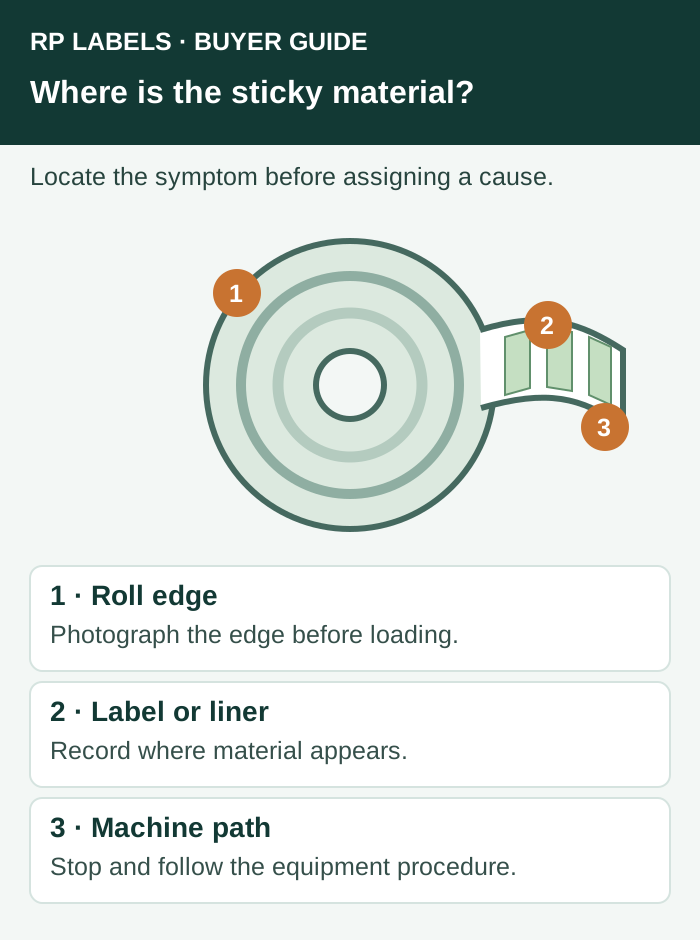
Locate the sticky material before changing the process
With the machine stopped and secured under the site's procedures, record whether the tack is at a roll edge, beyond a die-cut label, on the back of the liner or on a machine component. Keep the roll ID, material reference, artwork revision and supplied packaging together. Photograph the condition before cleaning or moving material, but do not touch the label adhesive or machine components in a way that introduces contamination.
A loose label, damaged edge, transferred adhesive or unrelated residue can look similar. Record what you can observe without claiming a cause. The printer manufacturer cab describes adhesive ooze as one possible cause of residue and dispensing problems in its listed equipment. It identifies several possible contributors, including adhesive characteristics and winding; its guidance is not a test result for a particular RP roll.
Compare rolls without mixing up the variables
If the line's procedure permits, compare a held roll with an apparently unaffected roll of the same construction, size and use, keeping the applicator setup and product consistent. Record whether the symptom follows the roll or remains at the same point in the machine. A single comparison provides a lead, not a statistically valid acceptance test. If there is no comparable roll, say so rather than substituting a different adhesive and calling the cause proven.
Keep track of the receiving date, whether the roll was opened, its packaging and any known storage exception. Avery Dennison's storage bulletin describes factors that can affect pressure-sensitive materials and finished labels. Its recommendations are specific to the scope of that source; request the applicable storage and shelf-life guidance for the actual construction rather than transferring a generic limit to every label.
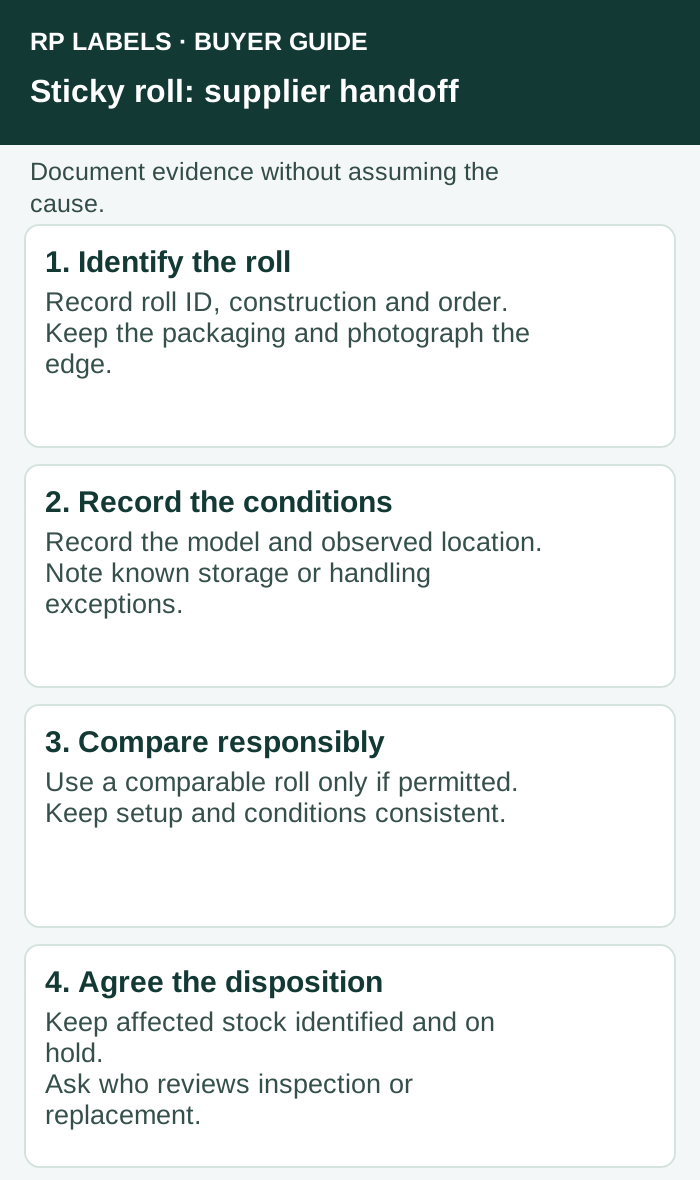
Keep inspection and machine cleaning separate
For a stopped machine, the qualified operator should follow the equipment maker's cleaning instructions and the site's isolation procedure. The correct cleaning material, access method and replacement parts depend on the machine. Do not scrape a print head or apply a solvent simply because an online guide mentions it for another model.
Cleaning the machine can remove a symptom from the path, but it does not establish that the remaining roll is suitable. Likewise, a clean-looking roll end does not establish that every part of the web is unaffected. Preserve a sample if the supplier asks for one and if it can be handled safely without disturbing evidence. Keep potentially affected material identified and separate until a responsible person decides whether it may return to use.
Agree the supplier's disposition before release
Send the converter the order and roll IDs, construction or material reference, images of the affected area, estimated quantity, equipment model, observed point of buildup and any comparison that was actually performed. Ask whether the roll should be inspected, replaced or assessed through another controlled process. Do not assume that rewinding will recover contaminated or damaged labels.
When a replacement or corrected roll arrives, agree who will confirm the identity, condition and performance required for that specific line. An acceptable initial observation is not proof of an entire roll's performance. If the issue persists with more than one known-compatible roll, the shared equipment path and setup also need review. The separate web-tracking guide addresses lateral movement rather than tack or residue.
What to specify in the next order
For an RP Labels vial label or supplement label inquiry, provide the substrate, application and storage conditions, applicator or printer model, roll dimensions and unwind, and any actual residue or dispensing requirements. Ask the converter what can be supplied and how any material or winding changes would be approved. Avoid prescribing an adhesive solely from a symptom: a construction also needs to suit the container and use.
Sources and scope
Sources accessed November 1, 2026: cab, adhesive ooze FAQ; Avery Dennison, storage conditions. The comparison and handoff on this page are editorial guidance, not evidence of an RP defect, testing result or guaranteed equipment compatibility. Demand layer: competitor and process pages linked here, including Avery, HERMA or OnlineLabels where cited, illustrate buyer language and process topics only. They do not supply RP minimum quantities, lead times, prices, certifications or materials. Authority layer: an RP number is backed only by a factory datasheet, a signed quote or proforma, confirmed product data, or a fact kept on the About page. The March 2026 proforma there is one production-run example, not a standing offer. RP shipping and planning pages describe what to confirm on a quote. Worked figures on this page are fictional unless an authority source is named for them.