Label Roll Telescoping: Separate a Winding Defect from an Applicator Tracking Problem
The label artwork has been approved and the roll fits the spindle, but the roll edge no longer looks flat. Layers appear to slide sideways and the web begins to wander as the applicator runs. Should the packing team adjust the guides, return the roll, or ask the printer to rewind it?
First establish when the movement appeared. Photograph the roll before loading, preserve its identification and compare it with a second roll under the same approved setup. A displaced roll before loading and a web that moves only after loading point to different checks. Neither observation alone proves the root cause, and a successful short run does not establish that the rest of the roll is acceptable.
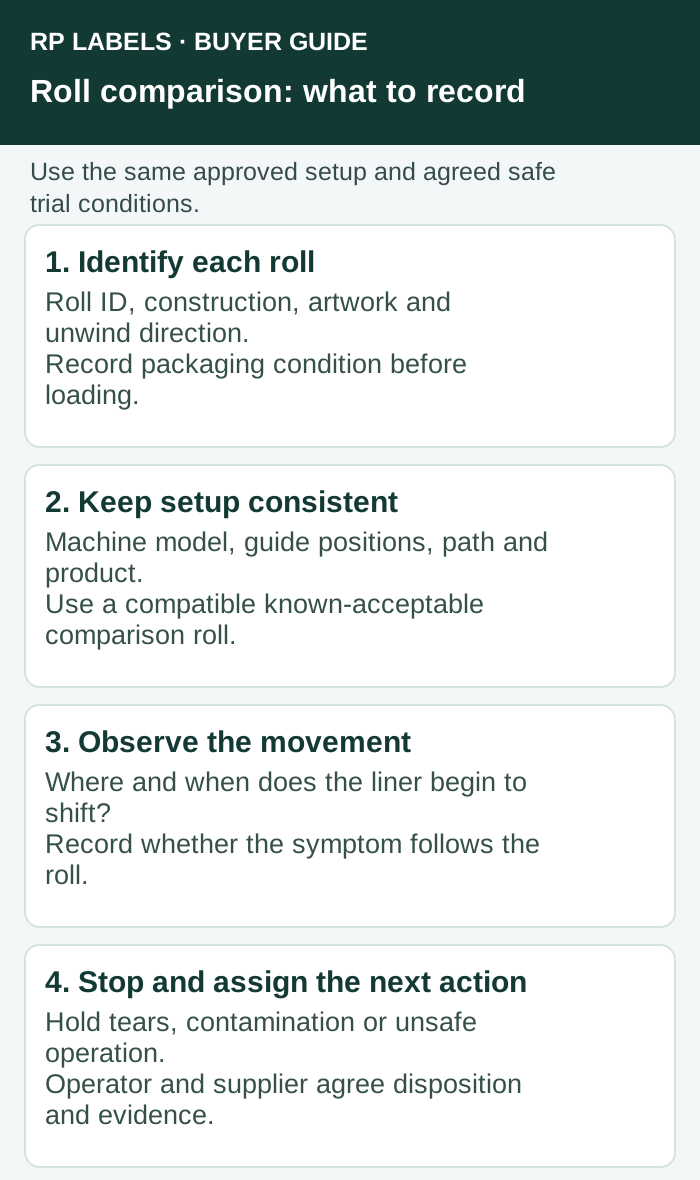
Record the roll before making adjustments
Keep the carton label, supplier roll ID, artwork revision, label orientation and delivery date together. Photograph both ends of the roll, the core, any damaged or dirty edge, and its protective packaging. Note whether the layers are displaced before the roll is mounted. If the roll is visibly damaged, contaminated, crushed or unsafe to handle, hold it for review rather than forcing it into the machine.
Do not flatten a displaced end by pushing on it and assume the internal layers are restored. Tell the converter what is visible and ask whether its acceptance criteria permit a controlled inspection, a replacement or a supervised rewind. A winding defect can have several possible causes; the visible shape alone does not identify which party caused it.
Dover Flexo Electronics' winding guidance describes telescoping as layers shifting sideways and discusses tension and alignment among possible factors. That is general web-winding information, not a diagnosis of a specific RP roll.
Use a comparison that isolates the change
With the machine stopped and made safe under its operating procedure, record the applicator model, the loaded roll orientation, the route of the liner, the guide positions and the current approved settings. Check the actual roll against the line's core, outside diameter and web-width requirements. The separate roll-envelope guide explains those measurements.
If the operator and site procedure permit a trial, compare the suspect roll with a known acceptable roll of the same construction and compatible dimensions. Keep the machine setup, product and trial conditions consistent. Document where the liner moves, whether movement begins immediately or develops as the roll unwinds, and whether the problem follows the roll. Stop the trial if the liner tears, the roll binds, labels leave the liner unexpectedly, or the machine's safety or quality limits are reached.
If only one roll shows the issue, preserve both roll identities and observations for the converter; it is a useful lead, not final proof. If both rolls move at the same location, inspect the common setup with the equipment operator. If the roll stays centered but the finished label is skewed, examine container presentation and application conditions too. Avoid changing several settings at once: otherwise the team may not know which change affected the result.
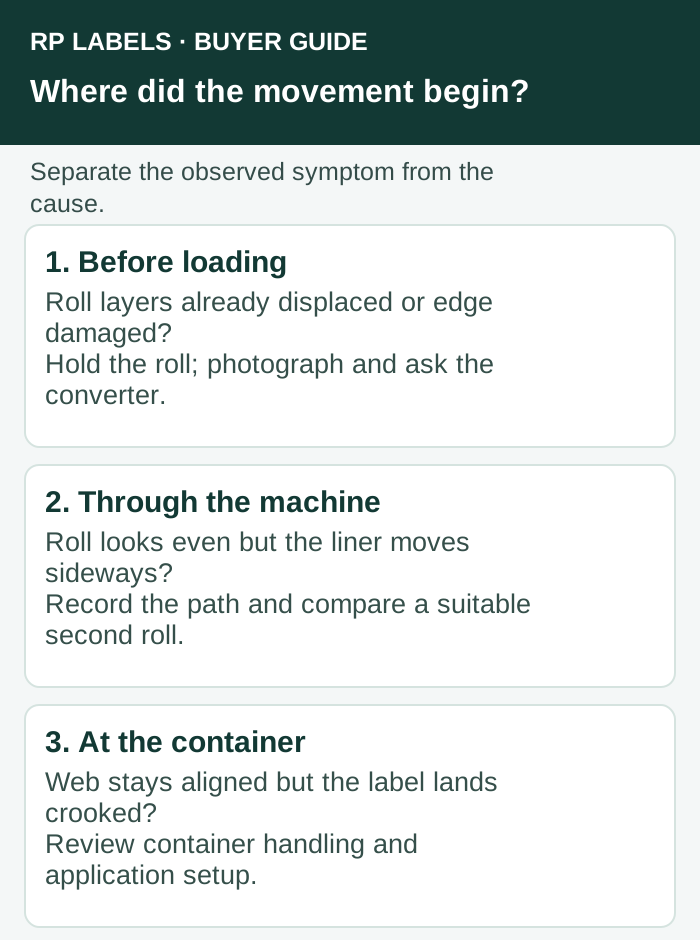
Separate the observed symptom from the decision
Layers displaced before loading
Next check: Document the roll ends, core, packaging and damage; compare supplied specifications. Ask the converter for a disposition before attempting correction.
Roll looks even, liner moves through the path
Next check: Check mounting and guides against the equipment manual; compare another suitable roll. Stop at agreed quality or safety limits; involve the line operator.
Web stays aligned, labels land skewed
Next check: Check container stability, timing and the point of application under the line procedure. Do not conclude that the roll caused the placement issue without a controlled comparison.
Edge damage, contamination or a tear
Next check: Preserve evidence and identify affected roll and portion. Quarantine the affected material and agree replacement or inspection with the supplier.
The manufacturer of a particular applicator may specify where the guides belong and how to adjust tracking. For example, Primera's AP550 manual discusses parallel label stock and guides for that specific model. Do not copy its positions or settings to a different machine. The operator should use the instructions for the installed equipment.
Decide whether to rewind, replace or investigate the machine
A controlled rewind may be an option only if the converter or a qualified operator accepts the material and the process can preserve label orientation, cleanliness, roll identification and usable quantity. Rewinding is not a guaranteed repair for a stretched liner, damaged adhesive, crushed edge or contaminated roll. Agree how a corrected roll will be identified and what sample, run conditions and evidence will be used before it is returned to production.
Replacement may be the simpler route when the material is visibly damaged or the line cannot hold a trial without risking product. Conversely, if a good comparison roll shows the same behavior, a machine or loading review may be more useful than requesting another identical roll. Keep a record of the agreed action and affected stock so that a held roll is not returned to use by accident.
This decision is different from agreeing how to handle a splice or releasing an opened roll from storage. Those guides cover related handoffs; neither replaces identifying where sideways movement begins on the actual machine.
What to send with your label order or issue report
For a new vial label or supplement label project, send RP Labels the actual applicator model, core and maximum roll diameter, web width, unwind direction, label construction, quantity per roll and any documented line requirements. For an existing issue, include roll IDs, photos of both ends before and after loading, a short description of the observed movement, the comparison conditions and the affected quantity. Ask who will review the evidence and what a replacement, trial or rewind would involve.
Do not approve a roll solely because it fits on the spindle or because the first few labels ran. Agree the acceptance criteria with the parties responsible for the actual line, and keep the observations with the roll's identity.
Sources and scope
Sources accessed November 1, 2026: Dover Flexo Electronics, roll winding defects; Primera AP550 applicator manual. Examples and decision records on this page are editorial illustrations, not reports of a customer incident, a validated machine trial or a universal acceptance standard.