Will a Supplement Label Fade on the Shelf? Define the Light Exposure Before Ordering
A supplement brand approves a vivid label under a desk lamp. Months later, some bottles sit in a bright shop window while the rest remain inside closed cartons. The packaging team wants to know whether the labels will look the same at sale. A digital proof can show the intended design, but it cannot establish the lightfastness of the finished print.
The purchasing decision is to define the exposure and an acceptable change, then ask the label supplier what evidence or representative sample is available for that exact construction. Indoor lighting, window-filtered daylight and direct outdoor exposure are different conditions. A generic promise that a label is “UV resistant” does not specify the color, ink, material, finish, exposure or measurement behind the claim.
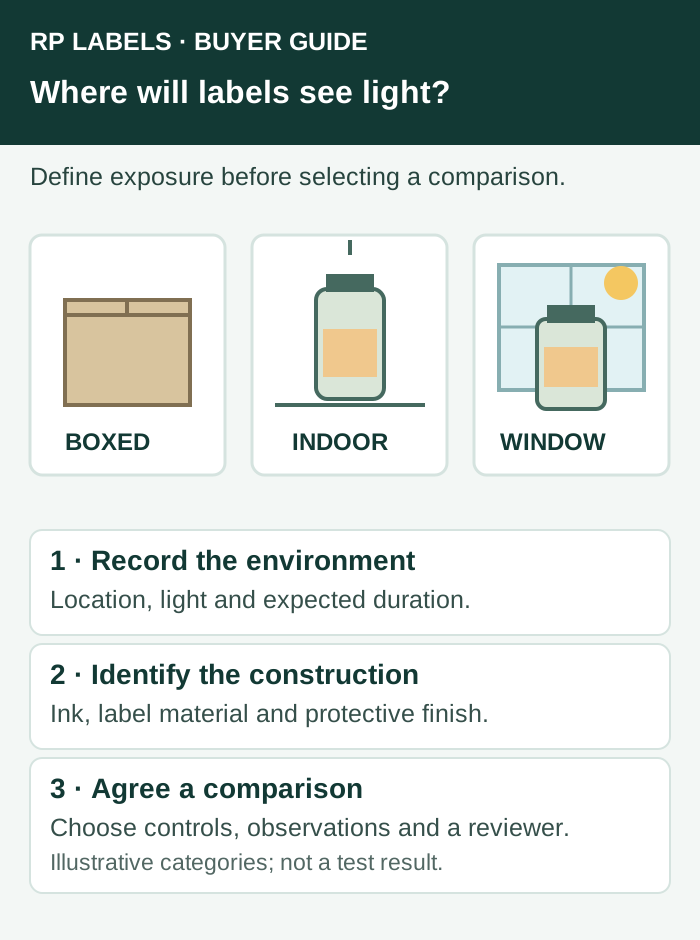
Describe where the label will spend its life
Map the journey: closed storage, transport, warehouse staging, retail display and customer use. Record which label face is exposed, whether bottles rotate, whether a window or display case filters the light and the expected duration of the most demanding stage. Separate the actual expected use from a worst-case test you may request. If the retail conditions are unknown, mark them unknown and ask the distributor rather than choosing an arbitrary duration.
Not every product needs an outdoor-grade label. A bottle kept in a carton until sale presents a different question from one displayed continuously in sunlight. Indoor lighting also matters when appearance or readability is critical; do not assume that every indoor condition is equivalent to dark storage.
Xeikon describes lightfastness as resistance of a printed image to fading or discoloration under light. Its discussion concerns its own printing systems and materials. It is useful for framing the question, not a warranty for an RP label.
Ask about the whole printed construction
Record the intended face stock, inks or print method, colors, white underprint if used, and varnish or laminate. Change one of those components and the prior evidence may no longer describe the actual label. A protective film can be relevant, but a clear finish by itself does not guarantee a particular period of color stability.
Avery Dennison's outdoor-label guidance discusses the role of materials, inks and protective finishes, and notes that applications require different tests. It covers demanding outdoor equipment rather than typical supplement shelves; use it to ask better questions, not to claim a shelf life or certification for this project.
Choose the features that matter to the brand and end user: a critical brand color, small black instructions, a variable lot code or a machine-readable symbol. A label may remain attractive while a critical field loses readability, or show a visible color change that the brand still accepts. Set separate acceptance decisions for appearance and function.
Agree a comparison before the test
Ask the supplier or an appropriate test partner to identify the sample construction, exposure method, comparison sample, observation intervals and who decides the result. If a formal test is needed, obtain the applicable method and confirm its scope and current edition with the testing party. A supplier's result on another ink or material should not be presented as evidence for your own printed labels.
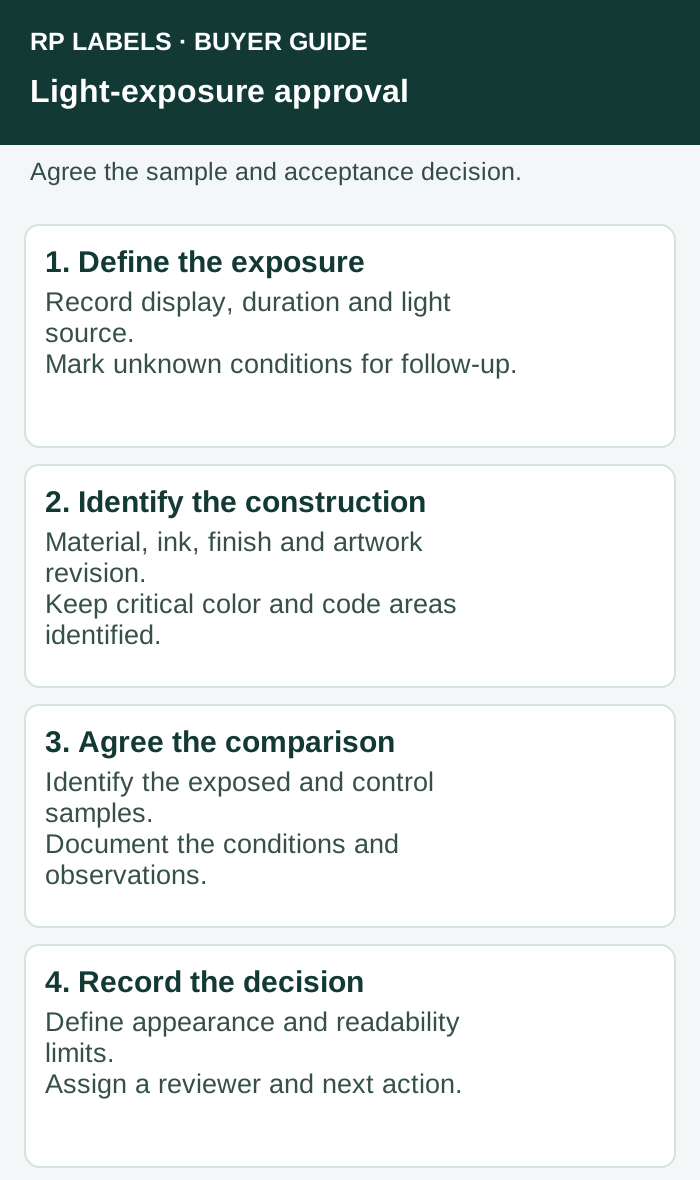
A simple internal comparison can help decide whether further investigation is needed, but it is not automatically an accelerated-aging test or a prediction of months on a shelf. Keep an unexposed control from the same construction, label both samples, document where each is kept and examine them under consistent viewing conditions. Record observations without converting a few days near a window into a guaranteed service life. If the decision is commercially or technically important, ask a qualified provider for an agreed test.
What should happen when appearance changes?
If an exposed sample shifts in color, compare it with the unexposed control and the brand's agreed acceptance criteria. Record whether the difference is in the ink, the label material, the finish or only an apparent change under a different light. Do not identify the mechanism from appearance alone. If instructions or codes are involved, the responsible reviewer should separately assess legibility and code quality under the applicable requirements.
Possible next steps include adjusting the packaging route, requesting evidence for another ink or finish, or agreeing a different label construction. The choice depends on the actual container and handling. A laminate can introduce other trade-offs, including later overprinting or appearance; the separate lamination and varnish guide addresses that decision.
Read the lightfastness report before approving a claim
Request the specimen identity, the exposure method and its result together. ISO 12040 describes assessment of lightfastness of prints and printing inks using filtered xenon arc light. If a supplier references it, ask which specimen was tested, the method edition used and how the outcome was reported. Have the testing party confirm the setup and comparison basis. A passing ink result in a different print construction leaves the finished label approval open. Siegwerk's UV label guide identifies the pigment as a factor in ink lightfastness, which is a reason to confirm which color and formulation the report covers.
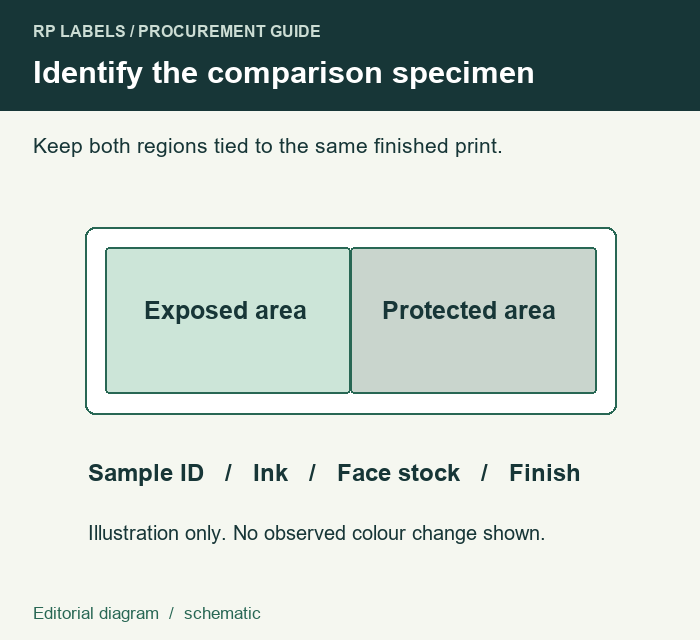
Ask for a comparison that uses a protected region or an identified unexposed reference from the same print construction, consistent with the agreed method. Keep the ink system, face stock, white underprint and finish on the report request. For a visual acceptance decision, identify the critical color, the viewing condition and the owner who decides whether the change is acceptable. For a quantified result, ask for the measure and rating basis before comparing two reports. Keep any separate read or scan requirement on its own acceptance line.
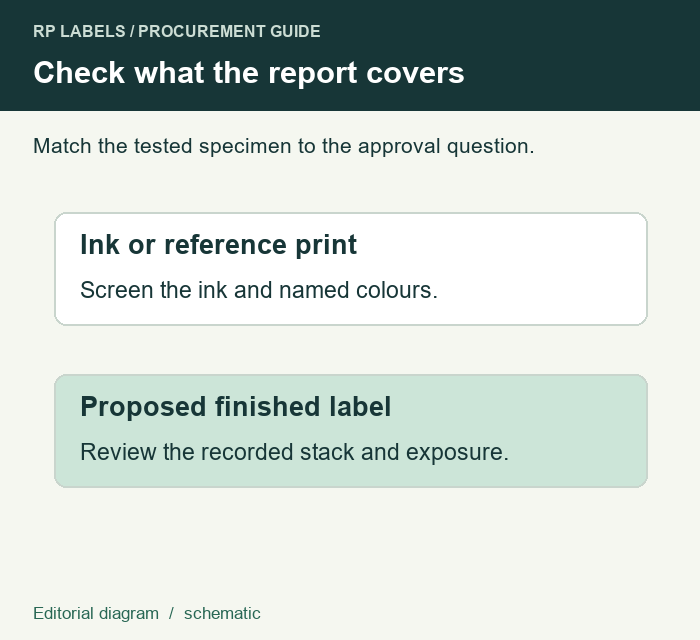
For example, an ink data sheet may provide useful screening evidence for a green brand color. If the finished label uses that ink over a different backing or under a laminate, ask the supplier whether a representative finished specimen and comparison are available. If the report already identifies the approved label stack, check whether it covers the requested color and the expected exposure question. Have the brand and testing party agree how the result will be used before committing the order. Keep the test result and any shelf-life claim as separate decisions. A laboratory exposure result by itself provides no conversion to months at retail.
Include the report reference in your RP Labels inquiry along with the print construction and the specific approval still open.
Put the exposure in the quote request
Send RP Labels the label size, container, artwork and critical colors, expected storage and display environments, whether a barcode or later-printed field must remain readable, and the duration the buyer wants to evaluate. Ask which construction is proposed, what samples or existing evidence are available, and whether a separate test is required. Do not approve a performance claim until its scope and the responsible decision maker are clear.
Sources and scope
Sources accessed November 1, 2026: Xeikon, label lightfastness; Avery Dennison, outdoor durable-label considerations. The exposure scenarios and workflow are editorial examples, not an RP test report, guarantee or customer case. Demand layer: competitor and process pages linked here, including Avery, HERMA or OnlineLabels where cited, illustrate buyer language and process topics only. They do not supply RP minimum quantities, lead times, prices, certifications or materials. Authority layer: an RP number is backed only by a factory datasheet, a signed quote or proforma, confirmed product data, or a fact kept on the About page. The March 2026 proforma there is one production-run example, not a standing offer. RP shipping and planning pages describe what to confirm on a quote. Worked figures on this page are fictional unless an authority source is named for them.