VOID or Destructible Hologram Labels? Compare What Happens on Your Package
We can produce tamper-evident VOID seals for cartons and packing boxes. Whether the VOID message transfers cleanly depends on the packing surface, so we confirm the construction against your actual box or film.
Suppose a buyer has two sample seals on a desk. One peels away with an obvious VOID pattern. The other breaks into small pieces. It is tempting to choose whichever looks harder to remove and finish the purchase order.
The next question matters more: were those samples applied to the same surface as the production pack? A demonstration on a convenient smooth panel leaves the buyer with an unresolved carton, bottle or closure. The attractive sample has moved the decision forward, but it has not finished it.
I would compare removal evidence on identified package samples before choosing between these constructions. The useful result is a recorded observation under agreed conditions, followed by a release decision. It is not a contest to make the largest mess.
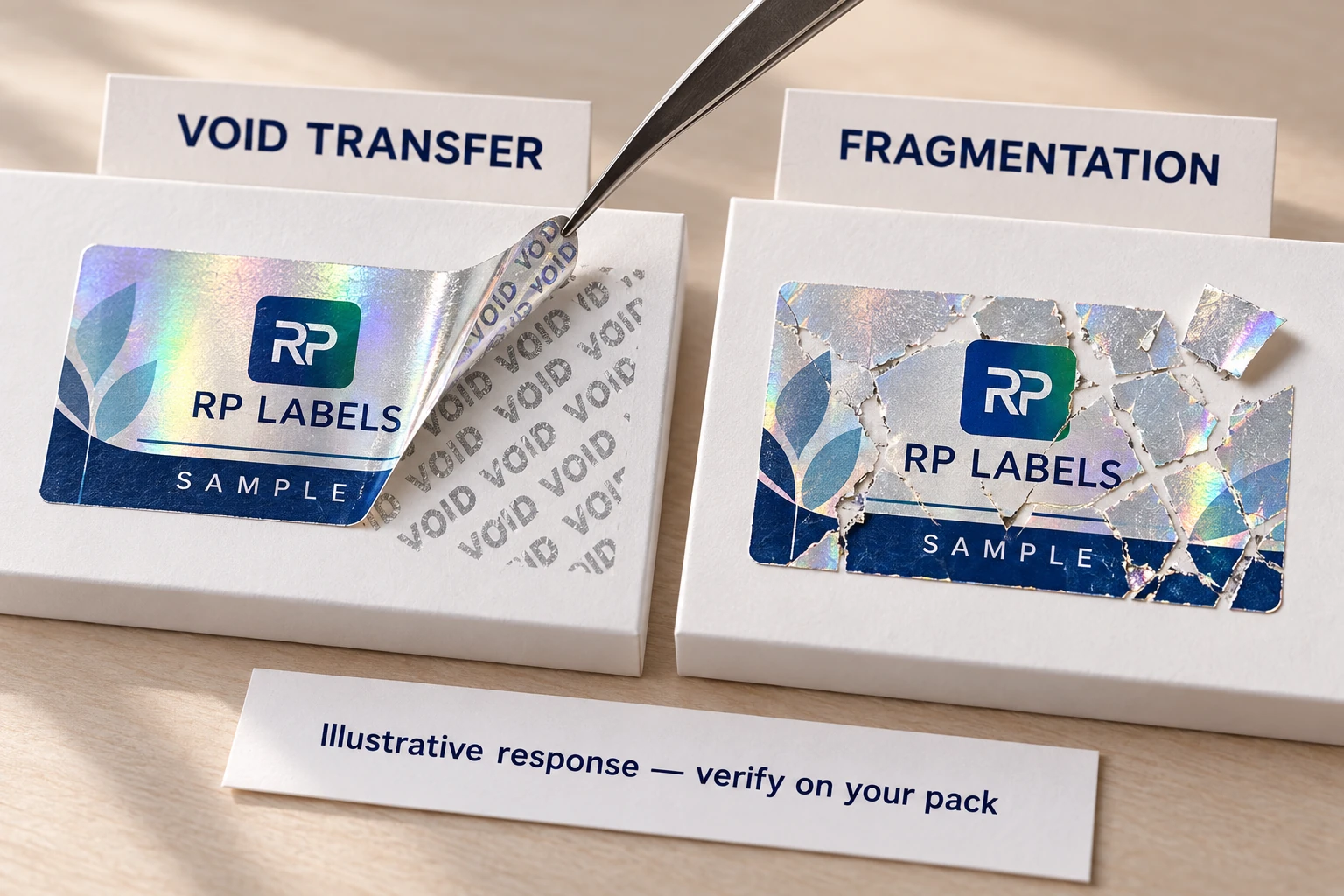
AI-generated packaging illustration of possible response types. It is not an RP test result, material specification or acceptance threshold.
The two names describe different kinds of evidence
A VOID construction is intended to reveal a transfer pattern or other disturbance when removed, according to the particular material design. Confirm where the indication should appear: on the lifted label, the package, or both. Different constructions can leave different amounts of residue.
A destructible construction is intended to lose its integrity during removal rather than lift as one reusable piece. What the buyer observes depends on the specified construction and application. “Destructible” alone does not define fragment size, removal effort or the condition of the underlying pack.
Avery Dennison lists VOID and destructible options within its specialty-label portfolio. That establishes the distinction between approaches, not the behavior of an unspecified RP material. Ask for the actual proposed construction and relevant technical guidance.
A holographic appearance can be incorporated into a design, but it does not settle either response. Keep the optical approval and the removal observation separate in the sample record.
Clarify no-transfer and non-reusable before comparing VOID samples
Ask where the opening message appears and what remains on the package after authorized removal. The word “transfer” can describe residue left on the substrate or reuse of the lifted label. Those meanings can point to different constructions.
For example, 3M describes an identified VOID material as non-transferable in the sense of non-reusable, while also describing a message transferred to the substrate. TamperTech uses no-transfer terminology for its non-residue construction, where the indication appears in the label and adhesive is intended to remain with it. Keep each manufacturer's wording tied to its own material. 3M FMV02 technical data, TamperTech non-residue labels.
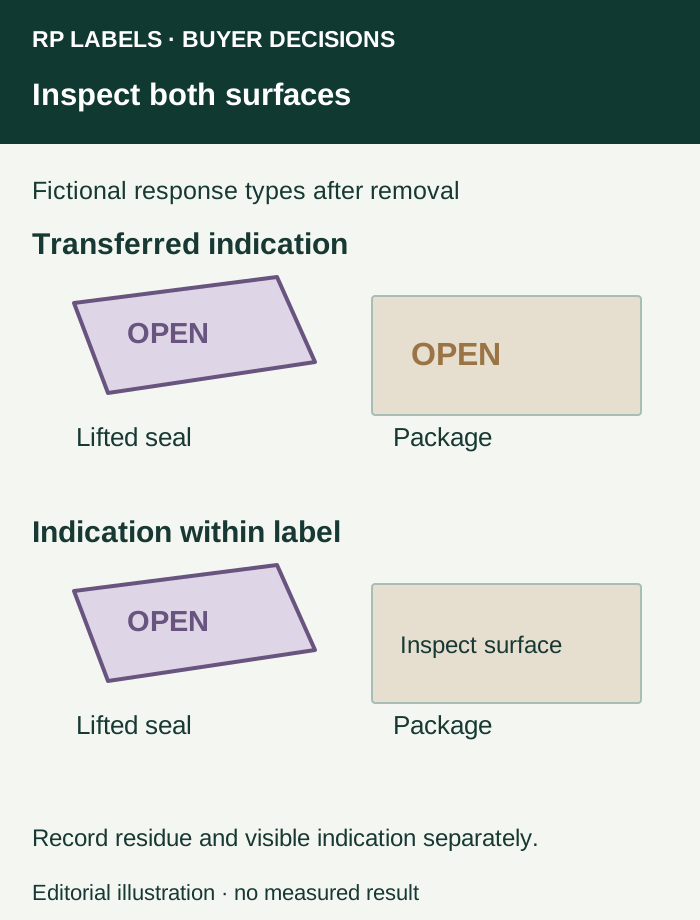
Return a two-surface observation map with the sample request. One field describes the lifted label. Another describes the exposed package. Record the intended message, residue and surface damage separately. For a reusable outer case, a clean surface may matter alongside a visible opening indication. For a disposable carton, an accepted transferred message may be useful to the receiver. Neither requirement establishes that an unnamed candidate will work.
The buyer should compare the actual package finish and application conditions. If a proposal is called non-residue, ask how that result will be assessed on the intended surface. Keep surface cleanliness separate from whether the opening indication remains recognizable. A clean-looking package alone leaves the indication question open.
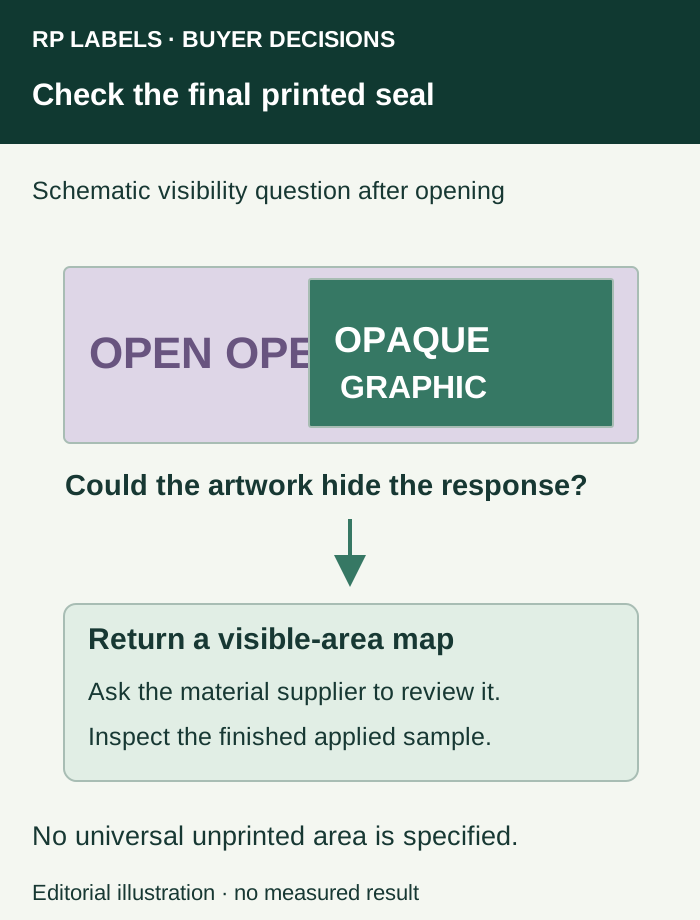
Inspect the final printed seal as well as the base material. Opaque graphics can obscure a response in some constructions. 3M's processing guidance for its 7381/7866 material specifically warns about that possibility. Ask the proposed material supplier to identify any corresponding artwork constraints, then check the actual finished design. The warning does not define a universal open area or establish RP stock. 3M processing guidance.
Add the response map, package-finish reference and final artwork to the existing specimen record when requesting an RP proposal. Ask the supplier to confirm the intended state on both surfaces and relevant use guidance. Keep the accepted construction and sample identity in the order so a terminology difference cannot quietly change the required result.
Start with the opening, then the surface
For a carton seal, show which flap is supposed to move. Position the proposed label across that separation and inspect the routes by which the pack could open. A seal entirely on one panel can remain intact while the intended opening is used.
For a cap and bottle, document the two surfaces and their relative movement. A sample on a flat spare panel will not reproduce the same geometry. Where a real opening involves bending, rotation or an edge, include that action in the agreed sample plan.
Record the package supplier reference and finish. “White carton” is not a useful substitute for an identified coated surface. Include relevant handling or cleaning steps that actually occur. If the sample differs from the production surface, record that limitation before anyone treats the result as transferable.
The feature-selection guide helps decide whether opening evidence is needed at all. Once it is, this physical comparison belongs to the actual pack and the proposed label construction.
Agree the observation before applying the samples
Operations, the package owner and the label supplier should agree what they need to learn. Obtain the proposed material's application and service guidance, then define the conditions relevant to the intended use. Do not borrow a convenient dwell time from a different product and call it a universal requirement.
Record who applied each specimen, when it was applied, the surface preparation, the application conditions and the time before inspection. Record the actual opening or removal action. Photographs should connect the label, the exposed surface and the specimen ID rather than show an unidentified close-up.
The acceptance rule needs the buyer's approval in advance. If the receiver is meant to notice opening evidence during an ordinary incoming check, say how that check is performed and what condition requires escalation. A laboratory-style observation with specialized lighting may not answer the receiver's question.
Unknown guidance is an open point for the material supplier. Unknown package conditions belong with the package or application owner. Leaving these fields open is more useful than entering invented numbers to make the sheet look finished.
When each option deserves to win
Consider two conditional buying situations. In the first, an obvious transferred message would help the receiving team recognize disturbance. If a specified VOID construction gives the agreed result on the actual surface, it may be the clearer choice. The team must also accept the residue and its consequences for authorized handling.
In the second, preventing a seal from being lifted as one intact piece is central to the brief. A suitable fragile construction may be preferable if the samples support that result. But fragments can add cleanup work, and damage during normal application would create a different problem.
Neither situation gives a universal winner. If legitimate service requires routine clean opening and reclosure, reconsider the package workflow. A permanent opening indicator and a convenient reusable closure are different assignments. Do not solve the conflict by describing an untested material as doing both.
Also watch for the pack failing before the chosen response can be interpreted. Damage to a carton coating may obscure what happened to the label. Photograph and report that outcome; do not rewrite it as an automatic pass for the seal.
Make the sample comparison traceable
Use the worked specimen record, blank record and field guide. The example contains two proposed specimen rows and deliberately contains no fabricated observation or approval.
Each row ties a candidate label construction to a package reference, opening action and planned observation. The response, image reference, deviations and release decision stay separate. That lets the buyer distinguish “a sample was requested” from “this particular combination was observed and accepted.”
If the two candidates were applied under materially different conditions, do not rank them from the photographs alone. Resolve the difference or repeat the relevant comparison. If neither candidate provides interpretable evidence on the intended pack, keep the decision open and discuss another construction or seal location.
For a quotation, send RP Labels the package reference and sample plan, seal size, quantity, opening photograph and desired evidence. Ask for the proposed construction and any application guidance needed to evaluate it. The order should name the accepted combination and its evidence, so the next roll is buying the same decision rather than the same material nickname.
Sources and scope
Demand layer: competitor and process pages linked here, including Avery, HERMA or OnlineLabels where cited, illustrate buyer language and process topics only. They do not supply RP minimum quantities, lead times, prices, certifications or materials. Authority layer: an RP number is backed only by a factory datasheet, a signed quote or proforma, confirmed product data, or a fact kept on the About page. The March 2026 proforma there is one production-run example, not a standing offer. RP shipping and planning pages describe what to confirm on a quote. Worked figures on this page are fictional unless an authority source is named for them.