Decorative or Security Hologram Labels? Give the Feature a Job Before You Buy It
Imagine a supplement launch with two people reviewing the same hologram sample. The designer tilts it toward the light and likes the color. The operations buyer wants to know what happens when someone opens the carton. Both are asking sensible questions. They are approving different things.
If the purchase order says only “custom security hologram,” that disagreement can survive all the way to delivery. A beautiful label can satisfy the artwork approval while leaving the opening question unanswered. The printer needs a defined job, and the buyer needs evidence that belongs to that job.
I would settle that before comparing the price of more elaborate patterns. A feature earns its place when somebody can explain what they will inspect and what they will do with the result.
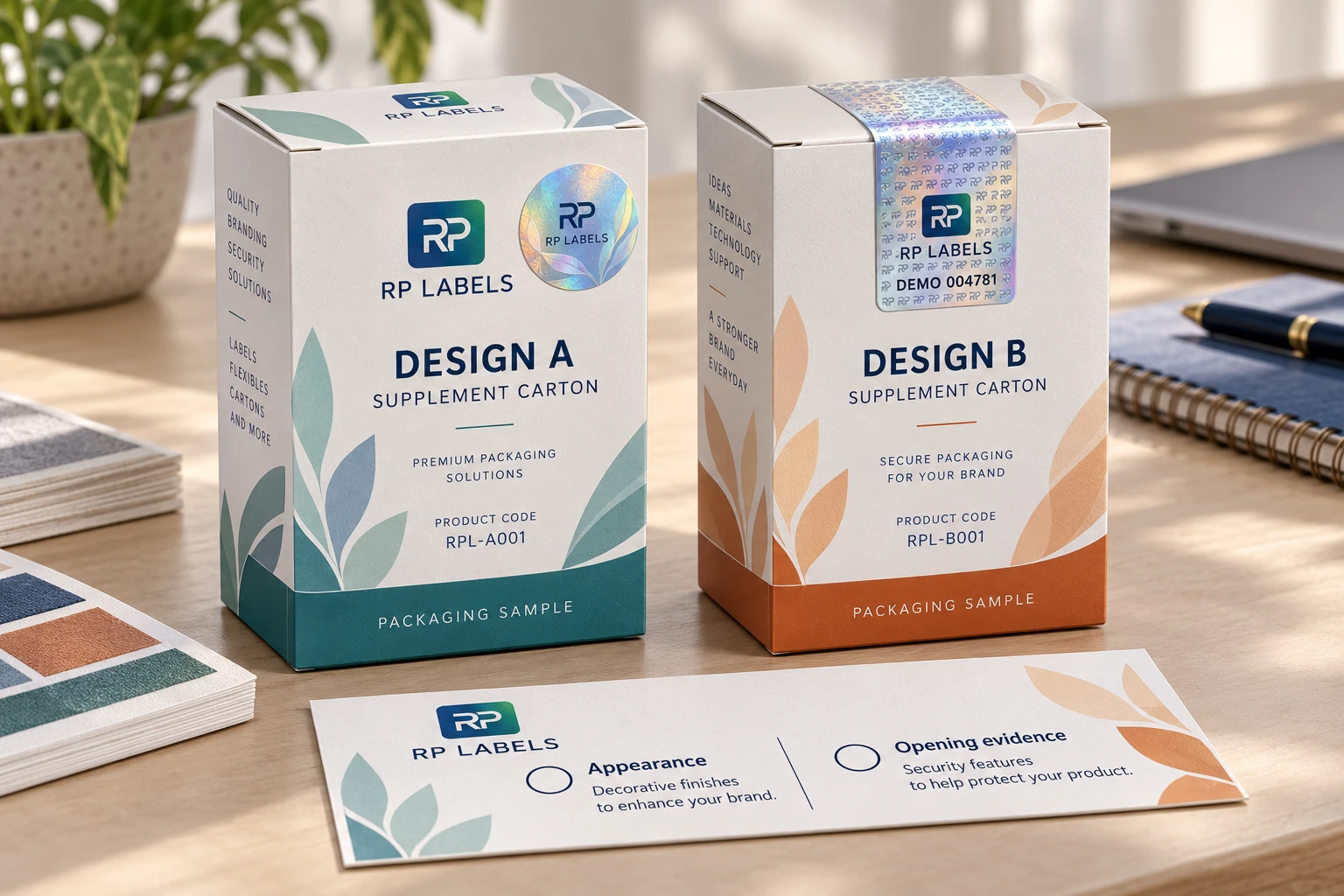
AI-generated packaging illustration. Sample layouts demonstrate feature placement; they are not evidence of tested opening behavior or product authenticity.
When appearance is the whole assignment
Consider a limited promotional carton whose brief is to catch the light beside ordinary printed packs. The buyer does not require an opening indicator or a consumer verification service. A decorative holographic finish can be a reasonable winner here.
The useful approval concerns the actual design: visible color movement, logo readability, coverage, placement and consistency against the accepted sample. Compare the effect on the intended carton under ordinary viewing conditions. An attractive close-up on a screen does not settle whether small dark lettering stays readable on a moving reflective background.
Do not quietly upgrade that approval into a security claim. A rainbow surface is an appearance property. The label may have other specified features, but those need their own evidence. Paying for serialization when nobody will maintain item records can create a second project without improving this first one.
That is a fair reason to choose the simpler quotation. It is also a reason to remove promises the pack cannot support.
Opening evidence changes the placement decision
Now change the hypothetical brief. The receiving team must notice whether a particular carton flap has been lifted before acceptance. A decorative badge on the front panel does not cross that opening. Even an excellent removal response would answer the wrong question there.
Start with a photograph of the actual opening path. Identify which panels separate and whether the package can be opened another way. Then propose a seal location and an observable response to investigate on samples. The response might involve transfer evidence or a fragile construction, depending on the selected material and surface. This overview does not choose a material from its name.
Give the inspection to a named function. A warehouse receiver may need an obvious condition visible without equipment. A trained investigator may work with an approved reference and a different inspection method. If neither person knows what a normal and disturbed specimen should look like, adding finer artwork will not resolve the missing instruction.
Use the VOID-versus-destructible comparison when the question becomes which removal behavior suits that surface. Keep that detailed sample decision separate from the broader decision to require opening evidence at all.
Recognition needs a reference someone can actually use
A custom optical design can provide a feature for comparison. The purchasing question is who will recognize it, using what reference, in what setting. A detail intended for magnified inspection cannot do the same job as a prominent feature a consumer is expected to recognize quickly.
Ask the proposed supplier to identify the feature and demonstrate its intended inspection method on a representative sample. Record what is being compared and who controls the reference. Distinguish the visible layout proof from whatever additional sample or process evidence has been agreed. A rendered proof establishes neither optical performance nor resistance to imitation.
The manufacturer KURZ describes decorative effects and several optical and digital label features. That supports treating them as different design choices. It does not establish that an RP sample contains every listed technology, or that any individual feature makes copying impossible.
A number is useful only if its record has a purpose
An individual identifier can connect a label to an item record. It does not create the record, maintain a destination or decide what a repeated scan means.
If the assignment is simply to open one instruction page, a shared QR destination may be sufficient. If the assignment is to handle item-level status, agree the identifier source, the service owner and the response before requesting variable printing. The static-versus-unique QR guide covers that scope decision.
This is where an apparently cheaper printing offer can become a more expensive overall choice: two quotes may include the same-looking code area while only one has described the data handoff. Conversely, an established buyer-owned system may already supply what is needed. Purchasing a second platform would then deserve a clear reason.
Put the requirement beside its evidence
The worked feature brief, blank version and filling guide turn these distinctions into a request a supplier can answer. The worked rows are proposed planning decisions, with approvals deliberately left open.
For example, the appearance row asks the design owner to compare the proposed finish with an accepted physical reference. The opening row identifies the carton flap and asks operations to define the observed response needed on the actual surface. The identifier row is deferred because the hypothetical brief has no item-status workflow. Deferring it is a decision, rather than an accidental omission.
Fill in the intended check first. Then ask the supplier to state the proposed construction or feature, what evidence they can provide, and what remains outside the quote. Do not mark “approved” because a row has been completed. The evidence reference and release decision are separate fields for a reason.
If the only approved need is appearance, buy a finish that meets the visual brief. If opening evidence is required, hold that part open until the application and inspection are defined. If item-level checking is required, scope its ongoing operation as well as the printed label.
For an RP Labels inquiry, send the feature brief with the package and opening photographs, proposed seal size, quantity and the person who will inspect it. Ask which print and sample scope can be quoted against those requirements. That gives both sides something more useful to approve than the word “security.”