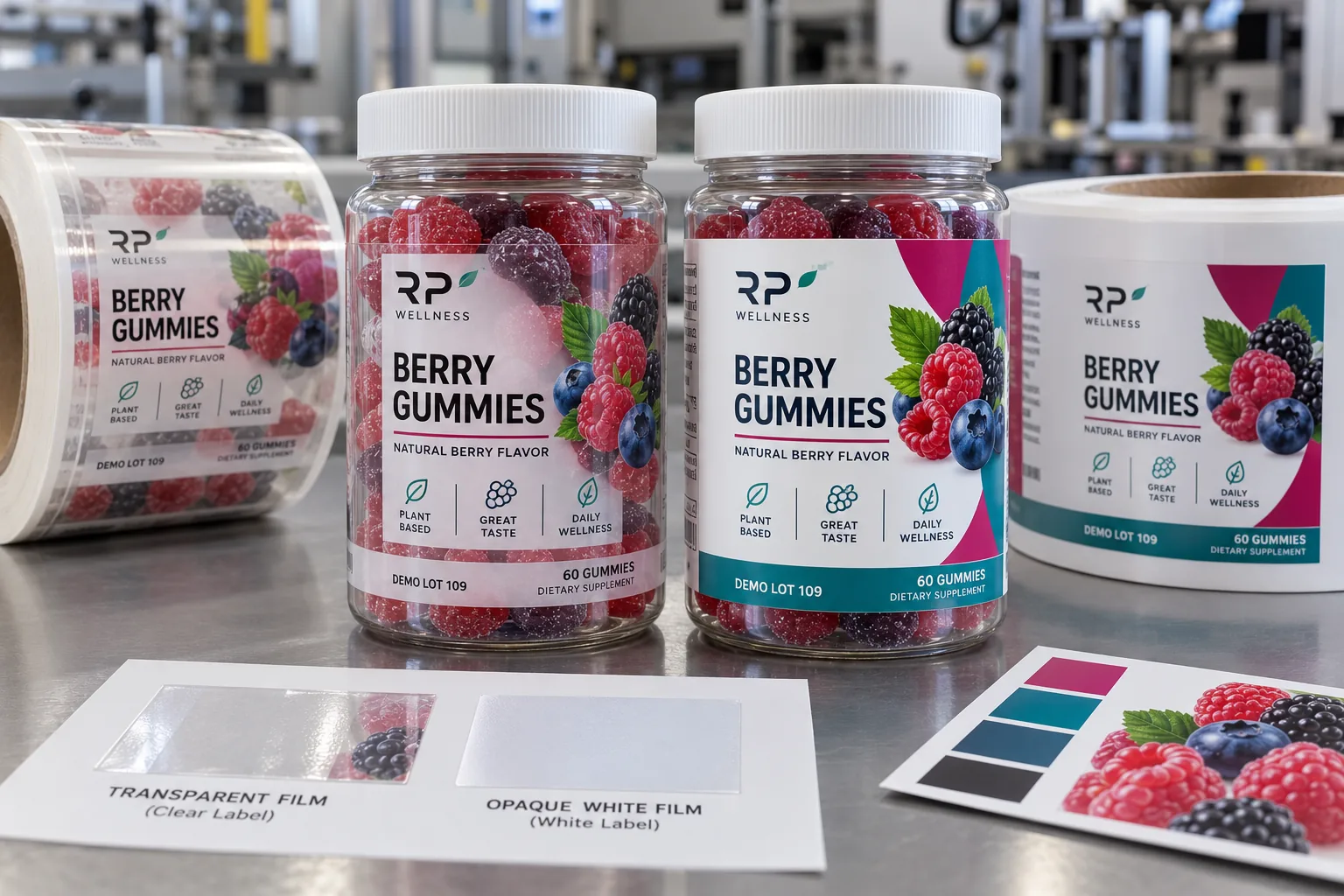
The clear gummy jar looks persuasive before artwork: you can see the fruit colors, the jar looks lighter, and a transparent label seems almost invisible. Then the first proof goes on a filled jar and the small ingredient line sits over a dark berry. I would pause the order there. Transparency is useful only when the product remains the hero and the information stays readable under changing fill levels.
The two RP Wellness jars shown above are AI-generated material concepts, not approved retail labels. The berry art, icons, product statements and DEMO lot are fictional. Test the actual jar and product; a generated image cannot prove print contrast or regulatory compliance.
Choose which part should be transparent
A label does not need to be entirely clear to offer a see-through effect. Reserve a window where the contents are attractive and put critical copy on an opaque or white-backed zone. A transparent film with printed white under the main name is one possible approach; a fully opaque printed film is another. Avery Dennison describes clear and white polypropylene film labels for rigid packaging. That identifies available constructions, not a universal recommendation for gummies or a guarantee that a particular printer can lay down enough white ink.
Ask the converter to show a finished proof on the exact clear jar, half full and full. Place red, purple and pale gummies behind the printed text. The background is moving product, not a controlled white page. If the name disappears when darker pieces settle behind it, add a backing panel or change the art.
Give required information its own stable surface
For US dietary supplements, the FDA dietary supplement labeling guide explains the required statement types and their placement. Your regulatory reviewer must approve the real product's content and layout. I would not place dense information over a transparent view of the gummies and hope the product itself becomes a reliable background.
Use a neutral or opaque field for the facts panel, ingredient list and variable information where needed. Check whether the jar has a front panel and an information panel in the usual orientation. The opaque-panel proof guide addresses the broader principle: decorative background and legible technical copy are different jobs. Also keep the lid and body artwork paired by SKU so one is not revised without the other.
Do not confuse label invisibility with adhesive invisibility
On clear plastic, trapped air, moisture or slight jar texture can make the label edge visible. A clear facestock may show every bubble that an opaque label would hide. Compare the printed samples under ordinary shelf light and against a dark background, not only against a white photo sweep. Make sure the actual packaging line can apply the label smoothly enough to support the intended look.
The opaque version is less dramatic, but it can be easier to keep copy consistent across different gummy colors or formula changes. I would favor the opaque route when SKU variants have very different contents behind the label, or when the information panel needs more reliable contrast than the clear design can supply.
What I would approve
Send a filled jar, cap, current artwork, ingredient and facts copy after regulatory review, variant list and application method. Ask for clear-film and opaque-film samples in the finished dimensions. Judge the front at shelf distance and the information panel at normal reading distance. Shake the jar, rotate it and check the darkest gummy color behind every line of type. A successful proof makes the contents visible where that helps and the copy stable where that matters.
Sources and scope
Reviewed October 9, 2026. The primary references linked below support the identified technical points. Buying scenarios and inspection checklists are editorial guidance, not RP production records, certification, legal approval or universal acceptance standards. Demand layer: competitor and process pages linked here, including Avery, HERMA or OnlineLabels where cited, illustrate buyer language and process topics only. They do not supply RP minimum quantities, lead times, prices, certifications or materials. Authority layer: an RP number is backed only by a factory datasheet, a signed quote or proforma, confirmed product data, or a fact kept on the About page. The March 2026 proforma there is one production-run example, not a standing offer. RP shipping and planning pages describe what to confirm on a quote. Worked figures on this page are fictional unless an authority source is named for them.