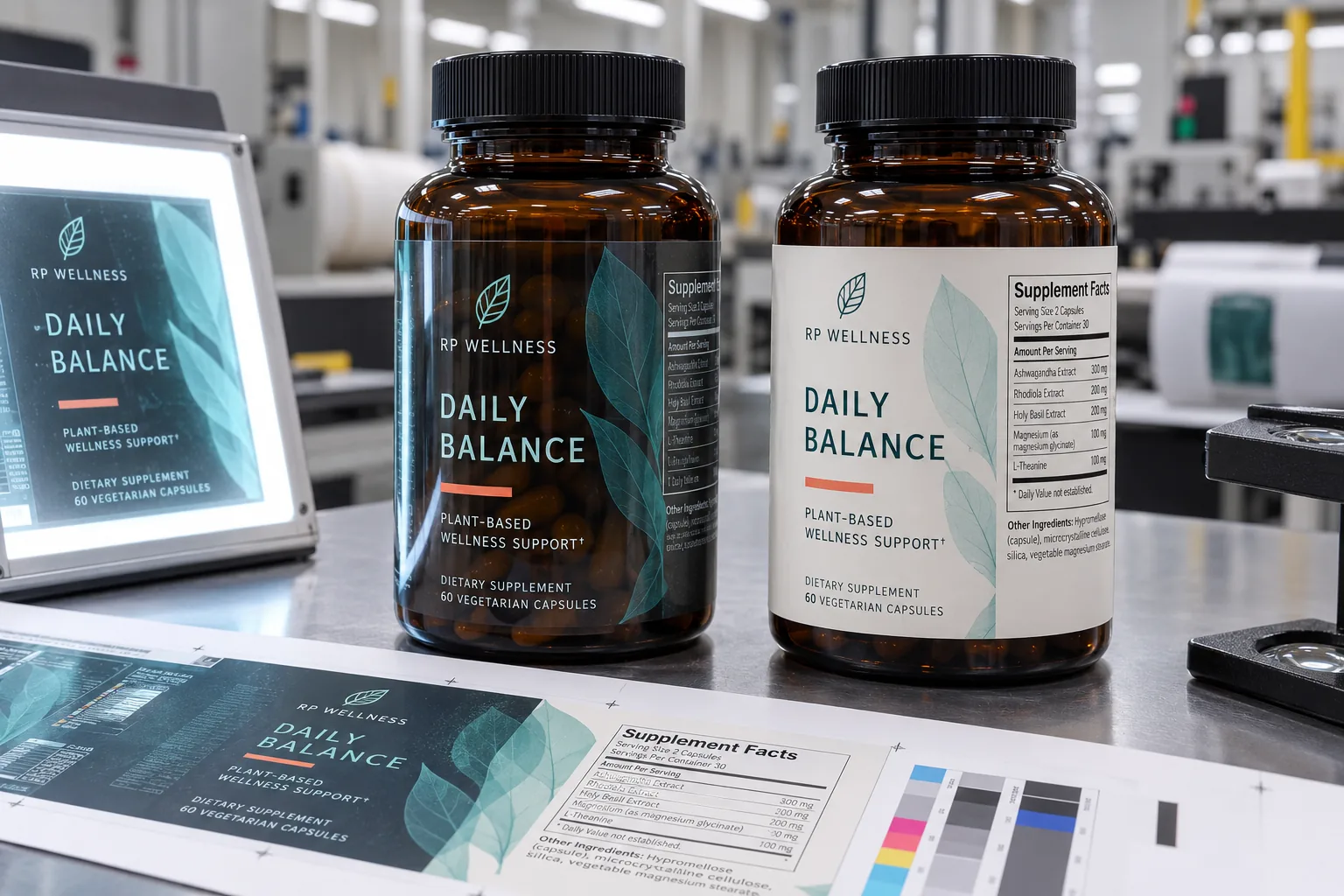
Clear film on amber glass can look expensive. The leaf icon and large product name may remain attractive while the small information panel disappears into the brown bottle. If I were choosing this construction, I would ask to see the Supplement Facts at normal reading distance before discussing whether the front has enough of a "no-label" look.
That is not an argument against transparent labels. It is an argument for using transparency where it helps and an opaque, neutral backing where dense required copy needs contrast. The actual bottle color, fill, lighting, ink and white-underprint all affect the result. A flat proof on white paper does not show that combination.
Keep the Facts area different design problem
FDA's Supplement Facts guide describes an easy-to-read style and calls for black or one-color type on a white or neutral contrasting background whenever practical, along with detailed format and type requirements. Its general labeling guide also says lettering must contrast sufficiently with the background. Final compliance belongs to the product's regulatory reviewer, but the print buyer should reserve a legible physical panel.
On an amber bottle, ask the designer to draw the Facts panel as its own zone, not to float it over the same transparent decorative film used on the front. A white-ink underlayer, opaque face stock or separate back label may all be candidates. The choice changes cost, appearance and sometimes application setup. Quote comparable constructions rather than comparing a transparent front-only sample with a full opaque wrap.
Test the filled bottle and the worst copy
A clear empty bottle can look lighter than one filled with dark capsules or powder. Put the real or representative fill behind the label, close the bottle and view it under warehouse and retail-like light. Bring the longest ingredients and the densest actual approved Facts panel. Photograph the result without boosting contrast in editing software. If staff have to rotate the bottle into a narrow light angle to read it, the proof is not doing its job.
Avery Dennison describes clear-on-clear film options for rigid packaging and emphasizes converting and application as well as appearance. That shows why the transparent construction deserves a real trial. It is not a guarantee that the printed RP Wellness design in the illustration meets U.S. supplement-label requirements.
Watch the seam and the white layer
On a cylindrical bottle, a fully wrapped information panel may approach the seam. Keep the Facts rules and small copy away from any overlap or gap. If the opacity is created with white ink, ask for a printed proof showing its registration behind the text. A slight miss may leave a dark halo or a line of text crossing from light backing onto brown glass. A separate back label can avoid that problem, but only if the application line can place both labels consistently.
Our two-bottle image is an AI-generated contrast comparison. Its ingredients, quantities and benefit language are fictional. Use the image to discuss construction, not as a nutrition template. The real proof must use the brand's approved content and must be reviewed at finished size.
The order brief I would send
Provide the exact amber bottle, fill color, label dieline, final text, information-panel dimensions, desired front transparency, proposed backing method and application process. Ask for an applied sample of the transparent option and the opaque-panel alternative. Record which one remained readable in the actual viewing condition and why.
I would take a slightly less invisible back panel over a gorgeous label that hides the information a buyer needs. The design can still feel premium when the brand and the required copy each get the surface they deserve.
Sources and scope
Reviewed October 6, 2026. The primary references linked below support the identified technical points. Buying scenarios and inspection checklists are editorial guidance, not RP production records, certification, legal approval or universal acceptance standards. Demand layer: competitor and process pages linked here, including Avery, HERMA or OnlineLabels where cited, illustrate buyer language and process topics only. They do not supply RP minimum quantities, lead times, prices, certifications or materials. Authority layer: an RP number is backed only by a factory datasheet, a signed quote or proforma, confirmed product data, or a fact kept on the About page. The March 2026 proforma there is one production-run example, not a standing offer. RP shipping and planning pages describe what to confirm on a quote. Worked figures on this page are fictional unless an authority source is named for them.