Cold Storage Vial Labels: Record the Whole Application-to-Return Cycle
We can produce labels intended for peptide vials stored in -80°C freezers. Cryogenic or deep-freeze use is a special construction: it is specified after we know the temperature, how long the vial stays frozen, and any solvents or wipe-down chemicals. This page does not publish a generic adhesive rating or certification. A test application is recommended before mass production.
A buyer asks for a label that tolerates the freezer. The vial is actually labeled at another temperature, packed after a short wait, removed for handling and returned to storage. That is one possible workflow, not a reported customer test. It explains why the lowest temperature alone cannot define the label order: the label must work through the transitions too.
The buyer would like one temperature rating to settle the order. The person handling the tray knows that the vials do not stay in one place. I would ask that person to walk through a normal cycle with an empty representative container. Where it is labeled, how long it waits and when it is handled tell the supplier more than the freezer setting on its own.
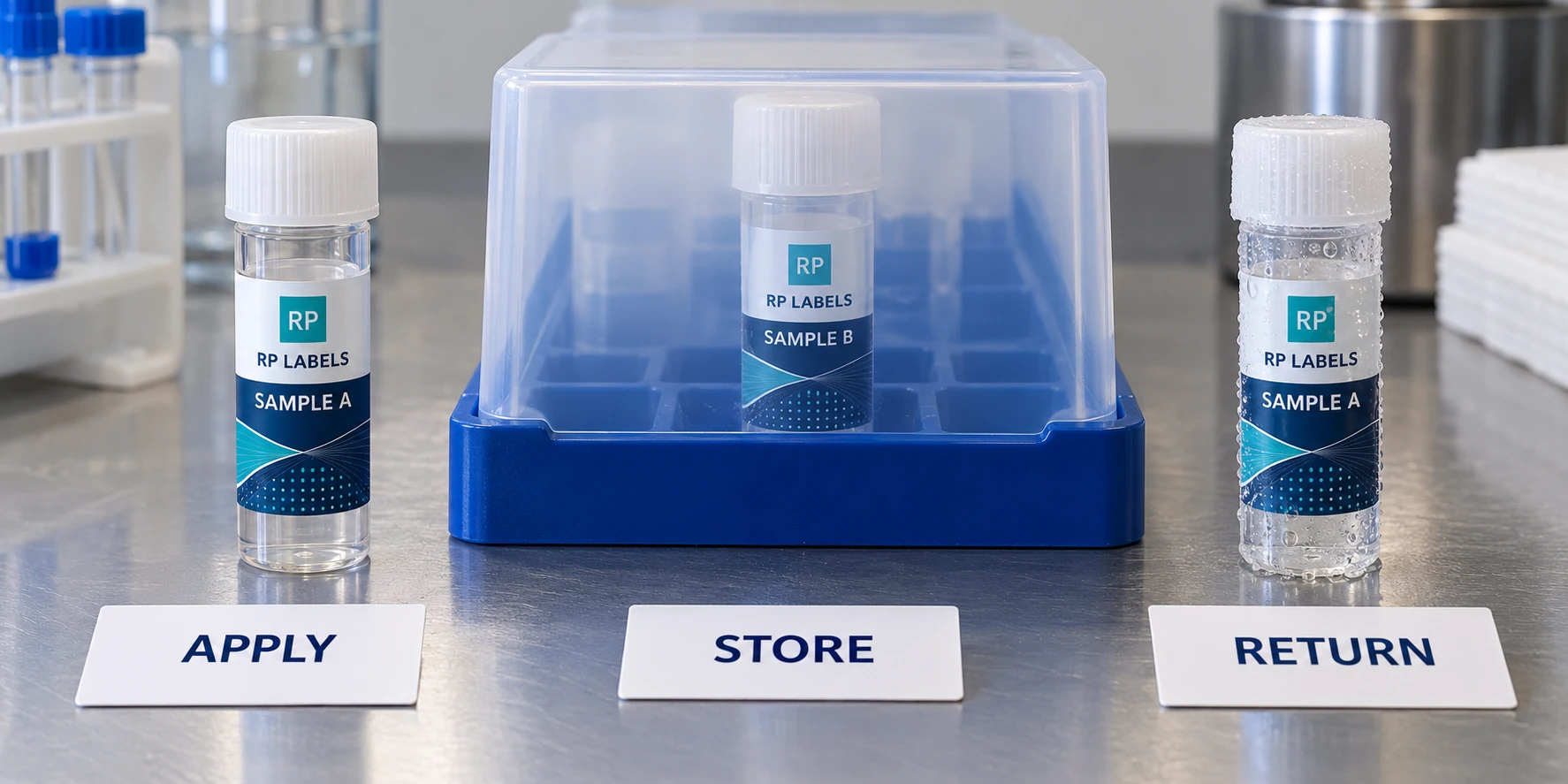
AI-generated packaging illustration. Fictional RP samples show the proposed decision; no physical test or customer order is documented.
Turn the route into observations a reviewer can use
Ask the person running the process to draw the sequence from label application to the last relevant handling step. For each stage, record the container condition, the intended duration and what happens next. Use actual operating information; do not borrow a dwell period or temperature from an unrelated product sheet. The label supplier then identifies whether the proposed construction has relevant guidance and where a physical trial is still needed.
The worked plan has three stages: application, storage and return to the working environment. Its result cells are deliberately empty. They are places for observations, not a suggestion that a test has already passed. At each stage, identify the same specimen and note the edge, fixed print, later-added data and scan function where applicable. A photograph of an intact logo does not show that the later identifier remains usable.
If an edge lifts only after return, preserve the sequence instead of reporting simply failed in freezer. The cause could involve moisture, time before cooling, construction stiffness or another process difference. A comparison should change one defined factor where practical and keep the rest visible. The responsible technical owner decides the method and acceptance conditions.
A stable route with applicable prior evidence may justify retaining a qualified construction. A new cold-apply step or a different return cycle changes the question even if the minimum storage temperature stays the same. This guide is about that sequence; the separate water-exposure guide addresses defining moisture contact.
Send the proposed sequence, exact vial, label size, print layers and quantity with the inquiry. Ask which complete construction can be sampled against it and which conditions remain outside the evidence. A precise limitation is more useful than an unqualified freezer-safe promise.
Application temperature and service temperature are different
Application temperature is the temperature of the vial and surrounding area when the label first touches the surface. Service temperature is the range the label experiences after it has formed a bond. A construction may tolerate cold storage after application but still struggle when placed directly onto a chilled, damp or frosted bottle. Tell the printer both conditions instead of giving only a freezer temperature.
| Apply warm, store cold | The label can bond to a clean, dry surface before cooling. Confirm how much dwell time is available before storage. |
|---|---|
| Apply to a chilled vial | Condensation and reduced initial tack become central risks. The supplier needs the actual surface temperature. |
| Repeated warm-cold cycles | Expansion, moisture and handling can stress edges. Include the full cycle in the sample test. |
| Deep-freeze or cryogenic use | This is a specialist specification. Do not assume a normal BOPP product label is suitable without documented material data and testing. |
Condensation often causes the failure before the cold does
A thin moisture film prevents a pressure-sensitive adhesive from making full contact with glass. The label may appear secure at first, then slide, curl or release at the closing edge. Keep vials clean and dry during application whenever the process allows. If labels must be applied to cold containers, state that clearly so a cold-apply option can be evaluated.
Small diameters need a conformable construction
A stiff label naturally wants to return to a flat shape. On a small vial, that force concentrates at the two vertical edges. A thinner film, suitable adhesive, controlled label width and rounded corners can reduce edge stress. A heavy laminate may improve surface protection but also make the finished label less willing to remain wrapped, so evaluate the complete construction rather than the face material alone.
Protect the print as well as the bond
Cold handling can add moisture, rubbing and contact with cleaning liquids. Ask whether the printed surface needs lamination or another protective finish. Thermal variable data has a different durability profile from factory-printed color, so test every printed layer that will carry a batch, date, code or QR field. A label that stays attached but loses readable data has still failed.
Worked cold cycle plan record
The rows below are hypothetical planning examples. Empty observation or commercial fields must be completed from the actual project; no sample has been tested for this article. Use the worked CSV and blank worksheet with the field guide. Keep the example references separate from production records.
| specimen reference | stage | surface condition | temperature and duration | next action | edge observation | data observation | decision owner |
|---|---|---|---|---|---|---|---|
| DEMO-A | Apply | Actual dry/damp state to record | Actual process values required | Wait then store | Process owner | ||
| DEMO-A | Store | Actual environment to record | Actual range and duration required | Return to work area | Process owner | ||
| DEMO-A | Return | Record condensation if present | Actual time and conditions required | Handle or restorage | Technical reviewer |
Bring this decision into the print inquiry
Contact RP Labels with the completed cold cycle plan record, the actual packaging reference, approved artwork and quantity per design. State which fields remain unresolved so the print specification and any relevant sample scope can be discussed against the same decision.
Related buying guidance: Custom peptide vial labels; Waterproof peptide vial labels; Vial label adhesive and edge lift guide; Peptide vial label size chart.