Waterproof Vial Labels: Define the Water Contact Before Choosing Film
Two buyers ask for waterproof vial labels. One needs occasional droplets wiped from an already labeled vial. The other wants to apply labels while containers are damp. These are conditional examples, but they lead to different sample questions. Buying a film face does not settle either workflow by itself.
A buyer who only wipes occasional droplets may reasonably prefer a simpler qualified construction. Another workflow may need labeling while the surface is already damp. I would not make the first buyer pay for a demanding condition they do not have, or let the second buy a dry-application answer by accident. Put the water into the process description before it enters the sample trial.
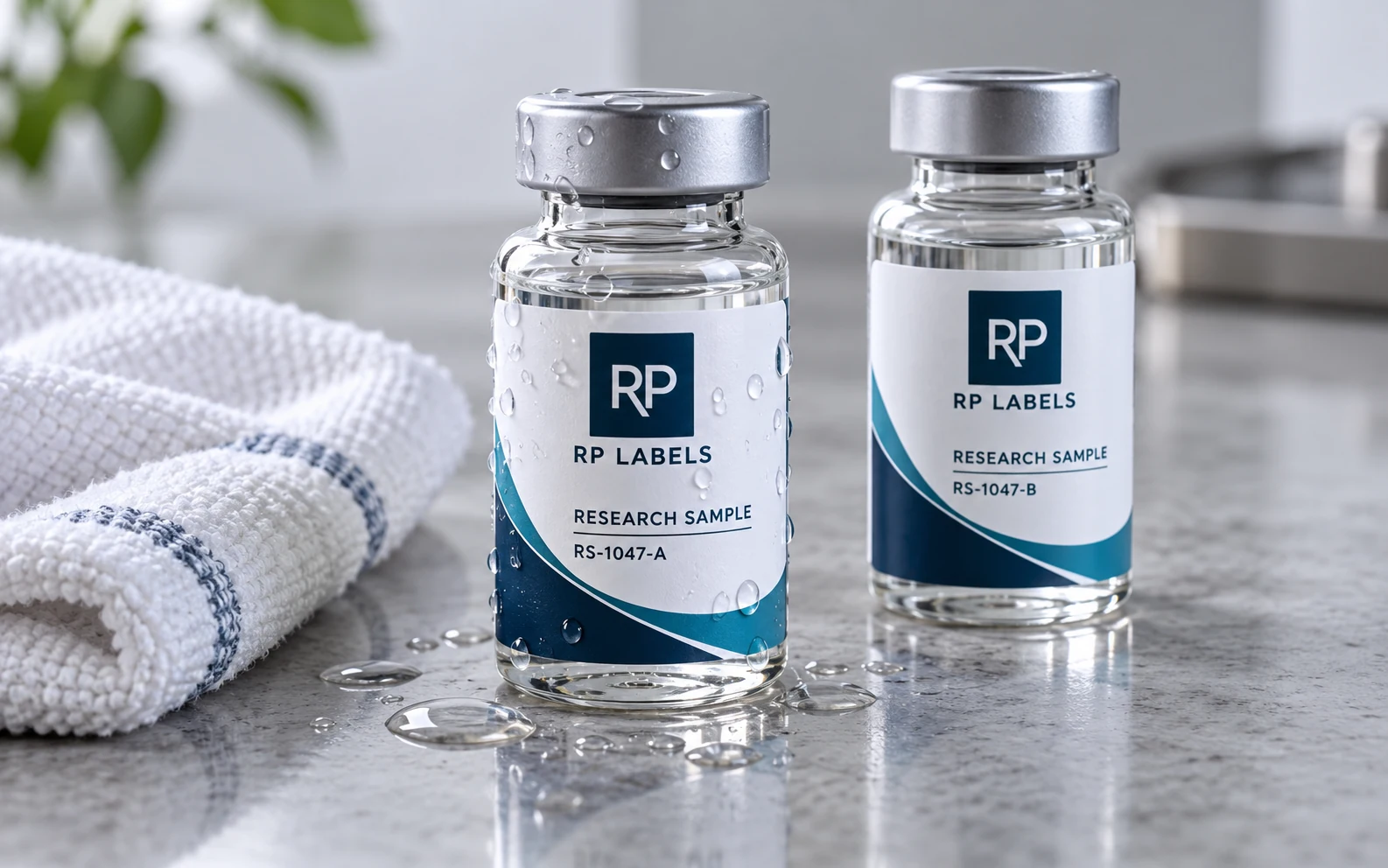
AI-generated packaging illustration. Fictional RP samples show the proposed decision; no physical test or customer order is documented.
Describe the exposure without turning it into a universal claim
Start with when the water appears. Is it present during application, after the adhesive has had the intended bonding time, during storage or during handling? Then describe contact: droplets, splash, a wet outer pack or another actual condition. If immersion is relevant, state it explicitly; do not let a splash-oriented sample become evidence for continuous submersion.
The example record compares an already-applied label exposed to droplets with a separate damp-application question. It does not rank materials or claim a successful result. For each candidate, identify face, adhesive, print and protective finish. Later-applied ink or handwriting belongs in the record too if it carries information that must survive.
Inspect both during the relevant exposure and after the planned handling step. Record edge lift, whitening, sliding, surface damage and identifier readability separately. A construction can remain attached yet become difficult to read; it can also retain sharp print while losing contact at the seam. Keeping those observations separate gives the supplier a useful next question.
A dry workflow may not need the same construction or trial as a repeatedly wetted one. Conversely, repeated cold-to-warm transitions deserve the fuller temperature sequence in the cold-storage guide. Keep this water-contact decision narrow instead of claiming that one worksheet covers all cleaners, oils and temperatures.
Send the actual vial, exposure description, application state, later marking and quantities to RP Labels. Ask for identified candidate constructions and a relevant sample plan. The purchasing objective is a label that suits the stated contact, with its limits understood, rather than the broadest adjective on a quotation.
Give clear-label haze a separate approval check
For a clear window, define the acceptable view at the point when someone has to read the vial. The same vial can have droplets on the outside, a cloudy area beneath the film or a loss of contact near the edge. Ask the sample reviewer to record where each change appears and whether the intended information remains readable. Adhesion and the appearance of the window need separate observations.
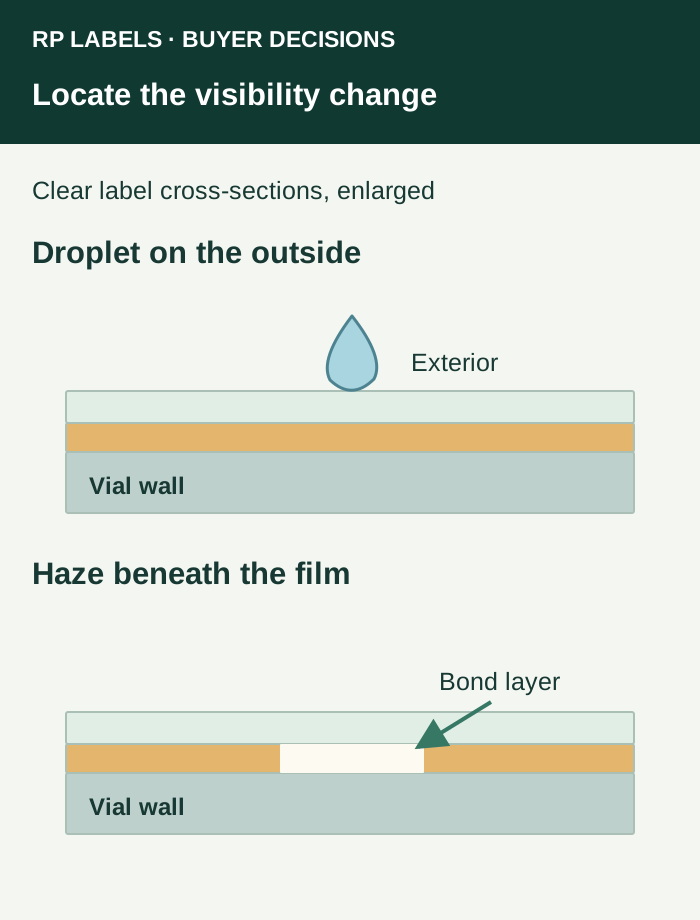
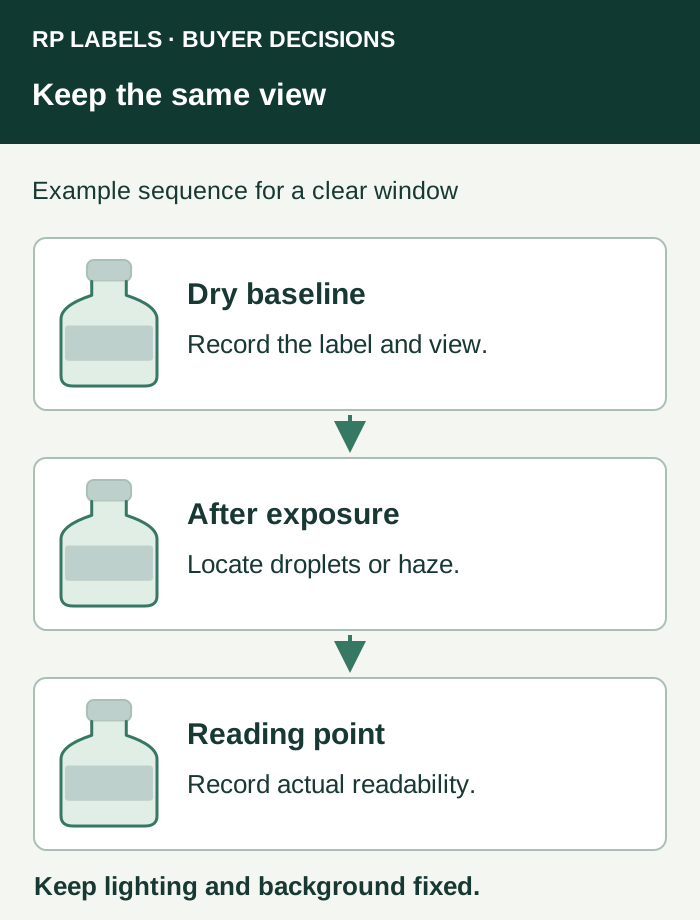
Use matching sample vials and record the label construction and application state. Capture a dry reference under fixed lighting and background. Compare the same view after the actual agreed exposure. When the procedure allows removal of external droplets, record the view again afterward and at the agreed reading point. A change that clears when droplets are removed gives the team a different question from haze that remains in the applied label. Ask the material supplier to examine persistent haze alongside wet-out, trapped air and the moisture history.
Avery Dennison describes moisture-related cloudiness for a particular clear adhesive system. Use that example to ask about clarity in the proposed construction on the actual vial. Establish recovery time and acceptable visibility from the relevant sample evidence. Avery Dennison CleanFlake guide for PET containers.
If the clear window remains important, compare candidates under the same conditions. If the essential information can sit on an opaque area, review the white ink plan while retaining a clear window where it serves the package. Give RP the dry and exposed views, timing, vial reference and exact zone that must remain readable.
What waterproof should mean for vial labels
For small research bottle packaging, waterproof label planning should consider the label face, adhesive and printed surface. A waterproof film face is helpful, but the label can still fail if the adhesive is not suited to the bottle surface or if the print is not protected from rubbing.
Ask about the real handling condition: dry shelf display, refrigerated storage, ice pack shipping, frequent hand contact, alcohol wipe contact or oily fingers. These details change the material choice.
Material comparison for small vial labels
| White BOPP | A common choice for waterproof bottle labels. It gives strong print contrast and works well for small text, color bands and batch fields. |
|---|---|
| Clear film | Good for a clean no-label look, but text contrast needs careful proofing. White ink or bold dark text may be needed. |
| PET film | A durable option for buyers who want stronger film performance and a premium feel. It is useful when the label must look crisp on small bottles. |
| Holographic film | Useful for premium packaging or brand protection. Avoid weak gray text because the reflective background can reduce readability. |
| Paper label | Better for dry boxes or short-term uses. It is usually not the first choice for damp bottle handling. |
Cold handling is different from simple water resistance
Moisture can form on a cold bottle when it moves into a warmer room. That surface moisture can attack the label edge and make weak adhesives show quickly. If the bottle may be refrigerated or shipped with cold packs, tell the supplier before the proof is prepared.
A good production discussion should cover bottle material, expected temperature range, whether the bottle is labeled before or after filling, and whether the bottle surface may be wet during application.
Surface finish affects readability
Gloss lamination gives shine and can make colors feel brighter. Matte lamination reduces glare and often makes small text feel more controlled. For tiny vial labels, the finish should be chosen around readability first, not only appearance.
If you want a luxury look, combine premium material with a simple layout. A crowded holographic label can look less professional than a clean white BOPP label with strong color coding.
When to choose waterproof plus oil-resistant labels
If bottles will be handled often, packed by hand or exposed to skincare oils, cleaning residue or general warehouse handling, ask for oil-resistant surface protection. This does not mean every chemical is covered. It means the material and surface finish should be discussed honestly before production.
Practical recommendation
For most custom peptide vial label projects, start with waterproof film material, strong text contrast and a layout proof at the real label size. Use matte or gloss lamination based on the brand look and readability. If cold handling or moisture exposure is expected, share that information before sampling.
Worked water exposure scope record
The rows below are hypothetical planning examples. Empty observation or commercial fields must be completed from the actual project; no sample has been tested for this article. Use the worked CSV and blank worksheet with the field guide. Keep the example references separate from production records.
| candidate reference | water contact | when contact occurs | application surface | finished construction | edge result | print result | next decision |
|---|---|---|---|---|---|---|---|
| DEMO-A | Droplets; actual duration to define | After application and agreed dwell | Dry in this example | Supplier to identify all layers | PENDING | ||
| DEMO-B | Damp surface at labeling | During application | Actual moisture state to record | Separate suitable candidate required | PENDING |
Bring this decision into the print inquiry
Contact RP Labels with the completed water exposure scope record, the actual packaging reference, approved artwork and quantity per design. State which fields remain unresolved so the print specification and any relevant sample scope can be discussed against the same decision.
Related buying guidance: Custom peptide vial labels; Peptide vial label size chart; Waterproof label material options.