Custom Label Production Timelines: Agree What Starts the Clock
The launch date is in the calendar and the label invoice has been paid. The artwork owner is still reviewing one paragraph. Purchasing tells the packer the labels are in production; the printer is waiting for approval of the revised file.
In this hypothetical order, everyone can be working honestly while planning from different starting points. Before relying on a custom-label lead time, agree which event starts it, which inputs must be complete and which date the supplier is actually confirming.
Rush requests and a quantity such as 10,000 pcs
Rush production, including jobs needed in 24–48 hours, can be requested when the material, process, and quantity allow it. Rush availability and the ship date are confirmed at the time of the order. This is not an automatic service for every job.
Production lead time for a quantity such as 10,000 pcs is confirmed on the written quote after we review artwork, material, and finishing. This page does not publish a single standard lead time for all 10,000-pc jobs.
I would ask for a readiness record alongside the quotation. Payment, a submitted PDF, an accepted proof and a confirmed production release are different project events. The schedule should identify the one the supplier uses rather than leaving the buyer to guess.
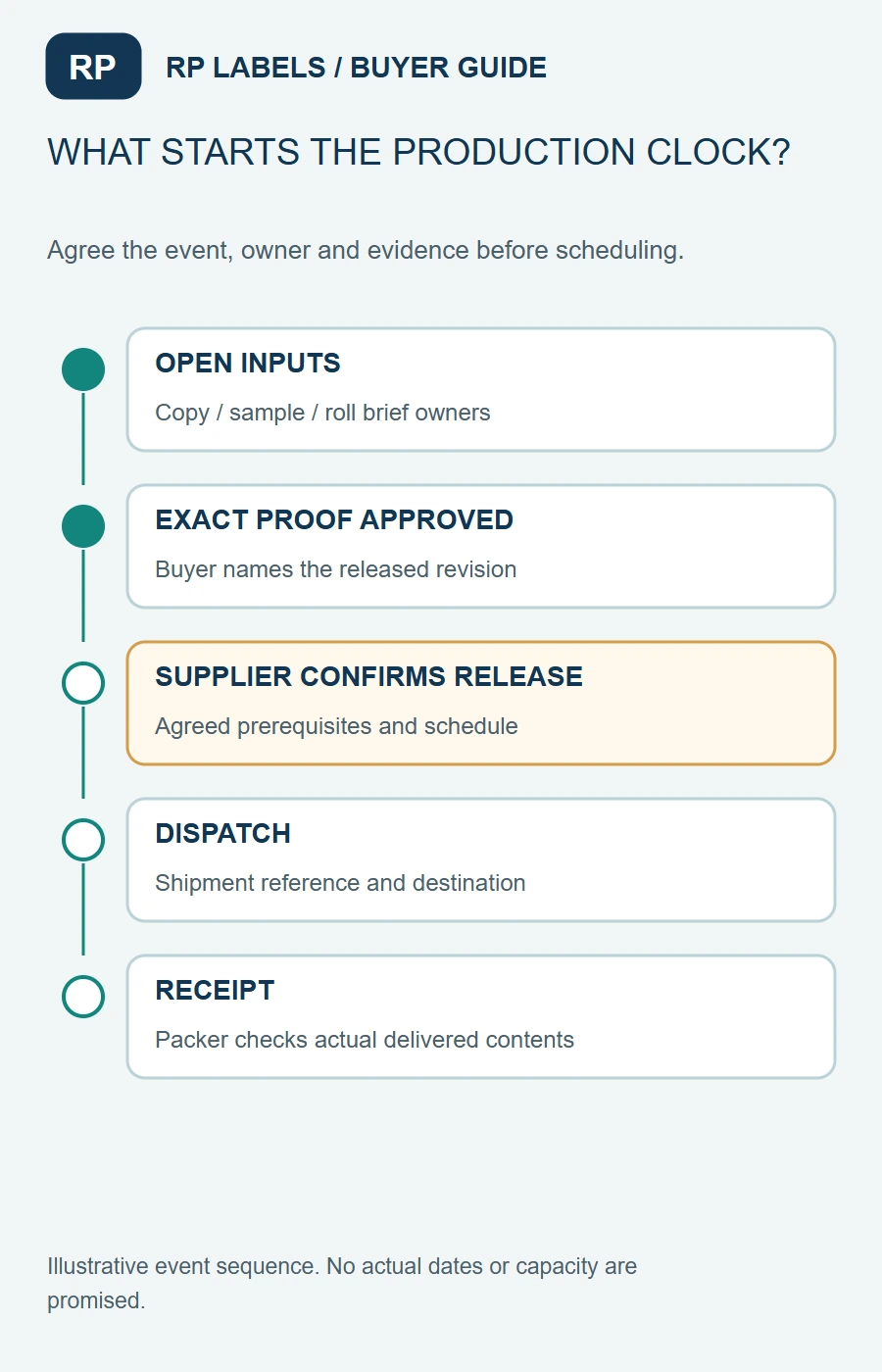
Illustrative scheduling workflow. No dates, production capacity, delivery guarantee or customer order are represented.
Put the needed arrival date in the brief
Tell the supplier when and where the labels are needed, and whether that is a preferred date or an actual packing dependency. Identify the destination and receiving arrangements. A required arrival date is useful planning information; it does not become a promise merely because it appears in the inquiry.
Ask the converter to distinguish its estimated production period from dispatch and transit. If the quotation uses working days, clarify the applicable calendar and any exceptions relevant to this order. Obtain the actual supplier response instead of borrowing another printer's published turnaround.
Avery's custom-printing information explicitly distinguishes proof approval for its roll and pouch orders from production and shipping. That is an example of why the starting event matters. Its times and terms are not RP's production commitment.
Identify the inputs that can still hold release
List the actual artwork revision, quantity per design, construction, finished format and any data file. Identify who supplies or approves each open item. If an applied sample or a machine trial is part of the agreed scope, record whether it must be complete before the production order can be released.
For a supplement label, a copy change may still require the responsible content reviewer. For a research-vial label, the packer may still need to confirm roll direction. These are examples of potential dependencies, not a universal list of every order requirement.
The copy-to-proof guide addresses the content and exact-file approval. The automatic-roll brief addresses the packer's application requirements. This timeline records when those owners have completed the agreed prerequisites; it does not replace their reviews.
Ask the supplier to confirm the release event
Once the open inputs are resolved, ask the supplier to identify the exact order and file revision accepted for production and the schedule that now applies. A buyer's approval email is important, but the buyer should not infer that an unacknowledged message has secured a particular press slot.
Keep the confirmation with the project record. If the supplier cannot confirm a date yet, the honest schedule remains estimated or pending. That gives the buyer a specific follow-up instead of a calendar that looks precise without an agreed basis.
An unchanged repeat may require fewer new decisions than a first order. It still needs the actual accepted scope and schedule. A prior run's timing is useful history, not an automatic booking for the next order.
Treat a later change as a scheduling question too
Suppose a buyer changes one label's product name after proof approval. The relevant question is not only whether the printer can alter the file. Ask what has already been committed, which work is affected and whether the confirmed schedule must be revised.
Do not instruct the team to overwrite the released file silently. Identify the proposed change and request the supplier's disposition. The answer may involve a revised proof, another sample or a different delivery arrangement. Cost and timing depend on the actual order status and supplier agreement.
If the original schedule is critical, the alternative may be to retain the accepted scope where it remains appropriate, postpone the change or discuss a separately approved staged delivery. The buyer must confirm that any retained content is still suitable; a deadline does not authorize printing incorrect information.
Decide what a partial release would mean
Two designs may be ready while a third is still awaiting review. Ask whether separate production or dispatch is feasible and how that affects cost, quantities and the remaining schedule. Do not assume that approving part of the range automatically produces an earlier shipment.
A shared launch can reasonably wait for one coherent delivery when handling and freight favor that route. A genuinely independent ready item may justify another arrangement if the supplier accepts it. Record which option is confirmed and keep the unresolved design on hold.
The worked readiness record shows an artwork input awaiting review and a proposed release awaiting supplier confirmation. It contains no promised dates. The blank record and field guide connect each event to its owner, evidence and current scheduling status.
Keep dispatch and receipt visible
After release, track the supplier's confirmed milestones and the shipment information actually available. Dispatch means the shipment has left under the agreed arrangement; it does not prove that the packer has received the correct labels in usable condition.
Confirm the receiving address, contact and any appointment requirement before dispatch. RP's shipping-information page describes shipping details as order-specific matters to confirm. The custom-order process provides the general starting steps; the project record turns those steps into a schedule both sides can identify.
For custom supplement labels or vial labels, send RP Labels the readiness brief, desired arrival date, destination, artwork status, quantities and outstanding approvals. Ask for the proposed start event and current schedule in the same reply. That is more useful than a lead-time number with no agreed beginning.
Sources and scope
Demand layer: competitor and process pages linked here, including Avery, HERMA or OnlineLabels where cited, illustrate buyer language and process topics only. They do not supply RP minimum quantities, lead times, prices, certifications or materials. Authority layer: an RP number is backed only by a factory datasheet, a signed quote or proforma, confirmed product data, or a fact kept on the About page. The March 2026 proforma there is one production-run example, not a standing offer. RP shipping and planning pages describe what to confirm on a quote. Worked figures on this page are fictional unless an authority source is named for them.