Supplement Label Copy: Track the Changed Sentence Before Print Release
A brand team approves the copy file. Prepress sends back a tidier label, and procurement is ready to release it. Then someone notices that the sentence on the back panel differs from the reviewed text.
In this hypothetical project, nobody needs another conversation about whether the design looks finished. They need to identify what changed, which other elements depend on it, and who can approve the resulting proof. A later filename does not answer those questions.
I would keep the order open at that specific point. Reopening every unchanged design choice wastes time; treating the changed sentence as a harmless layout adjustment risks approving content the responsible reviewer has never seen.
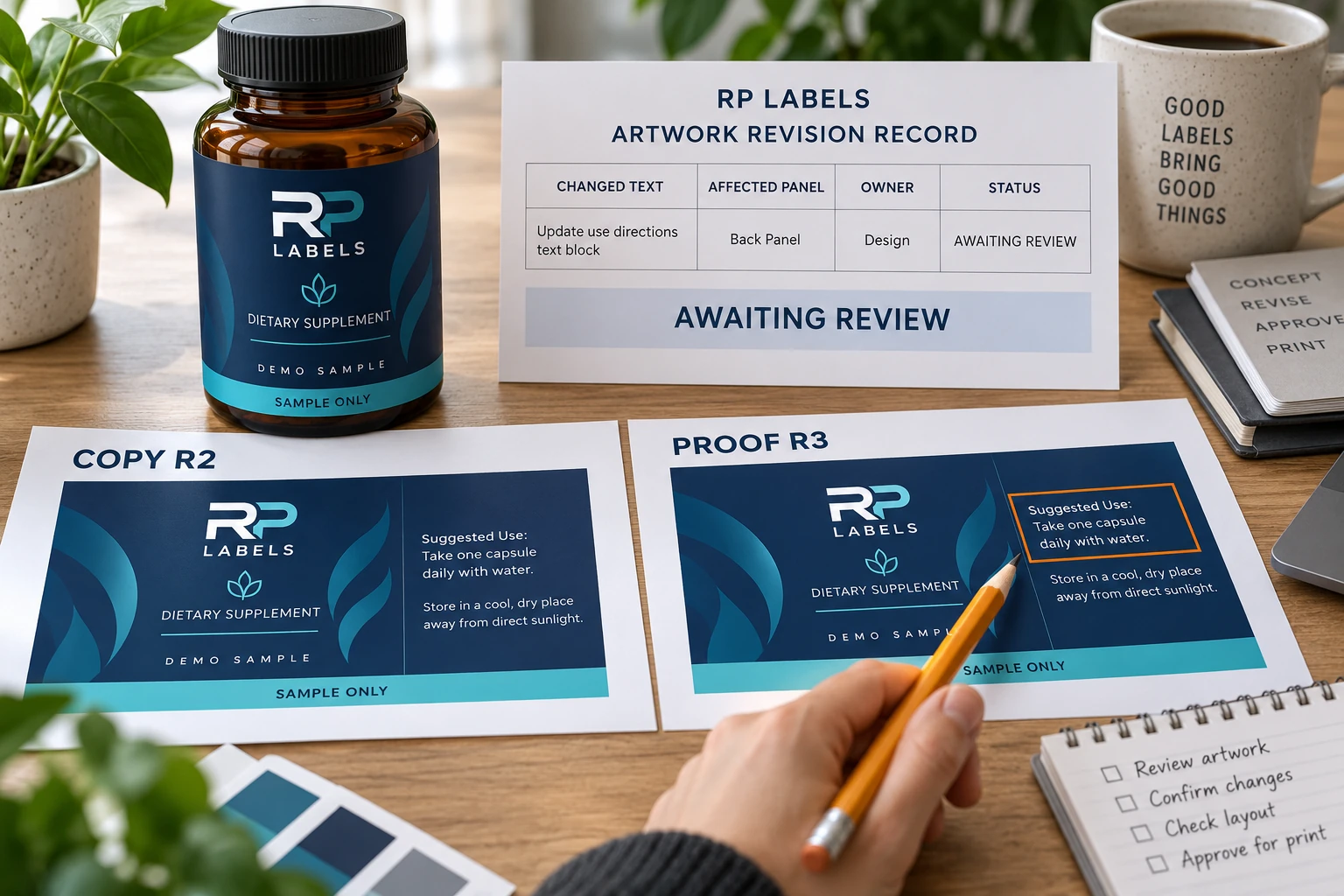
AI-generated packaging illustration. The sample wording, revision references and review record are fictional; no product claim or regulatory approval is demonstrated.
Give the reviewed copy a reference outside the artwork
Keep a controlled copy source that identifies the SKU, formula or product reference, intended market, language and revision. Give important blocks stable names: front identity, front claim, information panel, warning or other relevant sections. Include the actual text and the owner responsible for its review.
The point is practical. A designer should be able to place the correct sentence without searching an email chain. A reviewer should be able to compare the proof with an identified source rather than remembering which attachment seemed final.
Keep the full current source, not only a screenshot of the changed line. Context can affect what the reader understands. A shortened sentence beside a different heading or illustration may need the responsible reviewer's attention even when the individual words seem familiar.
Separate copy review from reproduction review
The buyer's appropriate reviewers decide whether product statements and required information are suitable for the actual product and market. Prepress checks whether the approved material can be reproduced in the proposed print layout. Those decisions meet at the finished proof, but they come from different evidence and authority.
FDA's structure/function claims guidance describes requirements for the relevant supplement claims, including substantiation, a disclaimer and notification. It does not make a printer's proof approval a regulatory determination. Refer the actual wording and context to the qualified reviewer; this article does not classify or approve a proposed claim.
The print team still has useful work to do. It can flag text that no longer fits, a moved panel, missing characters, poor contrast or a mismatch against the identified copy. Reporting a discrepancy is valuable. Silently rewriting it to make the layout fit transfers a decision to the wrong person.
Record the difference and its dependencies
Start with the exact old and proposed text in the internal record. Name the source revision and the affected artwork panel. Then identify what else may need attention: a linked marker, nearby qualification, translated block, information panel or related packaging. Do not assume every edit has the same reach.
For example, a spacing correction may leave the approved wording intact while still needing a layout check. A proposed shortened claim needs the responsible content review before it is placed and released. A change to copy length may also affect panel fit, code clearance or the white-ink area beneath small text. The reviewer determines the relevant dependencies for the actual label.
Ask prepress to return a marked comparison together with a clean proof. The marked version shows where to look; the clean version shows the whole label as it would be printed. Retain both with the same proof reference. An isolated crop can miss an unintended movement elsewhere on the artwork.
Follow one example without inventing an approval
The downloadable record uses a fictional review sequence. Copy source R2 is the intended reference. Proof R3 contains a proposed shorter front sentence, while a back-panel block has moved during layout. Both entries remain open.
| Change | Who supplies the next decision | What the record still needs |
|---|---|---|
| Front sentence shortened from the source | Responsible copy reviewer | Accepted wording or instruction to restore the source |
| Back block moved on the artwork | Artwork owner and relevant reviewer | Whole-panel check against the approved content and layout requirements |
| Clean revised proof prepared afterward | Named release owner | Identification of the exact file and scope approved |
Use the worked copy-to-panel record, blank record and field guide. The example contains no endorsed health wording. It demonstrates how a proposed change reaches an owner instead of disappearing into a filename.
If the copy reviewer restores the original sentence, prepress checks whether that text fits the actual panel. If it does not, the design may need to change. Reducing type or removing another block without review can create a new unresolved issue. Keep the decision attached to the affected artwork rather than asking procurement to guess which compromise is acceptable.
Approve the complete file after the changes are placed
A content decision is not proof that the correct text reached the print file. Compare the revised artwork with the accepted source and change record. Check the actual label size, all affected panels, linked markers, version identification and code locations. Use relevant physical evidence where readability or applied geometry remains open; the proof-versus-sample guide explains the limits of each evidence type.
Name the exact proof revision in the release. Record who approved it, when, which SKU and market it covers, and any unresolved conditions. The purchase-order line should point to that same file. A broad “looks good” message should not release another version sitting in the folder.
If only one design in a family changes, the brand's release owner should decide whether unaffected versions can proceed separately. That can protect a packing schedule without pretending the held design is approved. The printer must receive a clear per-version release, not a combined quantity with an unexplained exception.
Keep downstream stock decisions separate
This record controls the path from reviewed text to print proof. It does not authorize use or disposal of old rolls. Where existing printed stock is affected, connect the released file to the artwork changeover process and obtain the responsible buyer's disposition.
Likewise, a translated version may need its own dependency review. Use the multilingual artwork guide when the source change affects another language. Do not treat a corrected English PDF as automatic approval of every market variant.
For supplement label printing, send RP Labels the reviewed source and marked change record, the complete artwork, bottle reference and quantity per version. Name the copy and release owners, and flag anything awaiting their decision. The useful reply is a proof whose content and approval scope can be traced, rather than another file called final.