Custom Label Shipping Documents: Match the Invoice to the Packed Goods
A shipment can contain twelve rolls and twelve thousand labels at the same time. If the invoice says “12 pieces” while the packing list means twelve rolls, the buyer has an avoidable question to resolve before dispatch. Agree what each quantity measures and make the shipping documents describe the actual goods consistently.
The buyer does not need to write an improvised customs declaration. It needs the supplier, importer and carrier or broker to work from the same product description, shipment references and quantity basis. Resolve an inconsistency while the cartons are still identifiable at the shipping point.
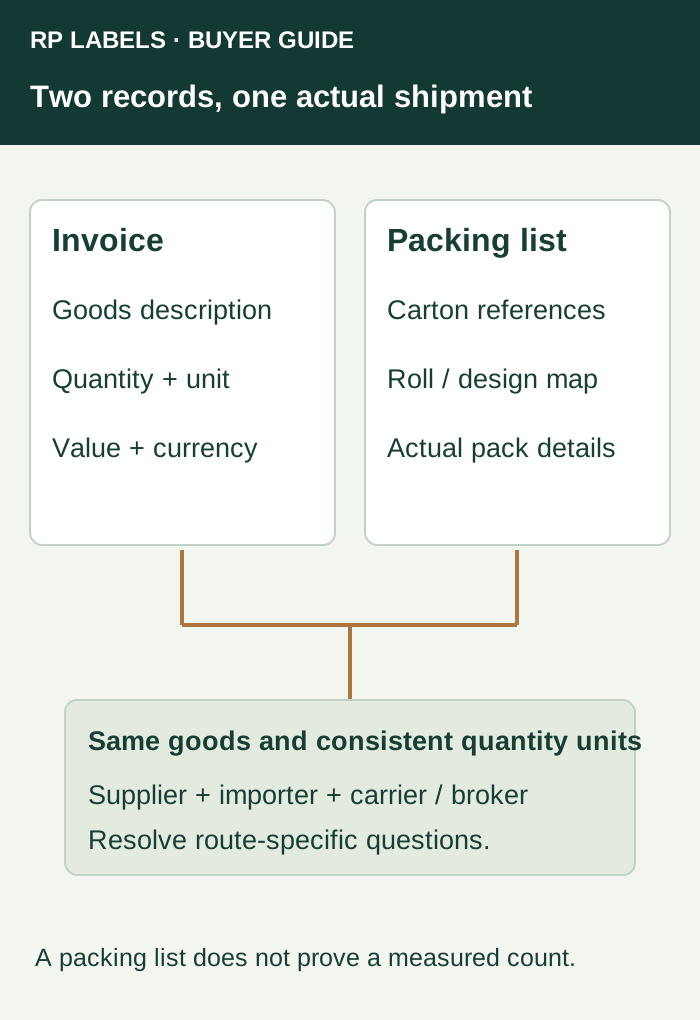
The invoice and packing list have different jobs
The shipping invoice identifies the goods and their values for the applicable commercial and customs process. A packing list connects the shipment to physical packages and their contents. A buyer's internal order schedule can provide the approved design and quantity references that both need.
DHL Express's US document guidance identifies information such as the goods description, reason for export and shipment value, and explains that incorrect or unclear information can cause review. FedEx Canada's documentation guidance likewise emphasizes accurate invoice and air-waybill information. These are carrier and route references, not a universal document checklist for every RP shipment.
Have the actual carrier or broker confirm what is required for the destination and shipping service. Keep the commercial sale, sample, return or replacement reason truthful. Do not assume a free sample is a document-only shipment or has no customs value; obtain the appropriate valuation and invoice instructions for the actual movement.
Write the product description before choosing the shorthand
Identify what is being shipped: for example, finished printed self-adhesive labels supplied on rolls, where that is the actual construction. Add the relevant material and product details requested by the carrier or broker. A general description such as “printing products” may not give the reviewer enough information.
Keep empty printed labels separate from the products they will later label. A roll intended for a supplement bottle does not contain supplements merely because the artwork names a formula. The description must match the packed goods. If labeled containers, samples of material or other items are also included, identify them accurately rather than hiding them inside one vague line.
Ask the supplier and importer to resolve tariff classification and origin against the actual goods and destination requirements. This guide supplies no tariff code, duty rate or origin declaration. A code copied from a different label material or a previous supplier may describe a different product.
Reconcile rolls, pieces and cartons in one worked example
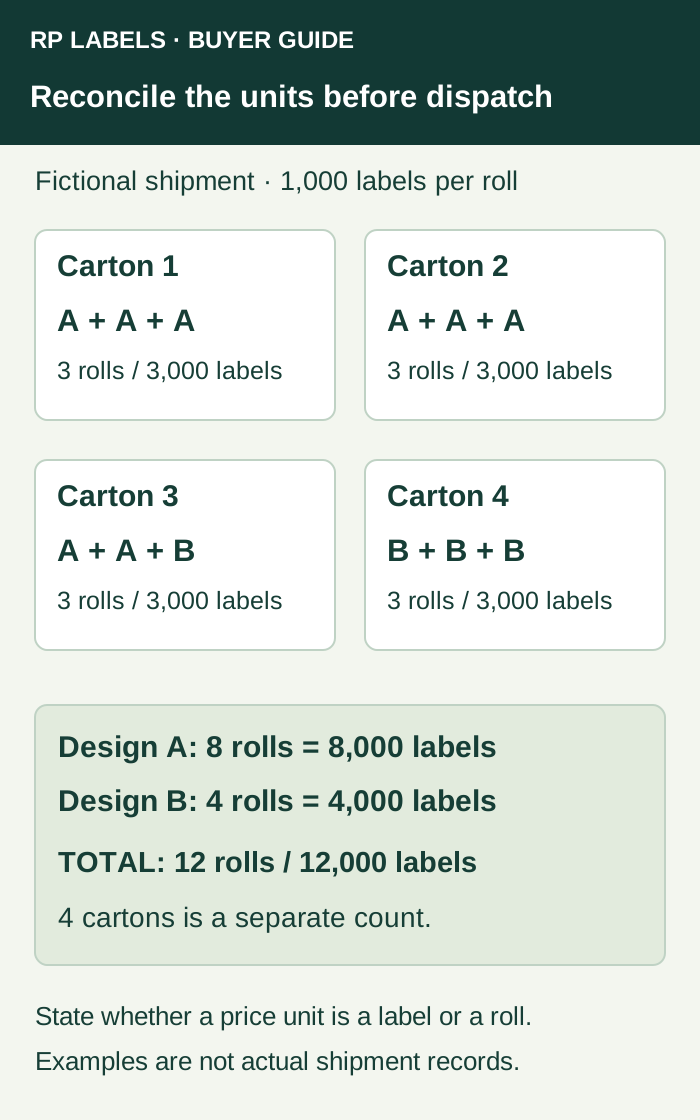
In a fictional shipment, Design A contains eight rolls of 1,000 labels and Design B contains four rolls of 1,000. Total finished labels are 12,000 pieces on twelve rolls, packed in four cartons. A possible packing plan is three rolls per carton: cartons 1 and 2 hold A, carton 3 holds two A and one B, and carton 4 holds three B.
If the commercial unit is one label, the invoice can identify 8,000 pieces for A and 4,000 for B, with the agreed unit prices and actual value. The packing list then records the roll and carton arrangement. If another unit is used, explain the conversion clearly and ensure the relevant documents agree. Do not change the declared unit merely to make the number look smaller.
Check identity as well as the total
A combined quantity of 12,000 cannot expose a substitution of one design for another. Connect invoice or order line references to the artwork or SKU schedule, and connect the packing list to carton and roll identifiers. The warehouse should be able to find the intended version without opening and unrolling every item.
Keep supplier-stated count and independently checked count distinct. The receiving quantity guide covers that later verification. This shipping check confirms that the document set is internally coherent; it does not turn the supplier's stated quantity into a measured one.
Close the handoff before collection
- Supplier: confirms the actual goods, quantities, packaging, weights and document revision it prepares.
- Buyer or importer: confirms the legal receiving party, destination and information requested for import.
- Carrier or broker: resolves the route-specific document and clearance questions within its scope.
- Receiving team: gets the carton map and order references needed to identify the arrival.
If a carton is removed or the shipment is split, ask which documents must be revised. A document set approved for four cartons should not accompany three cartons without the corresponding correction. Save the accepted revision with the shipment reference and replace superseded copies through the agreed process.
The delivery-scope guide covers who handles import costs and the delivery point. The packing guide covers physical protection and photographs. Neither replaces this document-to-goods reconciliation.
For an RP shipment of supplement labels or vial labels, prepare an inquiry with the receiving country, party, address, design schedule and required delivery arrangement. Ask how the final invoice and packing information will identify the goods and quantity units before dispatch.