Receiving Custom Label Rolls: Separate the Carton Count from the Label Count
The warehouse receives three cartons of printed supplement labels. The packing list says 30,000 labels, but the team has counted only cartons and rolls. Can production release the shipment as 30,000 verified labels? Not yet. A carton count, a roll count and an individual label count are different observations.
First compare the approved order, the packing list and the physical roll identities. Then record exactly how the quantity was checked. A supplier's printed roll quantity may be useful for planning; it is not the same as an independently counted quantity. If a roll is partial, unmarked or held for inspection, keep that distinction visible before allocating labels to a packer.
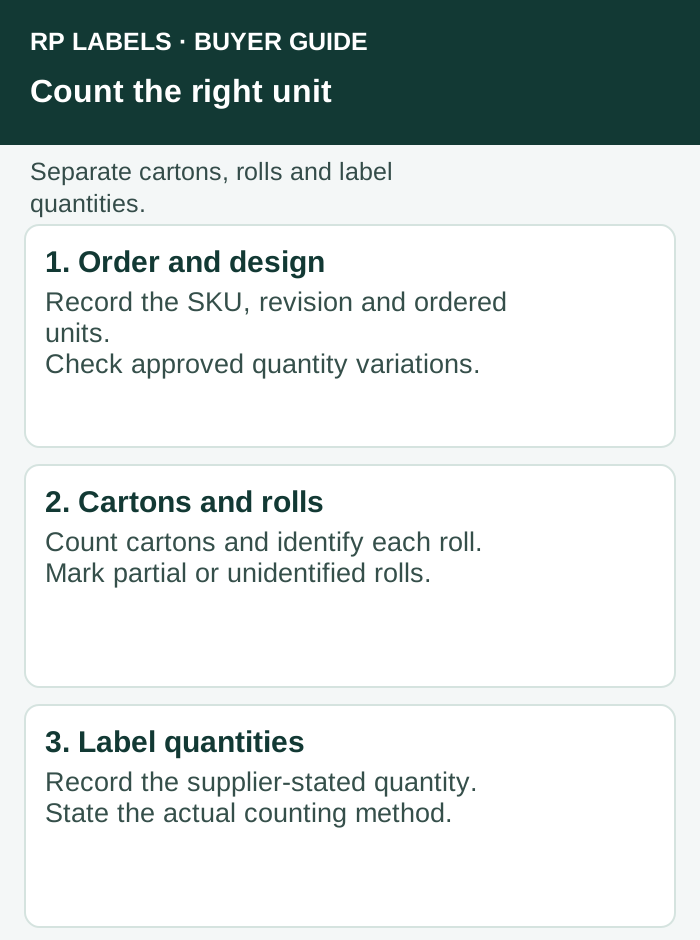
Start with the approved order and its units
Record each SKU, artwork revision, label size and ordered quantity. Check any approved change or permissible production variation before treating a difference as a shortage. The site's overrun and underrun guide addresses the commercial quantity agreement; this page addresses what a receiving team can actually confirm on arrival.
Keep the units explicit: one carton contains rolls, and each roll is expected to contain a stated number of labels. If there are several designs, identify the allocation per design instead of adding all rolls into one total. A packing list can describe the shipment, but the recipient should not describe its figures as physically verified without recording the method used.
Follow the identity from carton to roll
Compare the number of cartons received with the shipping documents. Note carton IDs, obvious damage and any missing or duplicate markings. Then compare roll labels with the purchase order: design, revision, roll ID, stated count and destination, if supplied. Keep each partial roll or unidentified roll separate until its identity is resolved.
GS1's explanation of logistics-unit identification describes identifying physical units and linking them to transaction information. It does not prescribe RP's packing process or prove the count inside a particular carton. Ask the supplier which carton and roll identifiers it can provide for your order.
Make the quantity basis visible
Imagine a fictional packing list showing two full rolls of 5,000 labels and one partial roll stated as 3,200. The stated total is 13,200 labels. If the receiver verifies the presence and identity of three rolls without counting the labels, the record should say “three rolls received; 13,200 labels stated by supplier.” It should not say “13,200 labels individually counted.” The numbers illustrate the calculation only; no customer shipment or shortage is implied.
If the project requires an independent count, agree with the converter and receiving team how it will be done, what equipment or records will be used, whether samples or waste are included, and how the roll will be rewound and identified afterward. Do not estimate an exact label count from roll diameter or weight without an agreed, validated method. Opening or rewinding a roll can change its condition and identity, so obtain the line owner's procedure first.
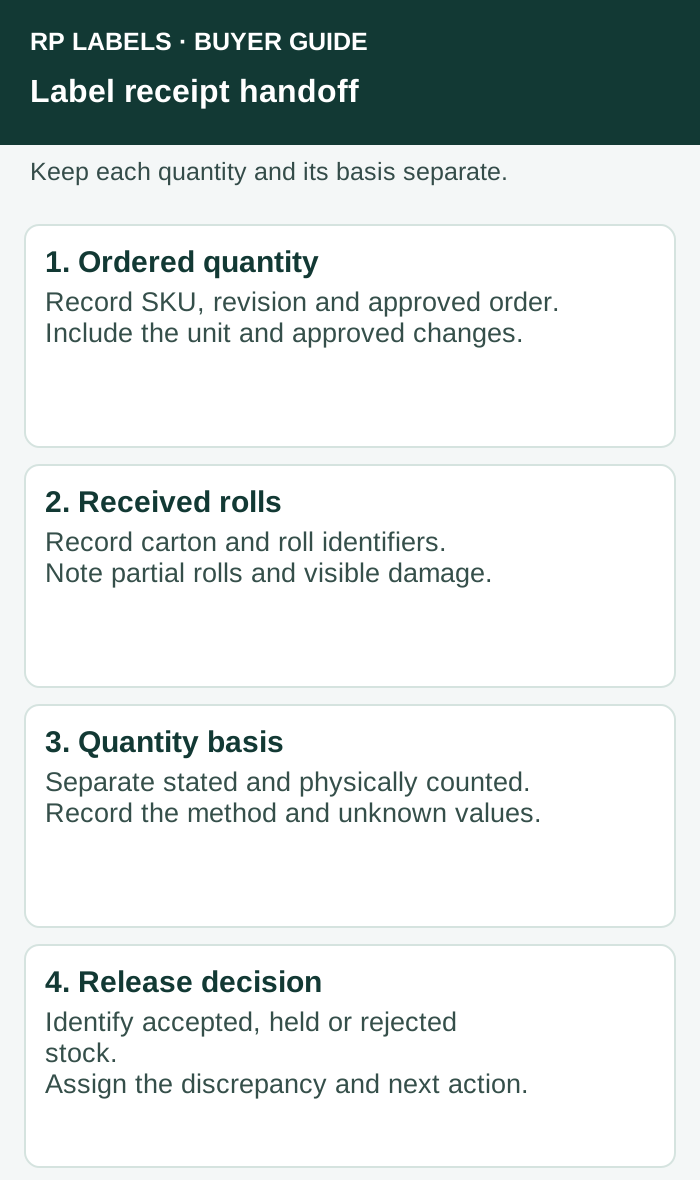
Separate receipt from release
Receipt confirms the checks actually performed. It does not automatically approve the artwork, adhesive, code quality or condition of every label. If a carton is damaged, a roll is unidentified, a revision differs from the approved order, or a count cannot be reconciled, place the affected stock on hold and record the issue, location and decision owner.
Ask the supplier for the roll manifest, the basis of its stated quantities and the agreed next step. Do not deduct the same held roll twice: distinguish received, held, accepted and rejected stock, and explain how those categories relate. A small sample check is useful evidence for the sampled units; it is not a full count or proof that the entire roll meets every criterion.
For labels sent to multiple packers, the split-shipment guide handles allocation between sites. The opened-roll return guide covers identifying stock when a partly used roll comes back to storage. Both rely on the physical roll identity established at receipt.
What to agree before ordering
Send RP Labels the SKU and approved revision, label size, quantity per design, preferred labels per roll, core and roll dimensions, and destination or packer allocation. Ask how partial rolls, carton IDs and stated quantities will appear on the packing list. Agree any independent counting or inspection requirement before production and dispatch; do not assume a particular counting service or accuracy without confirmation.
Sources and scope
Sources accessed November 2, 2026: GS1 logistics-unit identification; GS1 logistic-label guideline. These discuss logistics-unit identification, not an independent count of labels inside a roll. The numerical example is fictional, and the record is not a certified count.