Static or Unique QR Hologram Labels? Decide What Each Scan Must Know
A small supplement brand is preparing an instruction page. In this hypothetical project, every carton should open the same page, and the content team wants to edit it later. The buyer asks for unique QR codes because the destination must be changeable.
That is where I would pause the quotation. A destination that can change and an identifier that differs on every item solve different problems. Buying variable data before making that distinction can add approval work without giving the content team anything it needs.
Start with the response expected after a scan. Then decide which data the label must carry and who operates the response. Holographic material is a separate design and scanning consideration; it cannot fill in a missing data workflow.
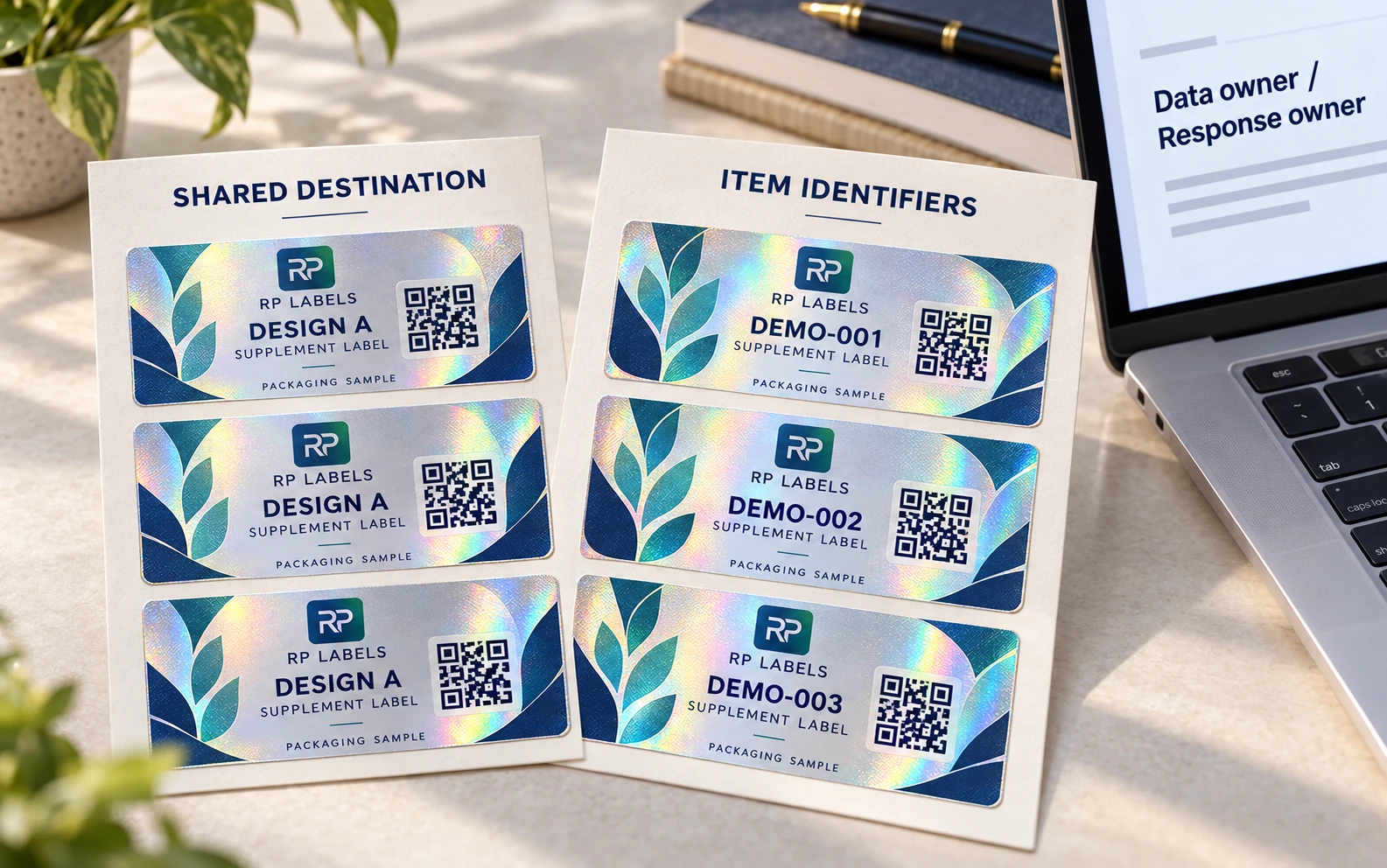
AI-generated packaging illustration. QR-like marks are decorative and are not functional code specimens. DEMO identifiers illustrate data scope, not authentication or inspection results.
A shared destination may be enough
If every carton needs the same instructions, the same encoded URL can appear on every label. The page behind a controlled redirect can change while the printed symbol stays the same. Describe that requirement directly rather than relying on a supplier's use of “dynamic.”
For this buyer, the important questions are whether the brand controls the encoded address, whether the destination works on a phone and who maintains the content. There may be no operational reason to identify each individual carton.
The simpler printed-data scope deserves to win when it meets the requirement. It can avoid an unnecessary identifier file, allocation process and item-status administration. Those savings are workflow considerations, not a promised price difference between printing methods.
The link-ownership guide covers the continuing address and content handoff. It is possible to choose a suitable shared code today and still create a broken-link problem later if nobody owns that handoff.
Unique data starts with an item-level question
Now consider a different hypothetical buyer. Its distributor needs to look up the status of an individual item rather than the instruction page for the whole product. This requires a way to distinguish item instances and a system that associates them with the intended records.
An identifier can be sequential or follow another agreed scheme; looking random is not what makes the underlying record controlled. In the GS1 system, GTIN together with a serial number can identify an individual trade-item instance. Other project schemes need their own defined namespace and rules. This is not a claim that a proprietary DEMO number is a GS1 identifier.
Ask who generates the production values, who checks the approved data file and how each value relates to the item record. If the values are printed before physical packs are assigned, specify that later association step too. A different visible number on every label is not sufficient evidence that the system knows which product received it.
A changing web response is another scope item
Both shared and unique encoded URLs can lead through a redirect. GS1's redirection guidance distinguishes printed identity from the changing location of related information. It also describes the organizational handoff between the people responsible for identification and for content.
For a purchase order, translate that into responsibilities. The printer receives approved encoded data or an agreed rule for generating it. The service owner defines the destination behavior. The brand approves what the user sees. If one supplier offers more than printing, list those services explicitly with their ongoing responsibilities.
Avoid an approval that says only “QR works.” A code can decode correctly, open a page and still show the wrong item status. Conversely, a correctly configured service cannot rescue a poorly printed symbol. Use the foil scan-contrast guide for the physical sample evaluation rather than hiding it in a data check.
Unique does not mean uncopyable
A visible code can be copied. A lookup may confirm that its value exists in a database while leaving the physical pack's authenticity unresolved. GS1's digital-signature guidance discusses this replication limitation. Do not convert a successful lookup into an unsupported “genuine product” message.
If the intended workflow includes repeated-scan alerts, agree what those alerts mean and who handles exceptions. Repeated scans can have legitimate explanations. The printed identifier, any physical security features and the operated investigation process need to be considered together for the actual purpose.
A buyer who only needs access to instructions should not inherit this entire system by accident. A buyer who requires item-level checking should not discover after delivery that the quote included only variable printing.
Compare two scopes before approving either
The worked QR scope sheet, blank version and field guide show the distinction using non-live examples. The shared row uses one proposed address for all items. The item row uses DEMO-001 through DEMO-003 and leaves system approval open. These values are not production data or working authentication links.
For each row, name the data generator, file approver, record-association owner, destination owner and expected response. State what the print quotation includes and what needs a separate service agreement. Review a small data sample before handing over a full file; preserve leading zeros and exact text where the approved format requires them.
If individual values are required, also agree a closeout handoff. The serialized-label reconciliation guide covers the accepted identifiers, rejects and exceptions that must connect to the physical shipment. Choosing unique data creates that responsibility; it does not complete it.
For an RP Labels inquiry, send the required scan outcome, proposed encoded-data examples, label size, quantity, surface and application method. Ask the quotation to identify the printing scope and unresolved data or service responsibilities. Decide whether every label really needs its own identity before approving a file containing thousands of them.