Direct Thermal or Thermal Transfer? Order the Stock Your Printer Uses
Confirm the printer’s actual printing method before buying the next roll. Direct thermal stock forms an image in a heat-sensitive surface. Thermal-transfer printing uses a ribbon and a receptive label surface. Matching the roll dimensions does not make the two supplies interchangeable.
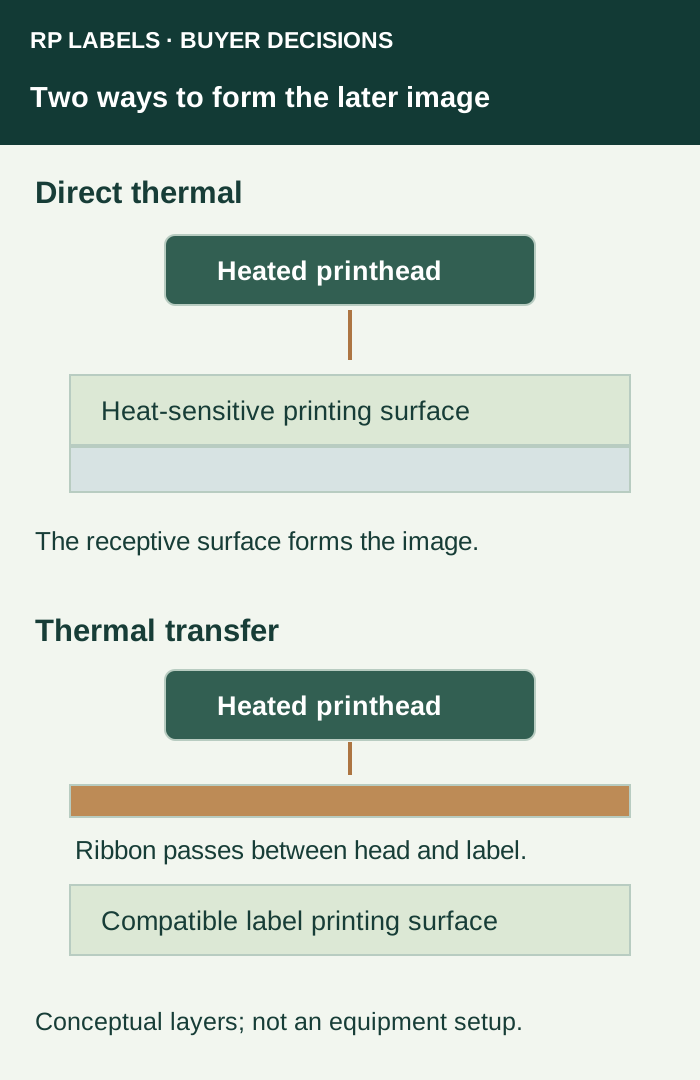
Identify the installed printer and the mode used for this job
Give the converter the exact equipment reference, the mode selected for the intended run and the current accepted media reference if one exists. Some equipment supports one route; other equipment has more than one configuration. The presence of the word “thermal” on an invoice is insufficient.
Zebra’s media portfolio distinguishes direct-thermal and thermal-transfer materials by printing technology. That distinction is about image formation. It does not establish the adhesive, label size, sensing behavior or durability needed for a particular vial.
If the operator cannot identify the route, ask the equipment or current-media supplier before ordering production stock. A simple media-identification check can help investigate an unknown roll, but it is not approval of a replacement construction. An unmarked roll should remain an unresolved input rather than become the basis of a large repeat purchase.
Separate the fixed artwork from the later identifier
A professionally printed label may leave a panel for a lot, date or internal code added at packing. Identify which surface the later printer actually marks. A white area in the design is only a visual reservation; it does not prove that the finished laminate, coating or exposed stock accepts the selected process.
For a thermal-transfer route, name the ribbon and the finished printable surface with the printer reference. Use the thermal-transfer combination guide for that compatibility decision. For a direct-thermal route, ask the supplier to identify the intended heat-sensitive material and any coating relevant to the job. Neither route can be inferred from the face material being paper or film.
The preprint and print-on-demand guide addresses how much of the label is printed at each stage. Resolve the media mechanism here before selecting the stock for that workflow.
Make two approvals instead of one broad “printable” claim
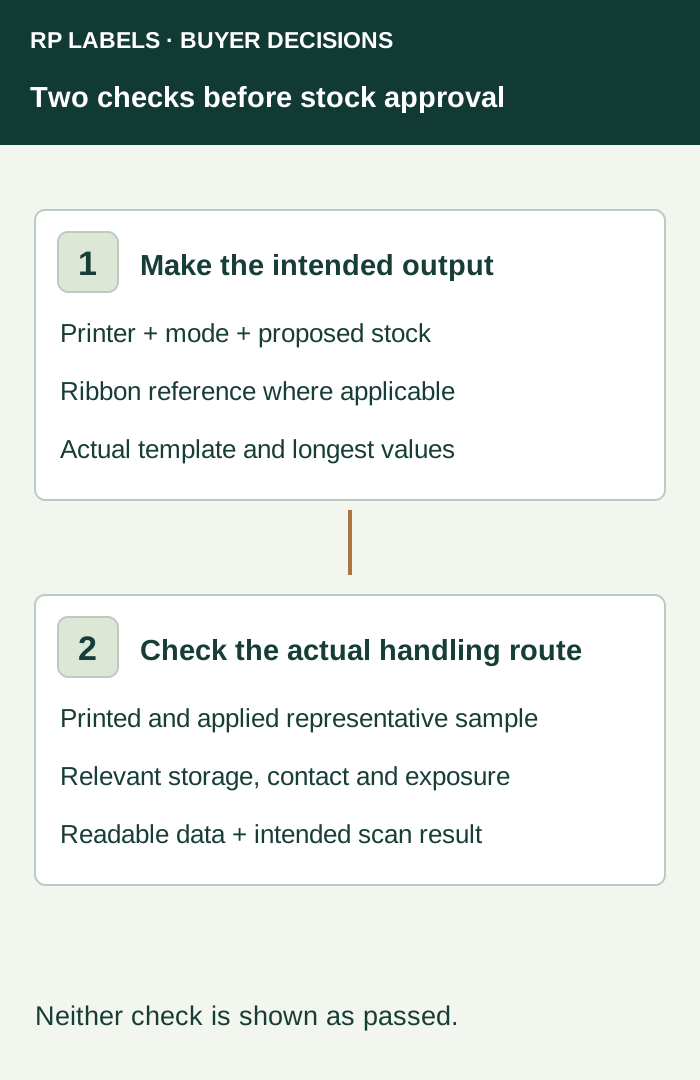
First, check that the proposed stock loads, senses and produces the intended output using the exact printing combination. Include the longest allowed data and the real finished label size. Keep the machine settings and consumable references with the output.
Second, check the identifier through the conditions it must survive. Relevant conditions may include handling, storage, light, heat, rubbing or an actual wipe. Choose them from the operation, not from a generic durability checklist. Adhesion to the container remains another part of the finished-label assessment.
Avery’s comparison notes that heat and light exposure can affect direct-thermal media. That is a reason to identify the actual use route, not a universal lifetime for every thermal material. Thermal transfer also needs its particular ribbon and surface evaluated; using a ribbon does not make every printed mark permanent.
Let the operating conditions decide which route deserves a quote
| Actual situation | Purchase decision |
|---|---|
| An established direct-thermal printer supports a short, defined internal-use route | Retain the route if identified media and representative output meet the actual requirements. Do not order transfer-only stock just because it is called a product label. |
| The accepted process uses a ribbon and an identified receptive panel | Quote that complete thermal-transfer combination; a similar-size direct-thermal roll is a different proposal. |
| The identifier must remain readable through a changed handling or storage route | Reopen the evidence for the proposed construction and output before approving either printing route. |
| All content is fixed before conversion | Compare a fully preprinted supply with local printing rather than buying unnecessary local consumables. |
Keep any claimed cost advantage conditional on actual quotations and operating records. Ribbon consumption, local setup, checking and unsuitable stock can matter, but this guide supplies no prices or universal lowest-cost route.
Send the media decision with the label inquiry
For vial labels or supplement labels, send RP Labels the exact printer, intended mode, later-added fields, current media and ribbon references where applicable, finished size, quantity per design and handling requirements. Ask which construction and sample scope can be proposed for that route. Availability and compatibility need confirmation for the actual order.
Prepare the inquiry draft with those details and send the equipment information through your chosen email or WhatsApp route. Do not release production stock while its printing mechanism is still described only as “thermal.”