Preprinted Vial Labels vs Print-on-Demand Stock: Choose by Change Frequency
A lower unit price needs another look when changing fixed copy could leave unused labels in stock.
Consider two hypothetical buyers asking for the same research-vial label with different supply needs. One knows the product name and design for the next six months but changes the lot on every filling run. Another changes the SKU code and disclaimer as often as the lot. I would not quote them both on the same assumption about how much of the label is preprinted.
The illustration below compares fictional RP Research examples. It is an AI-generated illustration, not a compatibility test for a thermal-transfer printer or a guarantee that either approach costs less.
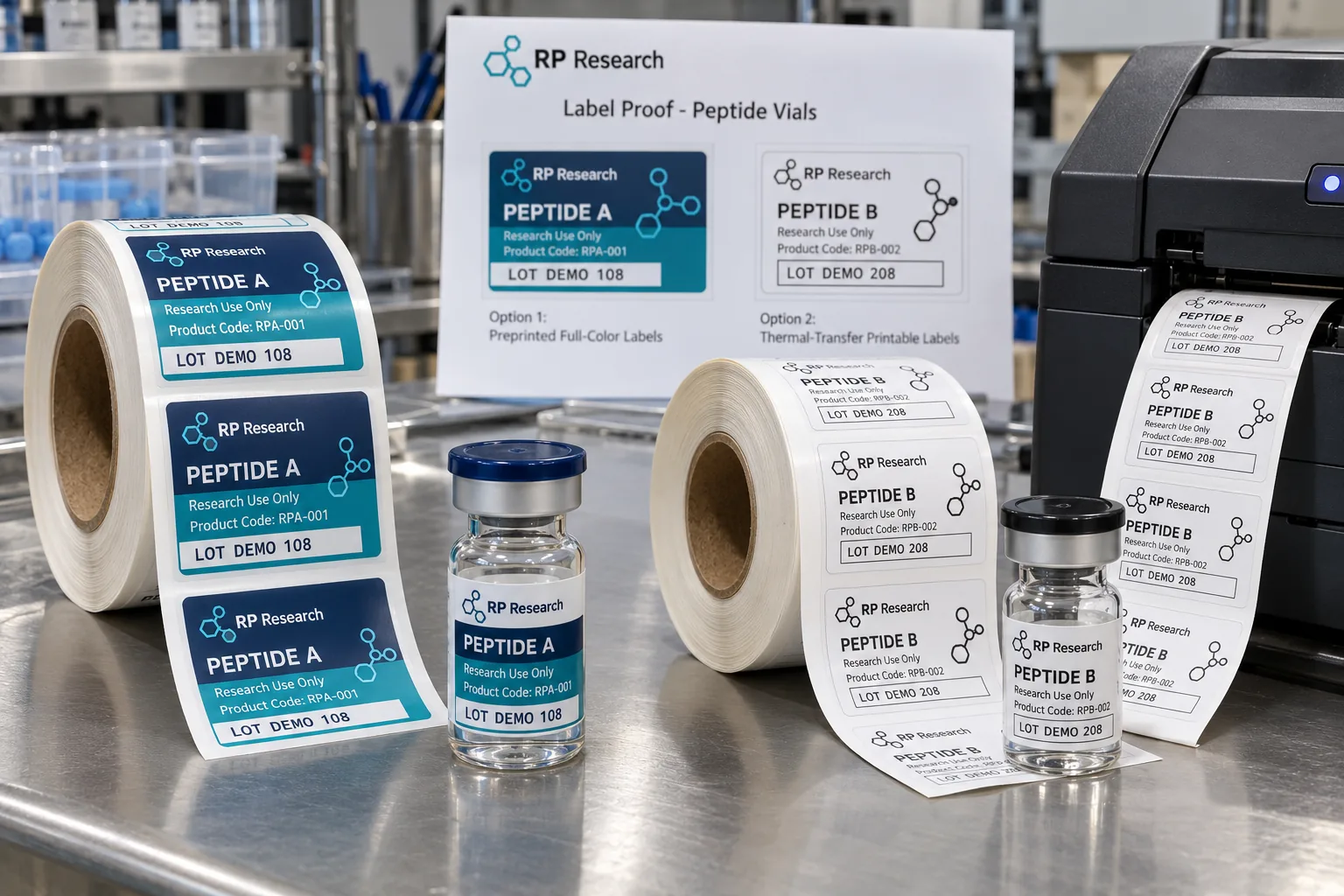
AI-generated comparison, not a tested printing result. RP Research, product codes and DEMO lots are fictional; printer and ribbon compatibility need a physical trial.
Separate stable copy from variable copy
Make two columns in the brief. Stable fields might be brand, product family, color system, fixed instructions and decorative graphics. Variable fields might be product code, lot, internal batch reference or a date that the buyer has independently approved. This sounds basic, but it tells the printer which content can safely sit on inventory and which content must be produced closer to use.
A full-color preprinted label can carry every fixed field. It may also leave a defined, tested zone for later variable printing. A print-on-demand label starts with printable stock and uses the buyer's own printer to put substantially more of the final artwork on each label. A hybrid can work when only the variable part changes. The decision is about the whole release process, not just whether a label roll has color.
Count the cost of unused labels and operator steps
For a stable design with repeat volume, professionally preprinted graphics may be easier to keep consistent. But if labels become obsolete after every name or copy revision, the wasted stock matters. For a small or fast-changing SKU range, local printing may reduce obsolete inventory, but it adds printer setup, ribbon or ink choice, file control, code checks and someone responsible for approving the output.
HERMA's thermal-roll overview distinguishes thermal materials and their intended printing routes. It supports asking about print process and stock compatibility, not the claim that any printable roll will survive your storage or handling conditions. HERMA's manual dispenser guidance also makes clear that supplying and dispensing labels is a separate operating step from creating variable content.
Put the weakest field through a physical trial
I would print the longest real code on the smallest real vial label. Then I would check character clarity, scan target if one is present, line breaks, ribbon transfer, and whether the printed data remains readable after the intended handling. Trial the exact printer, ribbon, face material, finish and label size. If a laminate covers the code area or a glossy spot rejects printing, an otherwise beautiful preprint is the wrong construction.
Our printable-stock guide goes deeper on printer and material choices; the overlaminate proof guide covers the order of printing and protection. Neither substitutes for the buyer's own released sample. If the label is applied by hand, check unwind and liner behavior. If applied on equipment, provide the roll core, outer diameter, gap and sensor needs before the quote.
Control versions at the point of use
The label file, variable-data file and physical stock all need matching version identities. In a preprinted workflow, retire the old roll when the fixed copy changes. In a local print workflow, lock the approved template and distinguish sample prints from released labels. Keep a short release checklist: correct SKU, current template, right lot, readable output, and counted waste. A neat label carrying the wrong current data can create a problem that a smooth-running printer will not reveal.
Put revision exposure beside the local work
Here is a hypothetical inventory calculation, not a price or waste forecast. A buyer holds 1,200 preprinted labels for a fixed design and expects to use 300 before an approved copy change. That leaves 900 labels whose eligibility must be decided by the responsible owner. They are not automatically waste, and this example does not authorize their use. The quantity exposes the decision hidden behind a low unit quote.
Change the situation: the fixed design remains valid through the intended run, but the lot changes. A preprinted family with a suitable later-print zone may keep the visual work consistent while moving only the changing field closer to use. That can be a sensible compromise if the exact zone, equipment, consumables and released output have been confirmed. A white rectangle in artwork is not evidence that the actual surface accepts the intended printing.
The worked field-to-supply brief, blank brief and field guide compare full preprint, hybrid and substantially local printing. They identify who owns stable artwork, changing data, equipment compatibility and output release. They deliberately contain no supplier prices or assumed labor rates.
Get the missing amounts from comparable quotes and your own operating records. Include setup and checking time, consumables, waste, equipment obligations where relevant and the disposition of obsolete fixed-copy stock. Existing local equipment may make flexible printing attractive; a stable approved design may favor professional preprint. Select the route that has an owner for every remaining step, rather than declaring one printing model universally cheaper.
What I would ask before ordering
Send the exact vial, artwork versions, number of SKUs, estimated labels per SKU, change frequency, variable fields, printer model if any, application method and storage conditions. Ask the supplier to quote the all-in path: printed roll, local consumables, proofing, setup and likely obsolete stock. I would choose preprint when the stable artwork and run size justify it; print on demand when change control and short-run flexibility outweigh the extra operator work. Do not turn this into a universal minimum-order or savings claim.
Send RP Labels the field-to-supply brief, quantity per design, changing fields and any local printer details. Ask which proposed stock and print scope can be quoted, with compatibility and local operating responsibilities left explicit.
Sources and scope
Demand layer: competitor and process pages linked here, including Avery, HERMA or OnlineLabels where cited, illustrate buyer language and process topics only. They do not supply RP minimum quantities, lead times, prices, certifications or materials. Authority layer: an RP number is backed only by a factory datasheet, a signed quote or proforma, confirmed product data, or a fact kept on the About page. The March 2026 proforma there is one production-run example, not a standing offer. RP shipping and planning pages describe what to confirm on a quote. Worked figures on this page are fictional unless an authority source is named for them.