Fine Lines and Reversed Text on Foil Labels: Review the Gaps Before Tooling
Before releasing a foil label for tooling, review the spaces that must stay open as carefully as the lines that must transfer. Fine positive strokes, small unfoiled gaps and reversed lettering are different features. A crisp enlarged PDF does not establish that the proposed foil process will reproduce all of them at the finished label size.
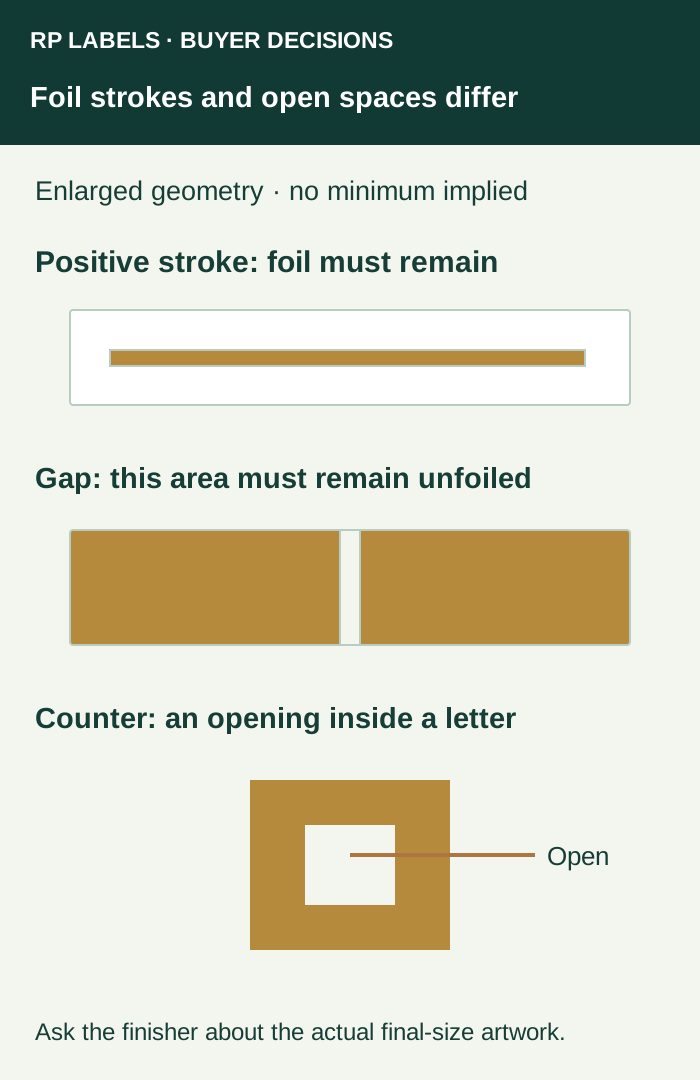
Identify the smallest meaningful feature
Mark the finest positive line, the narrowest unfoiled gap and the smallest enclosed space in a letter. For example, the opening inside a letter can be the limiting feature even when its outer stroke looks substantial. A drawing reviewed only at several times its final size hides that dependency.
Foilco’s fine-detail guidance discusses the risk of fine gaps filling and the importance of counters in typography. It also cautions about artwork combining very fine detail and large solid areas. Those are useful review questions, not universal RP manufacturing limits. Do not copy another finisher’s stated capability into your purchase specification.
Send the vector artwork at final dimensions, with the proposed foil region separately identifiable. Ask the converter to identify features needing revision or representative sampling for its actual route. If the process or stock is still undecided, keep feasibility provisional rather than approving a generic “gold foil” sample.
Positive detail and reversed detail can need different changes
A positive foil line is material the process must retain. A reversed letter or gap is an area it must keep clear within or beside that material. Enlarging the outside of an icon does not necessarily protect a narrow internal opening, and merely choosing a heavier typeface can make a small counter tighter.
When a detail carries product identity, preserve the meaning and obtain the responsible artwork owner’s approval for any change. Simplifying a decorative flourish is a different decision from changing a character in a product name. Keep required information in a separately reviewed readable treatment when the decorative route cannot establish it adequately.
Compare a targeted simplification before changing the whole design
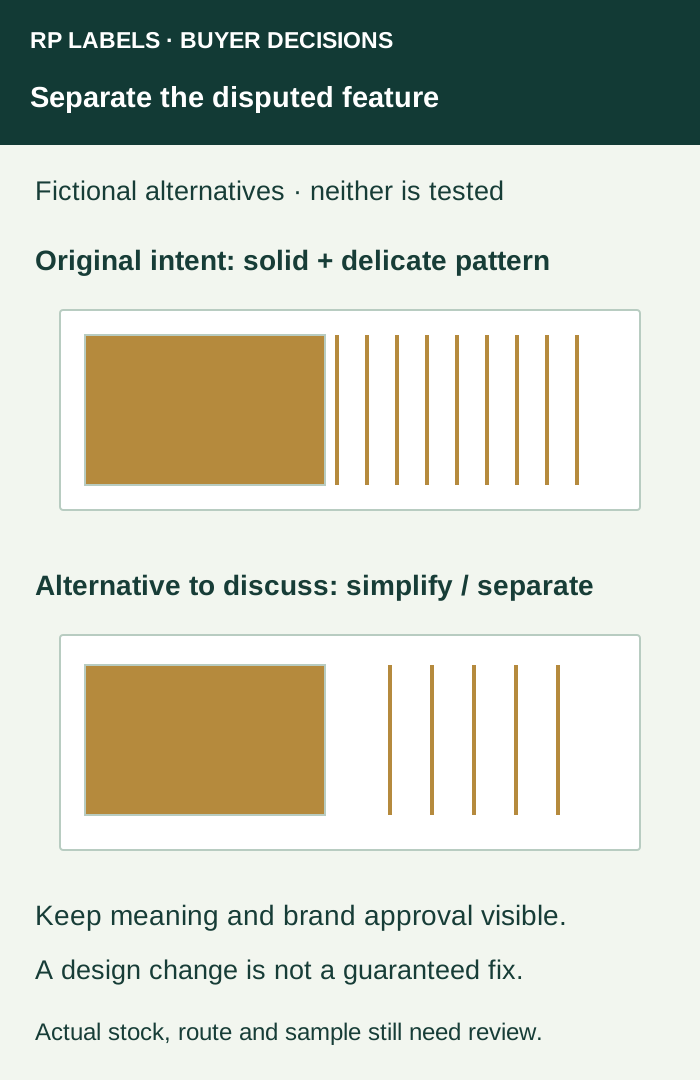
In a hypothetical design, a broad foiled badge touches a delicate line pattern and includes a tiny reversed brand mark. Ask which feature prevents release. The useful alternative may be opening the small counter, simplifying the pattern, increasing separation or moving the finest wording to a normal printed area.
If the converter can demonstrate that the original artwork meets the actual requirement, it can remain the preferred design. If a limited simplification meets the brand need with a clearer production proposal, it deserves consideration. A buyer should not remove detail solely because another supplier’s web page gives a different minimum.
Where the quote proposes another decorative route, use the foil and metallic-process guide to compare the result and scope. That is a broader process decision; a small artwork correction may resolve this particular issue without replacing the route.
Ask the sample to represent the disputed feature
| Question | Useful evidence to agree |
|---|---|
| Can the gap remain open? | A final-size representative reproduction of that specific gap on the proposed construction. |
| Can the fine mark remain distinct beside the solid? | The actual combination and spacing, with any proposed separation of operations identified. |
| Does later protection change the effect? | A finished sample representing the proposed protection rather than an unfinished swatch alone. |
| Does the effect work after wrapping? | The relevant finished label on the identified container, at normal viewing distance and angles. |
An unrelated foil swatch may help choose a color direction. It does not establish the fine detail in your artwork. A digital proof can show the revised geometry and intended foil area; reflection and actual transfer remain physical questions. Keep the sample’s identity and limitations with the approval.
Put a precise hold point before tooling
If the converter flags a feature, ask for an annotated return showing the location, proposed change and affected production scope. The artwork owner approves the revision; the supplier confirms the feasible production proposal. Ask whether the change alters tooling, proof, cost or schedule before treating the old quotation as unchanged.
The tooling and reorder guide covers which charges or retained tools need confirmation. This detail review does not establish ownership, tool life or a standing fee rule.
For supplement or reflective label projects, prepare an RP inquiry with the actual label size, stock/finish proposal, per-design quantities and marked fine features. Ask which artwork, process and sample scope can be confirmed. Retain the corrected file and accepted physical reference together so the next order reproduces the same decision.