Foil or Metallic Ink on Supplement Labels: Approve the Finish After Protection
Gold foil stamping can be produced on a matte black background. The contrast, foil shade, and edge quality are confirmed on a proof or physical sample for that material and artwork.
The metallic logo looks bright on the loose swatch. Then a protective finish is added and the buyer sees a different reflection. In this hypothetical order, nobody necessarily printed the wrong color. The appearance was approved at an earlier construction stage than the one being purchased.
The buyer who wants a quiet metallic sheen should not be pushed into a mirror merely because foil sounds more premium. The buyer expecting a bright reflection should not be shown a screen and asked to imagine it. I would compare finished samples on the bottle and let the intended appearance decide which process deserves the order.
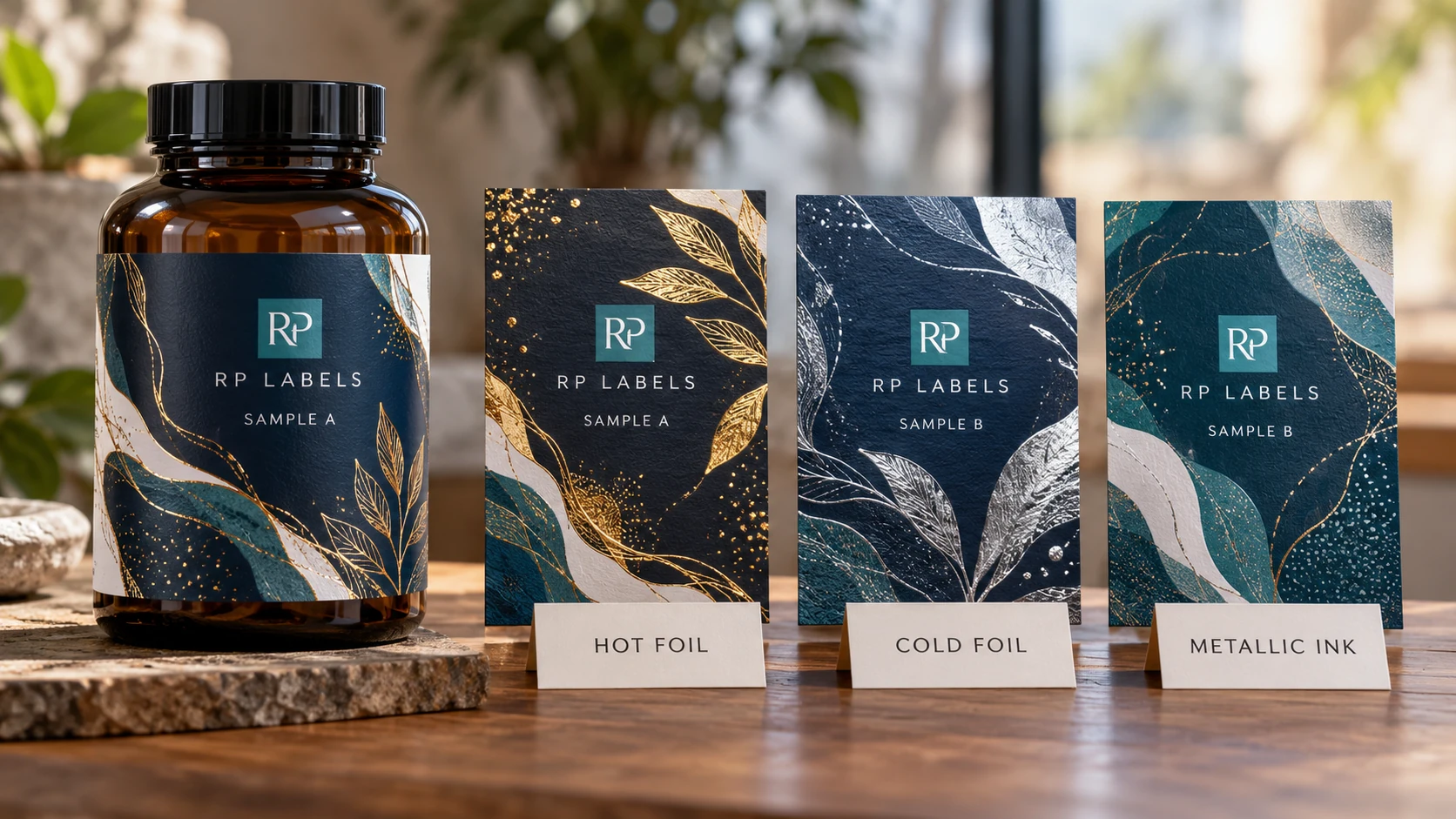
AI-generated packaging illustration. Fictional RP samples show the proposed decision; no physical test or customer order is documented.
Compare the finish you will actually receive
State the visual target in ordinary terms: a mirror-like accent, a softer shimmer or another actual reference. Identify the metallic areas in the artwork and which small gaps or text must remain distinct. The print supplier can then explain which available route is plausible for the stock, artwork and quantity. Do not assume every supplier offers every process.
The worked record compares a metallic element before and after the proposed protection. Keep the substrate and finish identified. If the unfinished swatch is only a selection aid, mark it that way; it should not silently become the repeat-order standard. Ask what production stage the physical proof represents and whether any later operation remains likely to change the appearance.
Look at the applied bottle under agreed viewing conditions and turn it through a normal range of angles. Check that the metallic area delivers the intended impression without making nearby information harder to read. A static photograph helps discuss a sample, but the moving reflection deserves a physical reference when it is central to the design.
Metallic ink can be a sensible choice when a restrained sheen is the goal, rather than a compromise chosen only for cost. A foil route may be justified where the buyer expects a distinct reflective accent and the artwork suits it. The delivered quotation should identify setup, finish and any retained tooling conditions without claiming a universal cheapest process.
Send RP Labels the appearance reference, protected-sample requirement, separate metallic artwork layer and quantities. Ask which production route and proof scope can be quoted. Keep the approved finished piece with the reorder brief so the next purchase protects the same expectation.
A metallic face stock is another construction, not another name for hot foil
A reference photograph can show a silver background without revealing how it was made. Before comparing hot foil, cold foil and metallic ink, ask whether the proposed label instead starts with a broad reflective face stock. The visual target may be similar, while the material and artwork responsibilities differ.
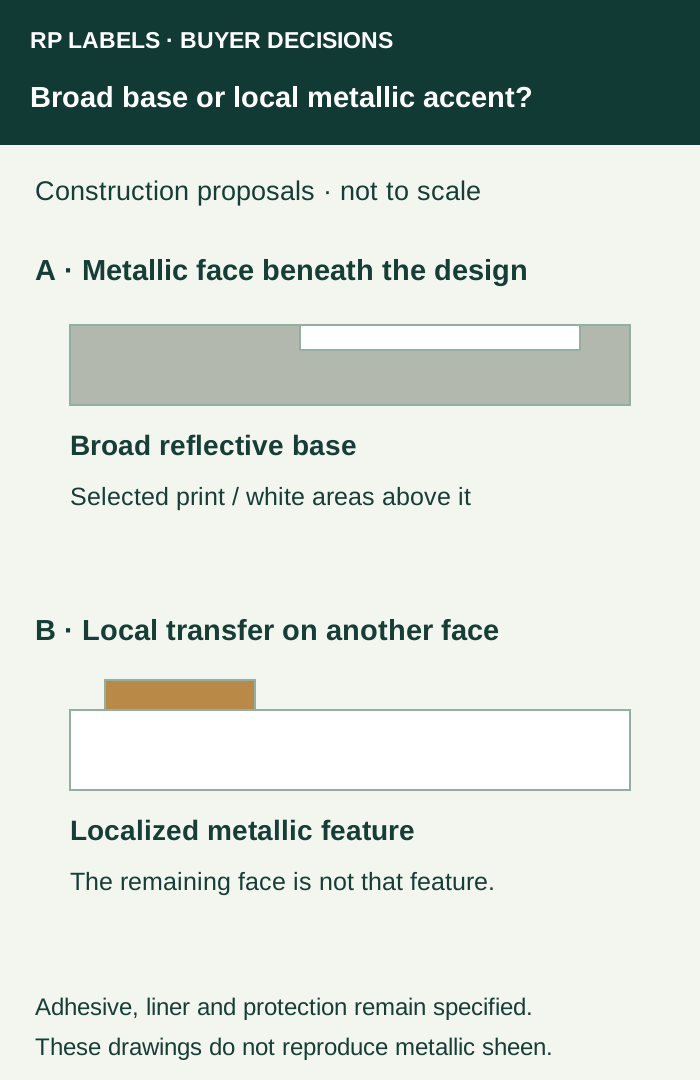
With a metallic base construction, selected exposed areas can provide the underlying reflective appearance, while printed and opaque areas control where it remains visible. A selective-transfer proposal locates the metallic effect through its own defined artwork and production route. Neither description identifies every layer or the final sheen; ask the supplier to name them.
Avery’s metallic roll-label guidance gives an example using metallic stock and white underprint where a metallic appearance is not wanted. It illustrates that alternative construction. Its layer names, ordering instructions, prices and availability are not RP specifications.
Compare the same three visible areas
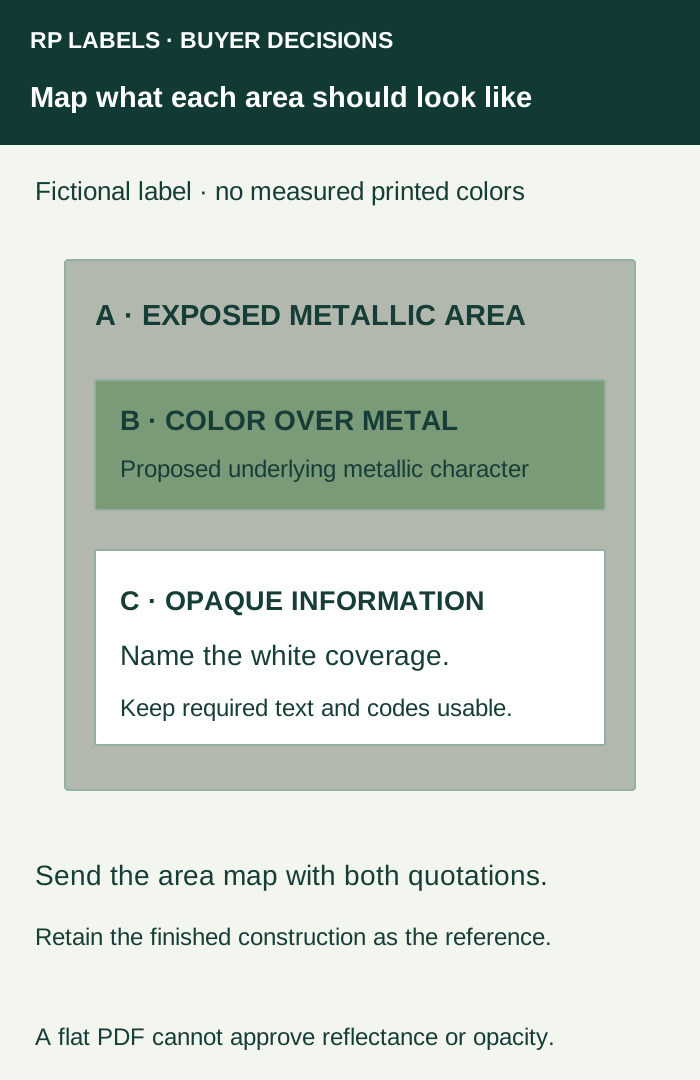
Mark one area intended to remain visibly metallic, one intended to carry color with an underlying metallic character, and one requiring a calm opaque background. This makes the proposed white coverage part of the actual file brief. Merely filling a PDF area with process white does not establish that white ink will be printed there.
Compare the same artwork under a metallic-base proposal and a selective-accent proposal. For broad reflective coverage with selected opaque panels, a suitable base stock may deserve discussion. For a small isolated accent on an otherwise quiet label, selective transfer may better express the original design. These are conditional directions to compare, not a universal coverage threshold or price rule.
Keep the finished construction in the sample request. A protective layer can change the appearance, and a small information panel still needs a legibility or code check on the applied bottle. If the supplied sample shows another material or an unfinished stage, document that difference instead of using it as an approved bulk reference.
Keep the quotations separate until their scopes match
Request the proposed stock, white and color treatment, transfer operation where applicable, protection, setup and quantities per design. Ask what changes for a reorder. “No separate foil pass” does not by itself establish a cheaper total, and the word silver does not prove an aluminum face, a particular polymer or a security function.
Send RP the marked reference, three-area map and intended supplement bottle. Ask which metallic construction and finished-sample scope can be quoted. Keep the stock-based alternative separately identified from hot foil, cold foil or metallic ink so the chosen purchase remains understandable after the sample conversation.
Hot foil: controlled accents with separate tooling
Hot foil uses heat and pressure to transfer foil through a prepared die. It works well for logos, borders, names and deliberate premium accents. Depending on the tooling and process, the result may be a flat transfer or combined with an embossed impression. Do not assume every hot-foil label is embossed.
The die, foil position and make-ready add setup. Very fine reversed type, tight registration beside printed text and sharply curved small bottles need production review. For stable artwork that repeats, the tooling can be worthwhile.
Cold foil: reflective transfer inside a printing route
Cold foil typically places a UV-curable adhesive in the intended image, laminates foil to it and removes the carrier. It is often considered for fine patterns, larger decorated areas and effects that will be overprinted with color. KURZ describes cold transfer as an inline decoration process and shows its use with overprinting; see the manufacturer's cold-transfer overview.
The word “cold” does not make it universally simpler or cheaper. Foil release, adhesive laydown, substrate smoothness, curing and press configuration all influence the result. Approve it on the actual label stock.
Metallic ink: printed character rather than a foil mirror
Metallic ink uses reflective particles in an ink system. It can create a convincing premium shimmer, but it usually does not return light like a smooth foil surface. Fine detail, ink film, background color and topcoat influence how bright it appears.
Buying rule: describe the expected reflection under real shelf lighting. “Gold” is a color instruction; “mirror-like, subtle shimmer or stamped accent” is a production instruction.
Coverage and substrate can change the choice
A small logo accent behaves differently from a full metallic background. Large foil areas can reveal surface texture or transfer variation. Metallic ink over an absorbent paper can appear different from the same ink on a coated film. A dark bottle may make one effect feel richer while reducing contrast in surrounding fine text.
Finish protection also matters. Laminate or varnish can alter gloss and reflection. If the label must resist oils, moisture or frequent handling, include those exposures in the finish decision instead of adding protection after the appearance is approved.
A digital proof cannot approve reflection
A PDF can verify location, spelling, trapping notes and the size of the metallic layer. It cannot reproduce the movement of foil under light, the grain of metallic ink or a tactile impression. Use a physical material swatch, comparable sample or production proof and view it on the intended bottle.
Photographing a sample helps remote teams discuss it, but a photograph also changes with angle, exposure and white balance. Keep one signed physical sample as the repeat-order standard when the metallic appearance is brand-critical.
Worked metallic process choice record
The rows below are hypothetical planning examples. Empty observation or commercial fields must be completed from the actual project; no sample has been tested for this article. Use the worked CSV and blank worksheet with the field guide. Keep the example references separate from production records.
| candidate | metallic target | substrate | protection | proof stage | applied appearance observation | owner | decision |
|---|---|---|---|---|---|---|---|
| DEMO-FOIL | Mirror-like accent to discuss | Actual stock required | Actual laminate or varnish | Finished construction required | Brand owner | PENDING | |
| DEMO-INK | Restrained shimmer to discuss | Same or identified alternative | Same protection where comparable | Finished construction required | Brand owner | PENDING |
Bring this decision into the print inquiry
Contact RP Labels with the completed metallic process choice record, the actual packaging reference, approved artwork and quantity per design. State which fields remain unresolved so the print specification and any relevant sample scope can be discussed against the same decision.
Related buying guidance: Custom supplement labels; Holographic vs foil labels; Lamination vs varnish; Materials and finishes.