Hand or Semi-Automatic Vial Labeling: Count Accepted Output
A tabletop labeler looks quick when one vial follows another. The buying decision gets less tidy when the roll changes, the first pieces need checking and someone has to separate the labels that will not be shipped.
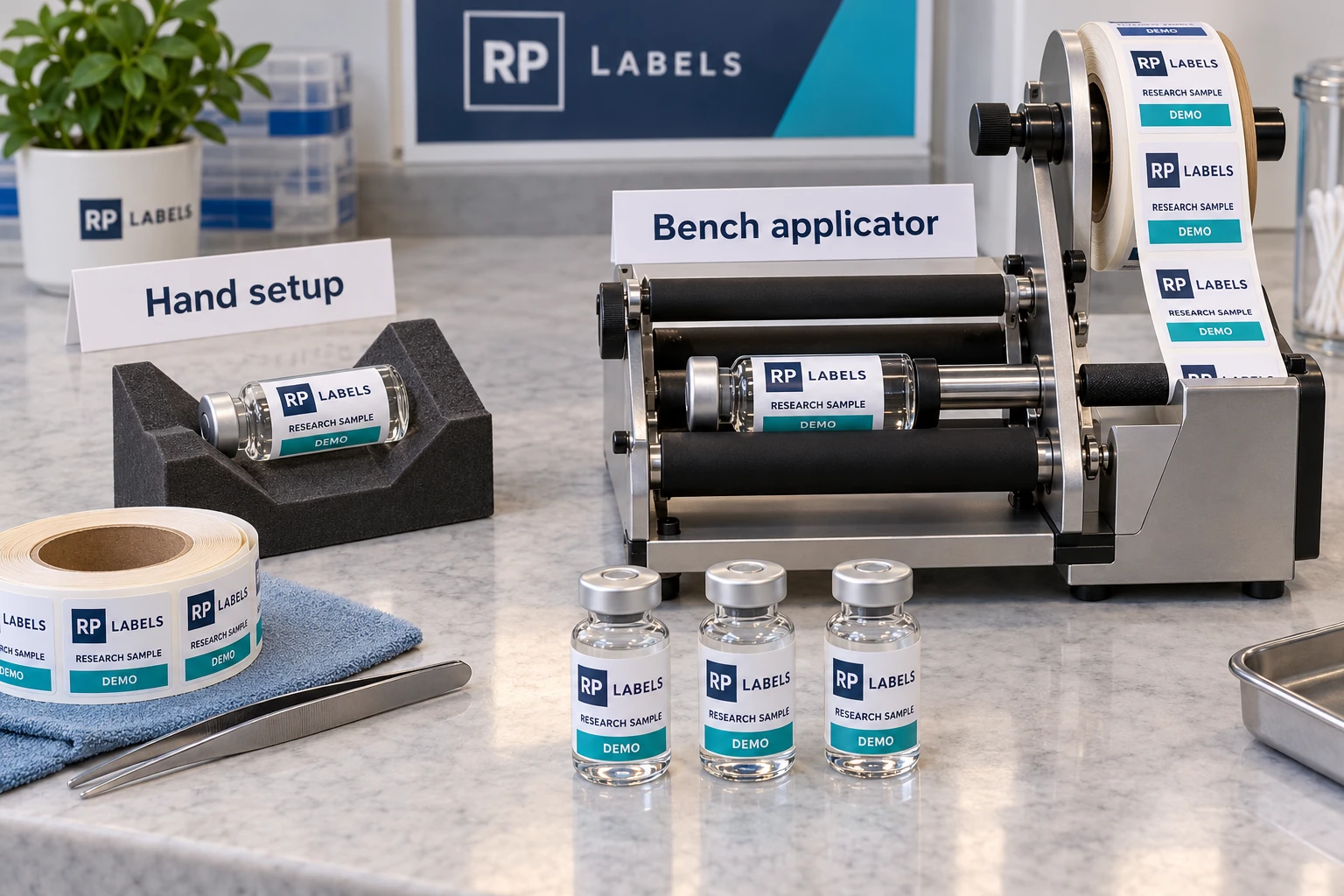
The short answer: hand labeling suits low volume, prototypes and frequent changeovers; semi-automatic application becomes useful when the same vial and label repeat often enough that alignment and operator fatigue become costly. Buy repeatability, not just advertised speed.
Most buyers first ask how many vials a machine can label per minute. In practice, the slower questions decide the result: how often the SKU changes, who loads the roll, whether the vial diameter varies, and what happens to the first ten pieces after every setup.
Time the order that will actually reach the bench
A machine demonstration with one familiar bottle proves less than it appears to. If your order contains several short designs, ask the vendor to include those changeovers in the trial. Keep the number of vials, label revisions, inspection requirements and acceptance criteria the same for the hand and machine routes. Otherwise the faster result may simply be doing a different job.
Start the record when the station is prepared, not when the first good vial begins rotating. Separate loading and adjustment, first-piece review, ordinary application, planned stops, rework and final inspection. Record accepted finished vials as the output. Labels dispensed and vials touched are useful observations, but neither is the count you can hand to the next packing step.
For a local comparison, divide the recorded operator minutes by the accepted quantity. Keep separate any other person's setup or inspection time rather than making it disappear from the machine case. This is a trial calculation for your workflow, not a published production capacity or a labor-saving promise.
A long stable run may make the machine's setup worthwhile. Frequent small changes may leave a simple cradle competitive. A stricter seam or rotation requirement can also change the result, even when the quantities are modest. Hand application deserves to win when it meets the same standard with less total work; the machine deserves to win when the actual run supports it.
Agree what happens if a restart produces several doubtful pieces. Quarantine and check them rather than letting the average speed hide them. Keep the accepted sample and the roll settings with the trial record. Send RP the vial reference, label dimensions and the equipment brief after the application route is chosen; ask the machine vendor to confirm that the trial format represents the production setup.
Download the worked example CSV · Open the working CSV · Read the field guide. The entries are planning examples, not completed results.
Hand application is not automatically unprofessional
For a short run, a trained operator with a simple cradle or alignment mark can outperform a machine that spends most of the job being adjusted. Hand application is flexible when vial sizes change, artwork versions arrive late, or each batch contains only a small quantity.
The weakness is variation. Labels can drift vertically, rotate away from the expected front position, trap bubbles or develop inconsistent gaps. Fatigue makes the last tray look different from the first. A written method and a basic fixture matter more than telling operators to “keep it straight.”
A semi-automatic labeler buys controlled repetition
A desktop wrap labeler rotates the vial and dispenses one label at a controlled position. It can improve seam consistency and reduce handling, especially when a long run uses one bottle and one roll. It still needs an operator to load, trigger and inspect.
Buying rule: calculate setup time, changeovers, rejected labels and inspection effort alongside application speed.
The vial must give the rollers a stable surface
Measure the straight-wall area between the shoulder and base radius. A tapered, deeply curved or highly inconsistent vial may walk sideways during rotation. The label should remain inside the straight wall, and the rollers must grip the container without contacting a fragile cap or closure.
Send physical vials to the machine vendor or label supplier whenever possible. A drawing can show diameter while hiding molding seams, surface texture and dimensional variation.
Roll specifications become production specifications
Core size, maximum roll diameter, unwind direction, label orientation, web width, liner type and the gap between labels all affect setup. A roll can contain perfectly printed labels and still be unusable on the machine because the copy faces the wrong direction or the roll is too large for the holder.
Clear labels deserve special attention. Some photoelectric sensors cannot reliably see a transparent edge on a clear liner. The machine may need an ultrasonic sensor, a printed registration mark or a different construction. Confirm this before the roll is made.
Artwork position must allow mechanical tolerance
Do not place a vertical rule, dosage line or QR code exactly at the seam and expect every wrap to meet like a book cover. Leave a controlled quiet area, define an acceptable gap or overlap, and keep critical copy inside the safe zone. A few millimeters of visual breathing room often looks more precise than a design that depends on impossible registration.
Build the first-piece check into the process
At each changeover, approve the first applied vial for height, rotation, seam, wrinkles and scan performance. Keep that sample at the station. Recheck after a roll splice, operator change or adjustment. A semi-automatic machine reduces variation only when the setup itself is controlled.
Before choosing the method
- List batch volume and the number of SKU changeovers
- Measure the actual vial straight wall and diameter variation
- Define acceptable vertical and rotational alignment
- Confirm core, unwind, roll diameter, liner and label gap
- Test clear-label sensor detection when applicable
- Approve a gap or overlap tolerance at the seam
- Create a first-piece and interval inspection routine
- Retain an approved vial for each artwork version
Bring the decision into your print brief
Use the identified references and open items in the worked record when discussing your custom print project. Include the actual package, artwork revision, quantity per design and the conditions explained above; leave unknown inputs marked for confirmation. Review the relevant custom-label service, then send the project details to RP Labels.
Related buying decisions
- Hand-Applied Peptide Vial Labels: Proof Alignment Before a Short Run
- Peptide Vial Label Roll Direction: How to Order Labels That Apply Correctly
- Vial Label Roll Size: Confirm the Applicator Envelope
Sources and scope
Reviewed October 25, 2026. Primary supplier or official reference supports the identified production concept. Procurement comparisons and worksheets are editorial guidance. Conditional examples are not customer records, completed tests, regulatory approval or universal acceptance standards. Confirm the actual proposed construction and process with the responsible supplier and buyer.