Vial Label Roll Size: Confirm the Applicator Envelope
The quote has the correct label count. The proposed roll is larger than the machine will accept. Before treating that as a packing detail, put the operator's roll envelope next to the supplier's labels-per-roll proposal.
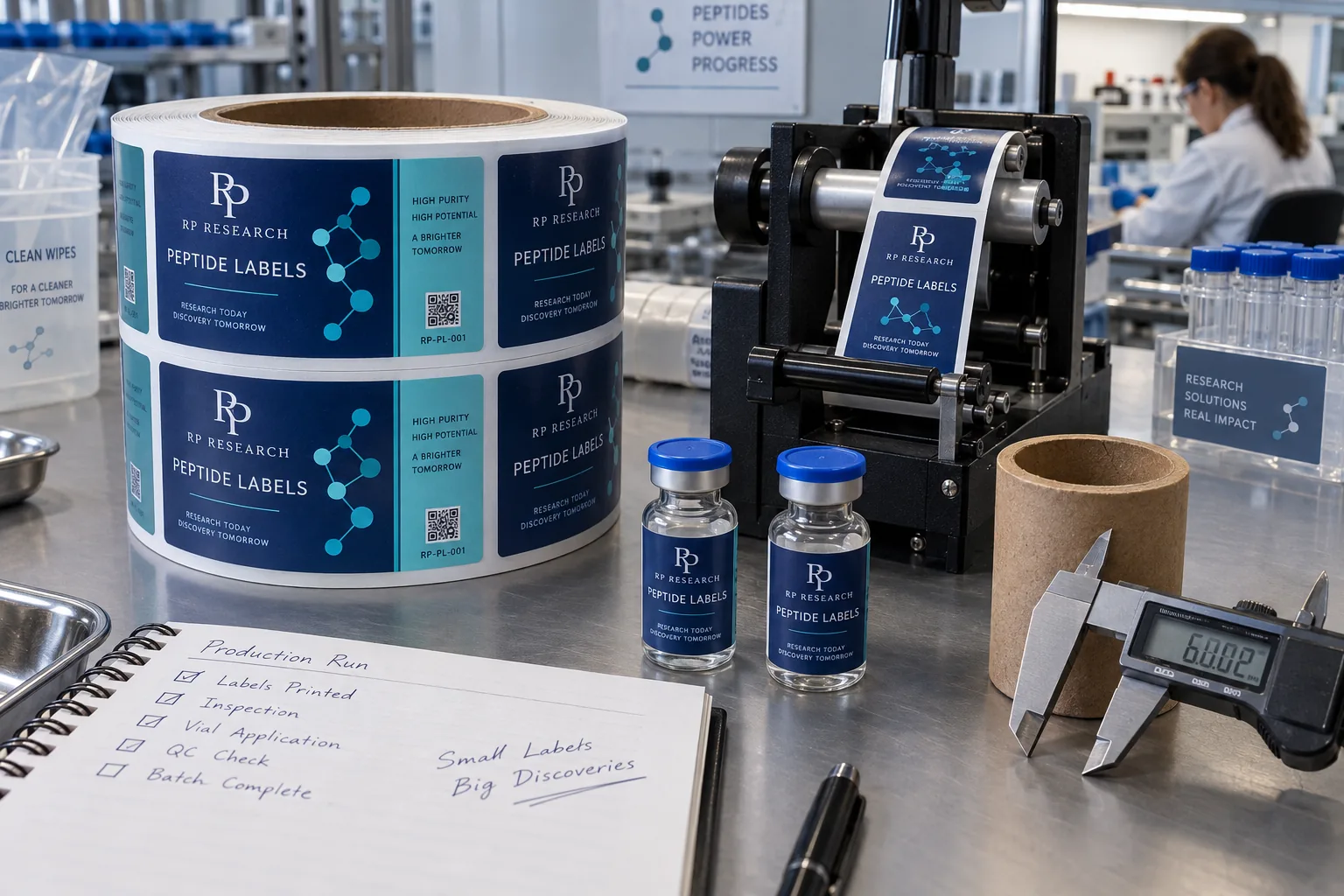
Before you buy a roll, check the spindle, not only the sticker. A beautifully printed peptide vial label is useless to a tabletop applicator if its core will not mount or the finished roll hits the guard. This is a mechanical fit decision, separate from artwork approval.
I would ask for a photograph of the actual applicator with its present roll, the machine model, and the label path. A quote that says only “roll labels, 2 mL vial” leaves too many assumptions with the converter. The vial volume tells me almost nothing about the spindle.
Translate the machine limit into the finished-roll packing instruction
A core diameter does not describe the outside of a full roll. It also does not describe the machine guard, holder clearance or the approved adapter arrangement. Start with the actual machine manual and the operator's confirmed setup. If the manual and the installed configuration disagree, resolve that difference with the equipment supplier before approving bulk packing.
Ask the converter to state the intended core inner diameter, finished outer-diameter limit, web width and quantity per roll on the same proposal. Label thickness, liner and winding affect the relationship between count and diameter. A rough calculation can help planning, but an unverified estimate should not override a machine limit. Request the converter's confirmed packing proposal for the actual construction.
Here is a useful distinction in the example worksheet: 'supplier can rewind' is not the same as 'packing team can use this roll.' If smaller finished rolls are needed, agree the split, identification and any resulting packing charges before the order. Do not plan for an operator to unwind a large roll by hand at the filling bench.
A larger roll can win when it fits the approved setup and reduces interruption in a stable run. Smaller rolls can win when the equipment envelope or short SKU changes make them more practical. Neither choice follows from the nominal vial capacity. The same total order can be supplied in different finished formats with different handling consequences.
Keep the confirmed machine limits, offered roll specification and trial-roll reference together. Mark unknown fields as awaiting the operator or vendor, and hold that part of the packing instruction. The roll may still need a dispensing trial after it mounts; fitting inside the guard is necessary, not a complete application approval. Send RP this completed equipment note with the vial dimensions and per-design quantities so the order specifies usable rolls rather than just a large number of printed labels.
Download the worked example CSV · Open the working CSV · Read the field guide. The entries are planning examples, not completed results.
Estimate roll capacity without confusing the core opening with its outside
A public printing-work discussion describes difficulty estimating label count under a maximum roll diameter. It is one operator’s question, not an RP order or evidence of general failure rates. The planning issue is worth separating into three steps: winding geometry, repeat length and usable delivered count.
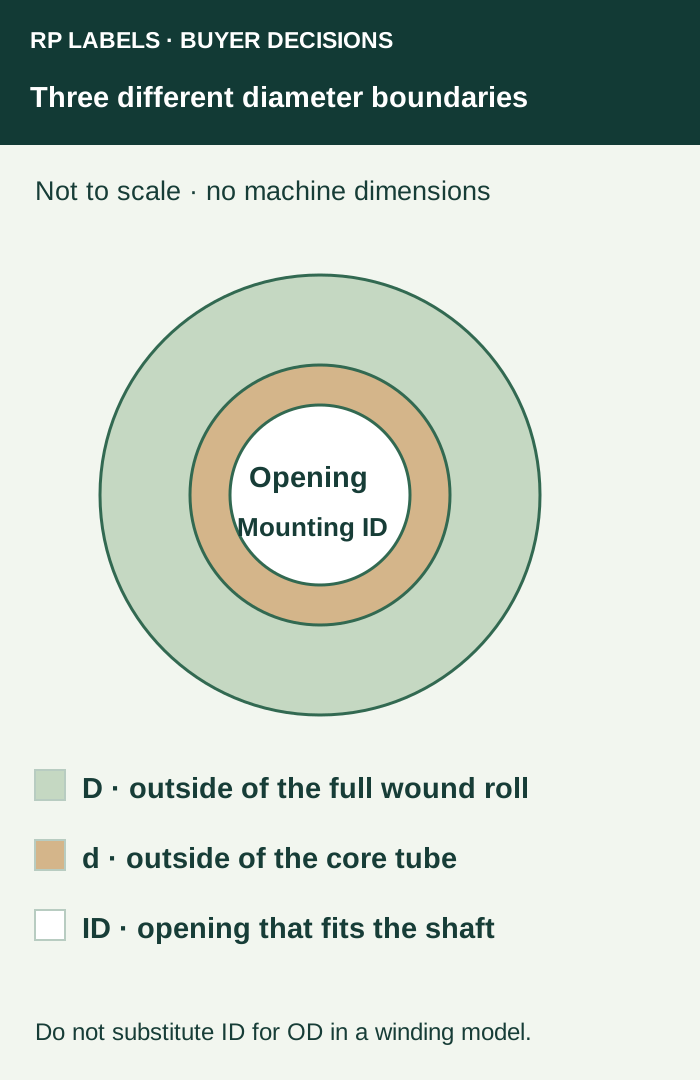
Avery Dennison’s roll calculator asks for roll OD, core OD and material thickness to estimate web length. The core ID used to mount the roll is not the same input as the core OD underneath the material. Identify both when requesting a roll-build calculation.
For an ideal uniformly wound web, cross-sectional area gives the model L = π(D² − d²)/(4t): full roll OD D, core OD d, effective wound-web thickness t and length L. Use consistent length units. This model assumes a uniform effective thickness and ideal winding; it is not a guarantee for discrete die-cut labels with gaps, compression or other winding effects.
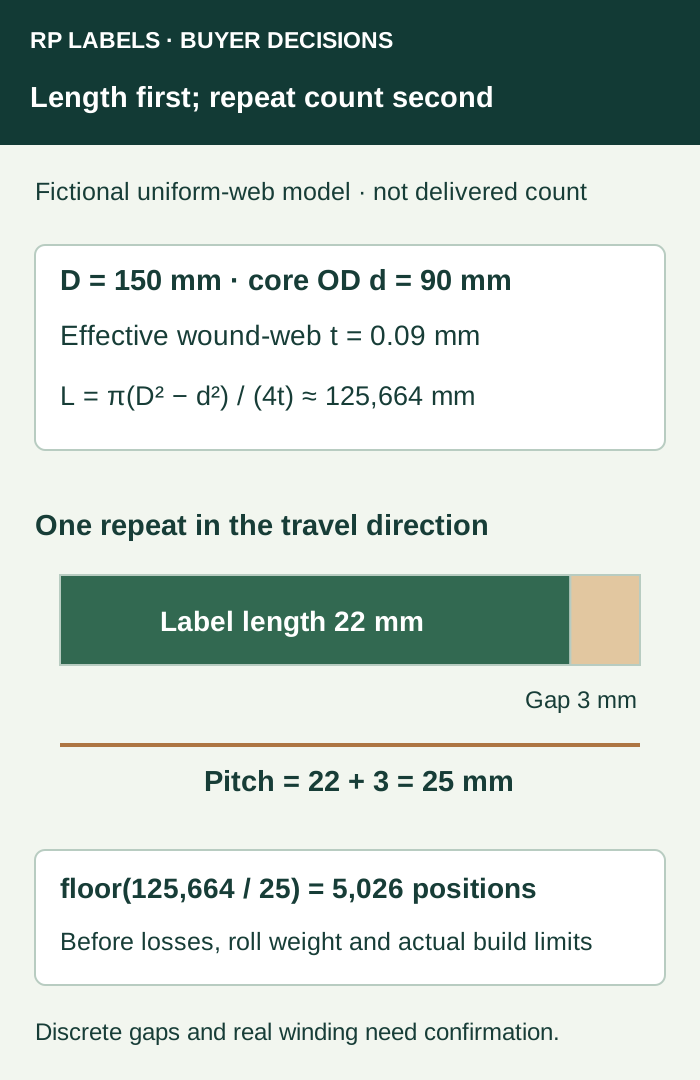
With the invented values shown, the model gives about 125.7 m of web. Dividing by the 25 mm repeat gives 5,026 complete theoretical positions after rounding down. Dividing by the 22 mm face length alone would incorrectly ignore the repeated gap. Different lane arrangements also change the relationship between rows and individual labels; use the delivered-lane guide for that separate count unit.
Theoretical positions are not saleable or usable output. The actual proposal must account for the accepted construction, winding, leader/trailer, splices, rejects, counting basis, roll weight and machine limits. Do not deduct an invented waste percentage or substitute face-film thickness for the full effective web input. Ask the converter for its confirmed finished-roll build and relevant trial or measured evidence.
If the machine limit is firm, a lower accepted count per roll may be the practical choice. If a count target is firm, ask whether it fits all the actual limits before approval. A calculator cannot authorize a larger roll or establish that the operator can load it. Include the identified core ID and OD, maximum finished OD, full construction and repeat dimensions with the RP inquiry.
Four measurements that belong on the RFQ
Cores we can supply
We can supply rolls on 1-inch or 3-inch cores, and on other core sizes when your applicator requires them. There is no single standard core that fits every machine. Please give the core inside diameter your equipment needs.
Four measurements that belong on the RFQ
Ask your operator to record the core inner diameter, maximum finished outer diameter, liner or web width, and label pitch or gap required by the sensor. Measure the core opening, not the outer wall of the cardboard tube. Then check whether the roll is wound labels-out or labels-in and which edge of the artwork leads into the peel plate.
Those numbers are machine-specific. HERMA's printed-roll guidance offers several core sizes and asks buyers for the maximum roll diameter their system can handle. Use the current manual for your actual equipment and installed configuration rather than copying dimensions from another applicator.
The Primera AP550 manual gives a different equipment-specific roll envelope. This is why “standard 3-inch core” should not close the discussion. Even if the core slides onto the spindle, a wide or heavy roll may be wrong for the tension path or table clearance.
Why a cheaper large roll can be the expensive choice
Suppose two quotations contain the same total number of labels. One uses fewer, larger rolls; the other splits the quantity across smaller rolls. The first may reduce roll changes and packing material. It may also exceed a small applicator's outside-diameter limit, make manual handling awkward, or leave a long partially used roll exposed between short SKU runs. These are trade-offs, not a claim that small rolls are always better.
For a high-throughput line that accepts the diameter, the larger roll may be exactly right. For a bench operation with frequent artwork changes, I would ask the operator which roll size is comfortable to load and how many labels are consumed before a changeover. Do not price the converter's convenience while ignoring the packer's daily routine.
A core that fits can still feed badly
Core fit is the first gate. The next gates are web width, winding, label gap, backing opacity for the sensor, and the way the label peels at the dispensing edge. A narrow small-vial label on a backing that wanders laterally can make repeatability worse even when the print looks clean. Ask for a short roll to run on the exact machine before ordering the full quantity.
Do not use the sample only to see whether a vial can receive one label. Run enough labels to watch the feed settle, stop, restart and change rolls. Confirm that the print faces the correct way on the vial without rotating the bottle by hand after each application. If orientation is the problem, use the roll-direction guide rather than changing the core specification to solve the wrong issue.
Send the converter a usable equipment note
| Item | What to send | Why it matters |
|---|---|---|
| Applicator | Maker, model and photo of the current label path | Defines the actual loading and dispensing arrangement |
| Core | Measured inner diameter and any approved adapter | Prevents spindle mismatch |
| Roll | Maximum permitted outer diameter and desired labels per roll | Balances capacity with handling |
| Web | Liner width, label pitch, gap and sensor method | Supports consistent feed and detection |
| Orientation | Labels-in/out and leading edge, ideally with a marked photo | Keeps artwork upright at application |
Do not guess a tolerance from another machine's manual. If the operator cannot identify a number, say so and ask for a production-representative trial. The roll receiving checklist covers counts, splices and winding quality after delivery; it does not replace this pre-order fit check.
Approve the full construction, not the core alone
Once the test roll feeds, inspect the label on the real vial after the usual handling and storage route. A core choice does not validate adhesive, curved fit, legibility or resistance to the intended environment. Keep those acceptance points in the same approval record, with the machine model and roll format clearly named.
My buying decision is simple: I will not approve a bulk roll format until somebody at the packing table can load it and run it without special improvisation. Send RP the applicator details, vial photos, desired size and expected labels per artwork; ask for a quote that states the finished roll format, not merely the label count.
Bring the decision into your print brief
Use the identified references and open items in the worked record when discussing your custom print project. Include the actual package, artwork revision, quantity per design and the conditions explained above; leave unknown inputs marked for confirmation. Review the relevant custom-label service, then send the project details to RP Labels.
Related buying decisions
- Peptide Vial Label Roll Direction: How to Order Labels That Apply Correctly
- Automatic Supplement Label Rolls: Get the Packer to Sign the Roll Brief
Sources and scope
Reviewed October 25, 2026. Primary supplier or official reference supports the identified production concept. Procurement comparisons and worksheets are editorial guidance. Conditional examples are not customer records, completed tests, regulatory approval or universal acceptance standards. Confirm the actual proposed construction and process with the responsible supplier and buyer. Demand layer: competitor and process pages linked here, including Avery, HERMA or OnlineLabels where cited, illustrate buyer language and process topics only. They do not supply RP minimum quantities, lead times, prices, certifications or materials. Authority layer: an RP number is backed only by a factory datasheet, a signed quote or proforma, confirmed product data, or a fact kept on the About page. The March 2026 proforma there is one production-run example, not a standing offer. RP shipping and planning pages describe what to confirm on a quote. Worked figures on this page are fictional unless an authority source is named for them.