How to Check Recycling Evidence for HDPE Supplement Bottle Labels
Ask for a report that identifies the finished label on your HDPE bottle. Match the report to the bottle resin and color stream, the printed face material, the adhesive, the finish and the area the label covers. A proposed label can meet the filling line’s adhesion needs while its behavior in recycling still needs evidence. Give those two decisions separate approvals.
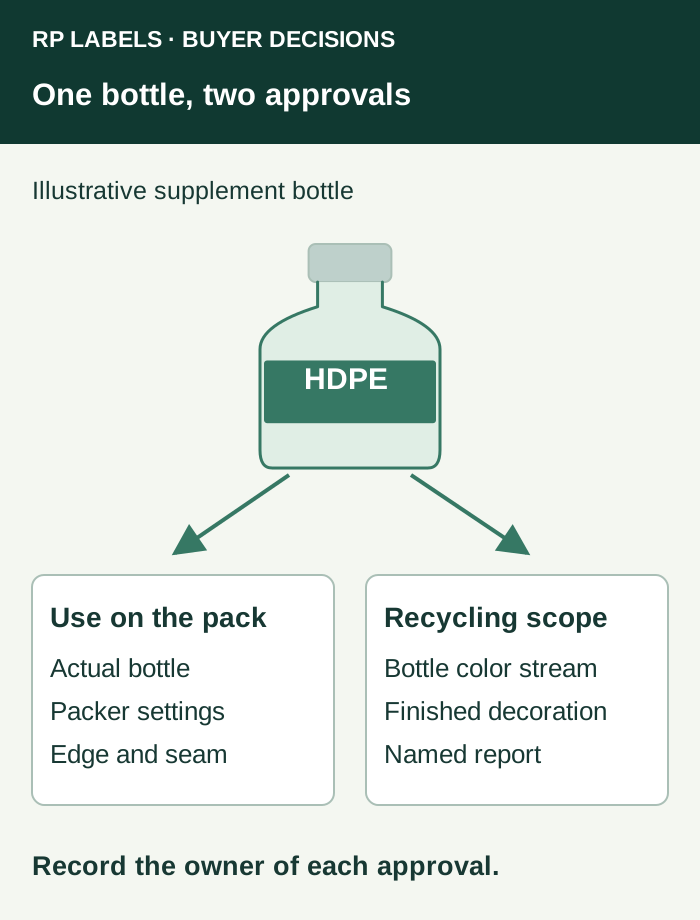
Start with the bottle specification
Ask the bottle supplier for the body resin and color, including whether the body is natural, white or colored HDPE. Identify the exact bottle item, the closure and any separate seal. Give the packaging reviewer the market and recycling stream the brand intends to assess. A bottle change from PET to HDPE sends the buyer back to the HDPE evidence route. The PET bottle guide covers the different container decision.
Capture the size and position of the decoration on the applied bottle. A short front label and a full wrap can leave different amounts of body visible to sorting equipment. Record the actual applied footprint and ask the reviewer which sorting checks are relevant to the proposed pack. For a tapered bottle or an irregular panel, use a bottle drawing and applied sample to establish coverage.
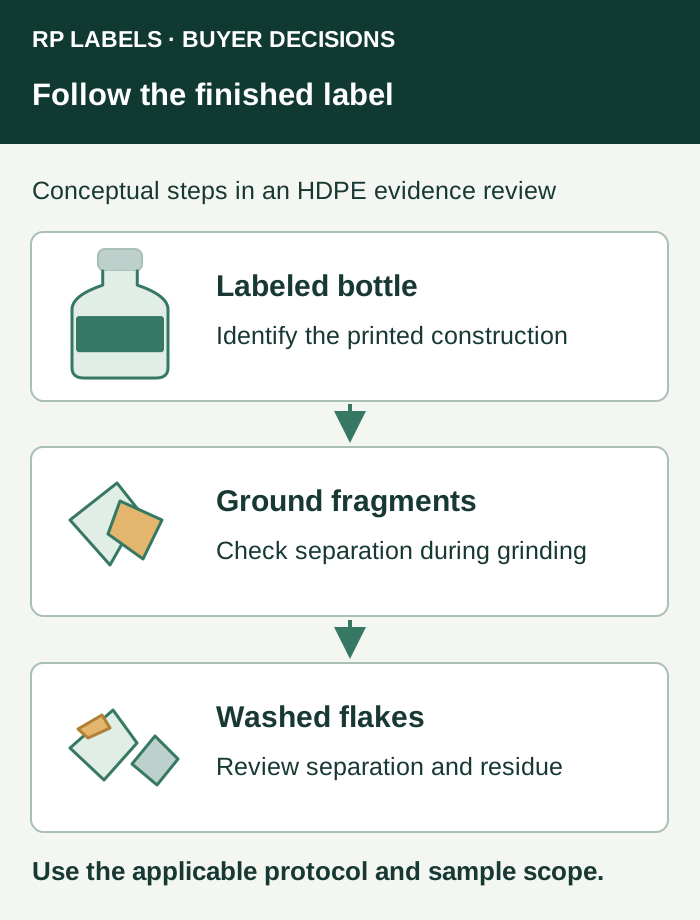
Ask what happens during grinding and washing
RecyClass evaluates label separation during grinding and washing and looks for remaining adhesive on washed HDPE flakes. Its scope also directs attention to ink bleeding for printed labels. Ask the reviewer to confirm which procedure, version and stream apply to the complete package. RecyClass HDPE label and adhesive protocol.
RecyClass has announced approvals for named label constructions on white HDPE bottles. Request the actual letter and its conditions from the supplier if the proposed stock relies on one of those approvals. Have the reviewer compare the proposed print and finish with the construction in the letter. RecyClass announcement on white HDPE evaluations.
Compare a repeat order with a material change
| Purchasing situation | What the reviewer needs | Order decision |
|---|---|---|
| The converter offers the evaluated construction | Exact material references, the approval scope and a drawing of the applied bottle | Continue to applied sample review once scope matches |
| A different adhesive or protective finish is proposed | The revised layer specification and an explanation of which prior results still apply | Hold the recycling decision while the reviewer resolves the change |
| A matte label becomes a large metallic wrap | The applied footprint, metallic decoration and intended sorting stream | Review sorting and recycling evidence for the revised pack before approving its specification |
For the in-use approval, have the packer apply the identified label to the real bottle with the intended line settings. Check the seam, edge contact and readable information after the agreed handling conditions. Record the results against the label stock, bottle item and artwork revision. The HDPE adhesion guide explains how to control that comparison.
Put both approvals in the quote brief
For custom supplement labels, send RP the bottle drawing or sample identity, printed footprint, quantities by design, application route and the recycling evidence your packaging reviewer needs. Prepare the inquiry with a request for identified candidate constructions and the evidence available for each. Give the packer responsibility for the applied trial and the packaging reviewer responsibility for confirming the recycling scope.