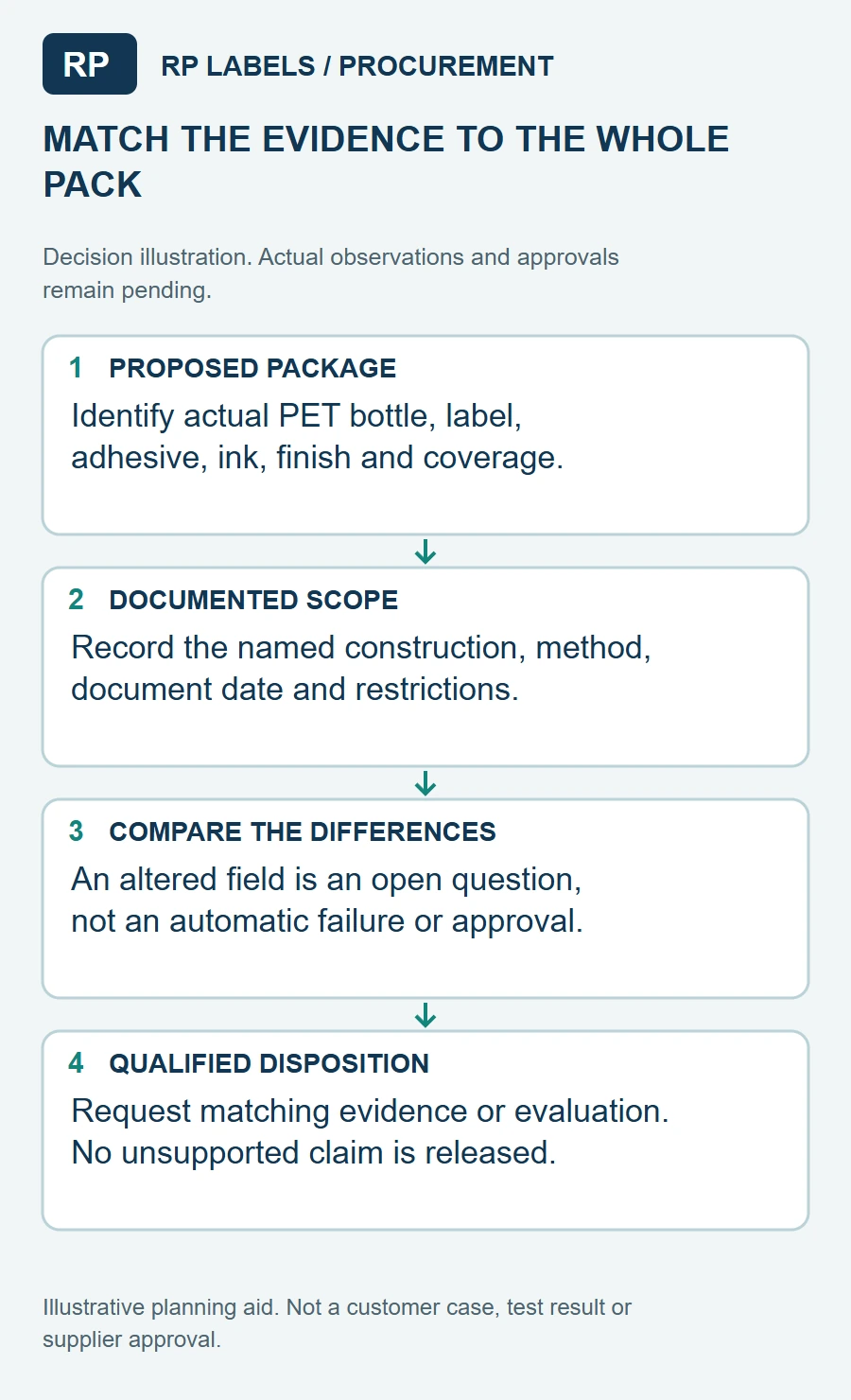
"The bottle is PET" does not finish the recycling conversation. A supplement label is an assembly of film or paper, ink, adhesive and finish. It also covers part of the bottle. Each of those decisions can change how the pack is sorted or processed at end of life.
I would ask this question early if the brand has an actual recyclability requirement. It is hard to retrofit a wash-off label after the artwork, color coverage and adhesive have already been approved around a different construction. At the same time, I would not print a recyclability claim merely because a supplier offers a "green" face stock.
First identify the bottle and the collection route
Confirm whether the body is clear PET, colored PET, HDPE or something else; the cap and label may be different materials. Specify the sales market and any applicable local collection scheme. Guidance for PET recycling does not automatically transfer to a different bottle resin or every geography.
The Association of Plastic Recyclers' PET packaging resources emphasize that label material, adhesive and ink must be assessed as a construction. The cited resource addresses PET thermoforms and points to PET bottle criteria; it should not be treated as a blanket certification for a supplement bottle. Use the current bottle-specific APR design guidance or the target market's equivalent with your converter.
A wash-off adhesive is not a removable sticker
A removable label may peel by hand while a wash-off construction is designed to separate under a recycling process. Those are not synonyms. Avery Dennison explains that adhesive behavior in the washing step depends on the label and bottle materials; it describes a specialized PET separation technology, while noting that manually removable labels are a different route.
Ask the supplier for the exact face stock, adhesive, ink and finish combination with relevant test evidence, not just a material name. A thin film may resist shower humidity beautifully and still be the wrong construction for your recycling objective. Coverage matters too: a large dark wrap can affect sorting even if the adhesive is designed to release later. Artwork choices belong in the technical discussion.
Test the pack during use as well
The label has to work before it reaches a recycler. Apply samples to the real clean bottle, then look for edge lift, wrinkling, opacity loss, ink scuff and adhesion after your expected storage and handling route. A material that only works under ideal lab conditions may create returns or relabeling waste. Conversely, an aggressive permanent adhesive may hold very well and frustrate the end-of-life requirement.
The paper-versus-BOPP guide explains ordinary moisture and finish trade-offs, but a recycling brief needs more than a two-material comparison. Ask whether the full construction has been evaluated against the relevant design-for-recycling protocol for your bottle type. If not, say "under evaluation" internally rather than marketing it as certified.
Put the evidence request in the RFQ
| Item | Buyer provides | Supplier confirms |
|---|---|---|
| Bottle | Resin, color, dimensions and photos | Construction suited to that surface |
| Route | Sales market and recycling objective | Applicable protocol and scope of any evidence |
| Artwork | Coverage, ink and finish needs | Effect of the complete print construction |
| Use | Storage, handling and application method | Applied-sample plan on the actual bottle |
My decision would be based on two separate checks: the label performs on the shelf and the complete pack has evidence for the end-of-life route being claimed. Send RP the bottle specification and market requirements; we can discuss construction options, but no recyclability endorsement should be inferred from a generic sample photograph.
Sources and scope
Reviewed September 29, 2026. Primary GS1, APR, equipment and materials references support the identified technical points. Buying scenarios and inspection checklists are editorial guidance, not RP production records, certification, legal approval or universal acceptance standards. Demand layer: competitor and process pages linked here, including Avery, HERMA or OnlineLabels where cited, illustrate buyer language and process topics only. They do not supply RP minimum quantities, lead times, prices, certifications or materials. Authority layer: an RP number is backed only by a factory datasheet, a signed quote or proforma, confirmed product data, or a fact kept on the About page. The March 2026 proforma there is one production-run example, not a standing offer. RP shipping and planning pages describe what to confirm on a quote. Worked figures on this page are fictional unless an authority source is named for them.