Hologram Carton Seals for Returns: What the Receiving Team Can Actually Check
Consider a hypothetical returned carton on a receiving table. The employee can see a holographic strip, but the useful question is not whether the strip is shiny. It is whether that exact seal is in the expected place, remains continuous across the opening, and matches the reference for that SKU and batch. Without that baseline, a return team is only admiring foil.
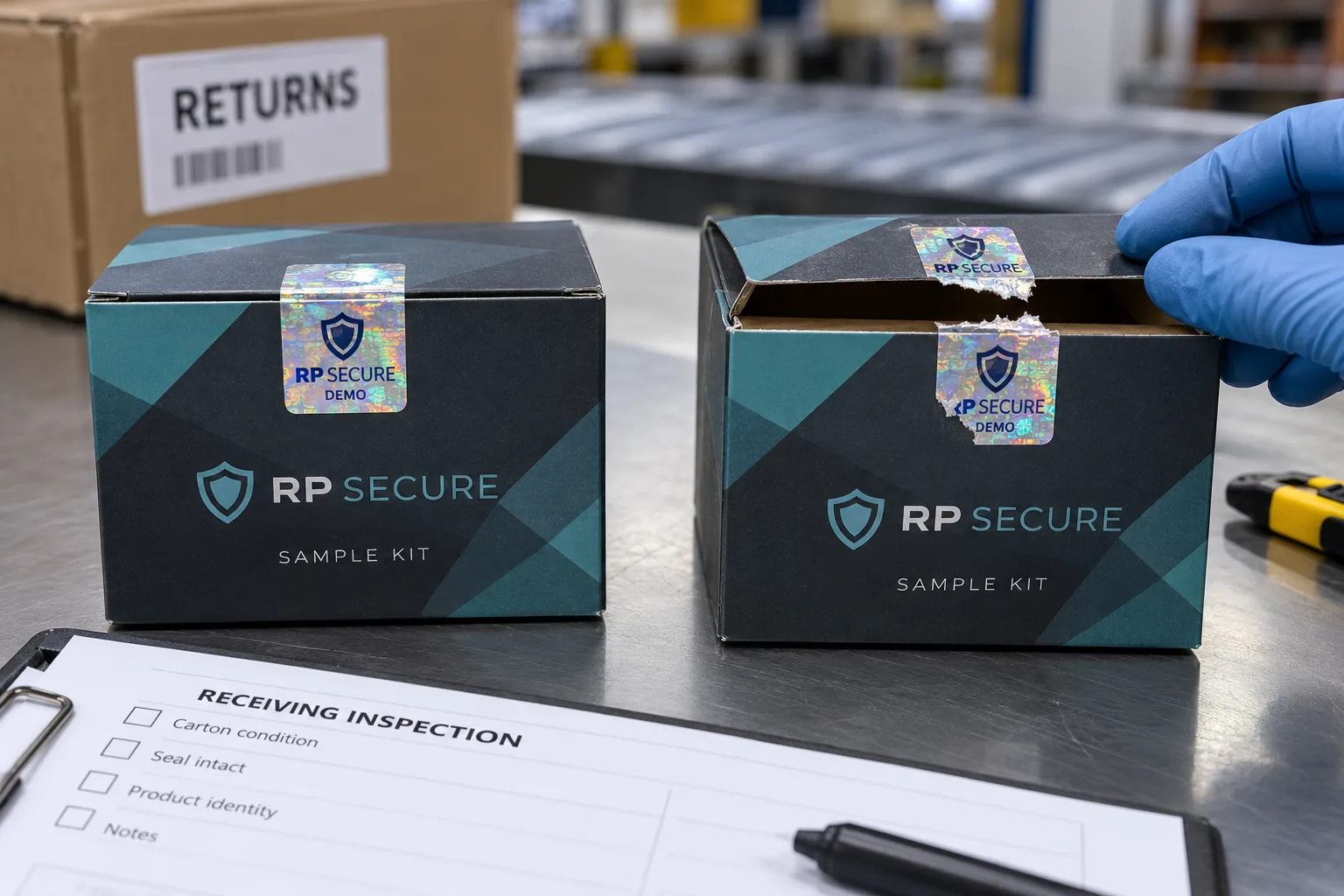
AI-generated packaging illustration. Fictional RP demonstration samples; not an actual order, completed test, authentication or approval record. Any displayed checks or codes are illustrative.
The two RP Secure cartons in the illustration are fictional examples of intact and visibly torn opening bridges. The image does not authenticate a product and cannot establish what happened to a real return. A broken seal is a reason to escalate according to company policy, not a diagnosis of counterfeiting or contamination.
Define the normal carton first
Keep an approved reference photograph and one physical production sample for each carton finish and seal version. Document where the bridge crosses the flap, its orientation, its size, the design details an inspector can reasonably see, and any printed serial or lot relationship. A premium-looking hologram that drifts between batches is hard to inspect. If a new artwork version is released, retire the old reference deliberately rather than leaving both on the table.
Test the seal on actual finished board. HERMA's first-opening label example explains that tamper evidence is a material-and-surface construction, not a holographic appearance alone. It also shows why the flap joint matters. Do not copy its medical-packaging claims onto a general custom label without qualification.
Choose inspection questions a person can answer
A receiving checklist can start with: Is the outer carton present and correct? Is the seal present in the expected place? Is it continuous over the intended seam? Is there tearing, residue, displacement or a second sticker covering the first? Do the printed SKU and lot data match the expected records? Is the carton crushed, wet or otherwise altered? Record photographs before further opening so the reason for escalation is preserved.
Visual receiving checks need the buyer's applicable reference and disposition policy; holographic appearance alone does not establish provenance. If the brand also uses a QR or serialized code, check the data system separately; the visual versus digital guide explains why the two checks answer different questions.
Decide what each result triggers
An intact seal can support a defined screening step, but it should not automatically put a return back into saleable stock. The brand needs its own return policy, product-condition criteria and, where relevant, quality or regulatory review. A broken or missing seal should trigger segregation and investigation, not an accusation made from a photograph. Give receiving staff a simple place to log uncertainty instead of forcing a yes-or-no conclusion they cannot defend.
Proof the opening behavior on multiple cartons from the intended material and printing finish. Check whether the tear is easy to see without destructive handling; then see whether normal shipping abrasion can create a false alarm. The tear-path guide covers the die-cut details. A seal that fails during distribution is not a useful return control.
The purchasing brief
Send the carton sample, coating details, flap geometry, expected opening motion, packing-line method, volumes, reference artwork and receiving decision tree. Ask the converter for physical trials and document what those trials demonstrate. If there is a serial or QR system, specify who owns the code data and how exceptions are resolved.
I would buy a seal only after the receiving team can explain, with a sample carton in hand, what they will actually look for. The line that applies it and the desk that judges it are part of one specification.
Leave room for an honest uncertain result
Consider a hypothetical return whose seal appears intact, but the receiving team has only an older artwork reference. Calling it genuine would overstate the evidence. Calling it counterfeit would do the same. The useful action is to preserve the observation and obtain the applicable reference from its owner before any stock disposition.
The worked return-triage record, blank record and field guide include intact-looking, visibly damaged and uncertain cases. The examples propose receiving routes; they do not authorize resale, disposal or a security accusation. Actual photographs, data checks and release decisions remain open.
Receiving records what it can observe before further opening. The reference owner identifies the current carton/seal version and any legitimate version differences. The responsible returns or quality owner decides the next step under the buyer's own policy. Keep those responsibilities distinct. A worker should not have to invent product-condition rules to complete a label checklist.
If recurring shipping damage produces confusing seals, return the observation to packaging development with the identified carton and seal reference. Do not change the receiving rule silently to make the ambiguity disappear. A simpler seal that staff can interpret under the intended conditions can be a better purchase than an impressive effect nobody can explain. The full return decision still depends on the buyer's product and process.
Record the case identifier and the reference version used by the reviewer. If the reference changes during investigation, retain the earlier observation and identify the later review separately. That keeps a revised instruction from silently changing the meaning of a photograph already captured at receiving.
Send RP Labels the receiving brief, carton sample, seal artwork, quantity and expected opening/inspection route. Ask which proposed construction and sample scope can address the physical observation; retain return-release authority within your operation.
Sources and scope
Demand layer: competitor and process pages linked here, including Avery, HERMA or OnlineLabels where cited, illustrate buyer language and process topics only. They do not supply RP minimum quantities, lead times, prices, certifications or materials. Authority layer: an RP number is backed only by a factory datasheet, a signed quote or proforma, confirmed product data, or a fact kept on the About page. The March 2026 proforma there is one production-run example, not a standing offer. RP shipping and planning pages describe what to confirm on a quote. Worked figures on this page are fictional unless an authority source is named for them.