Kiss-Cut or Through-Cut Labels: Specify What Stays on the Liner
“Die-cut to our shape” does not fully specify a label delivery. The buyer still needs to say whether each label stays on a continuous backing, sits on a sheet or arrives as a separate backed piece. For a bottle-label order, settle the cut depth and finished supply format together. For a machine-fed order, get the packer to confirm the continuous web it will actually load.
A shaped label can be supplied in more than one format. The visible outline on the bottle may be identical while the work needed to peel, count, handle or feed it changes. A photograph of the applied label cannot resolve those differences.
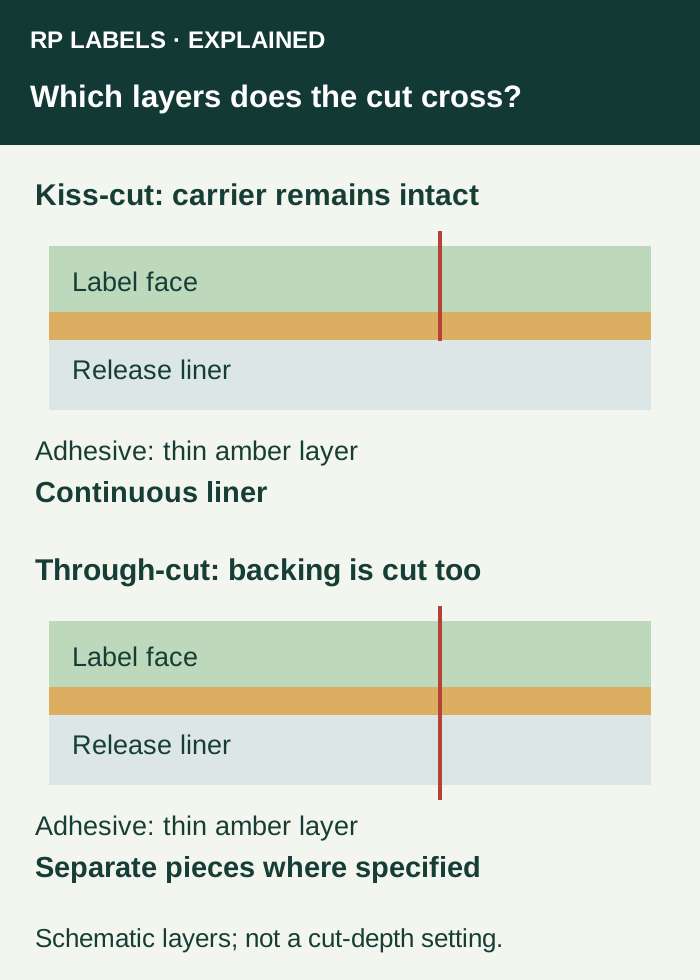
Separate the label outline from the backing outline
A kiss-cut separates the label face and adhesive while leaving the release liner intact beneath the label. A through-cut continues through the backing. The actual cutting method and terminology vary, so ask the converter for a drawing showing which layers are cut rather than approving a name alone.
In its consumer-sticker terminology, Avery distinguishes individually die-cut stickers from kiss-cut stickers on intact backing. That describes Avery's products, not RP's available formats or a universal use of “die-cut.” Label converters can use dies to make kiss-cut roll labels too. Write the required physical result into the order.
For a separately supplied seal, specify both the adhesive label outline and the surrounding backing size. If the backing follows the same outline, ask how the operator starts peeling it. If a larger backing area is proposed, check whether it fits the intended distribution and handling method.
Matrix removal is another choice
The matrix is the surrounding face material and adhesive left outside the individual cut labels. Removing it can expose the backing between and around labels; it does not mean removing the backing itself. Leaving the matrix in place creates a different finished web or sheet.
Lexmark's label-characteristics guidance distinguishes stripped edge matrix from total strip matrix for its printing context. Its printer-specific recommendations are not an applicator standard. The useful purchasing distinction is which surrounding material remains, and whether the next process accepts it.
Ask for a top-view drawing or representative finished sample. Mark the label, the clear liner area, any retained matrix, the sheet or web edges, and any intended perforations. A circle around the artwork alone leaves too much unspecified.
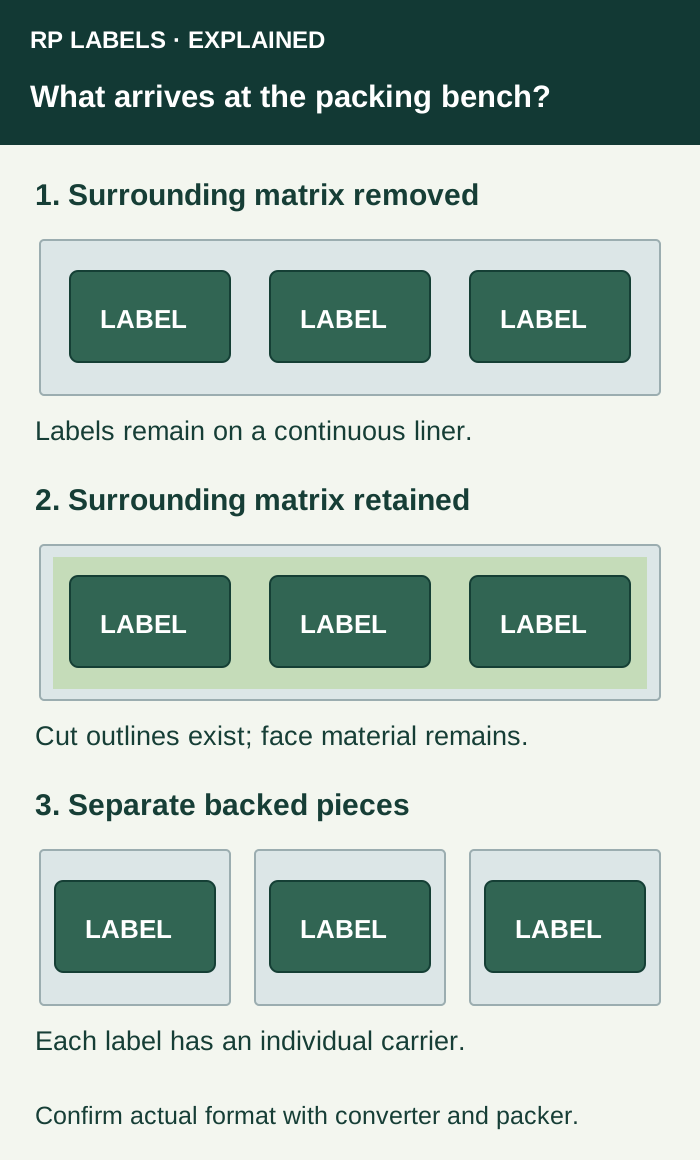
Choose the format around the person or machine applying it
Manual application at a bench
For a short vial run, labels on an organized sheet or small roll may keep the designs together and make the next label easy to find. Have the operator try the intended peel action while wearing the gloves actually used in the process, where applicable. Record whether the operator can start the peel without touching the adhesive area or damaging a delicate label.
Separate backed pieces may make sense when a single seal is handed to another person or included in a kit. They also create loose pieces to count and control. Compare the real handling task, including how design identities stay separated after the outer packaging is opened.
Automatic or semi-automatic application
The packer needs an accepted web arrangement, not a bag of individually cut labels with the right artwork. Confirm the label pitch, exposed gap or sensing arrangement, web width, liner, core, diameter and unwind direction with the equipment owner. The machine-roll brief covers those dimensional requirements.
Retained surrounding material can change what the operator or sensor sees. Do not assume a previously accepted setting applies to a different matrix arrangement. Ask the packer to review the proposed finished web and define whether a representative dispensing trial is needed before the balance is produced.
A worked order note that removes the ambiguity
For a fictional supplement bottle job, the buyer requests a shaped label and says it will be machine applied. A useful proposed note would read: “Supply labels kiss-cut on a continuous release liner, surrounding matrix removed as shown on drawing FORMAT-R2; no individually separated pieces. Packer to confirm web dimensions, sensing, unwind and the representative roll before production release.” All dimensions and approvals remain project-specific.
For a manual hologram-seal job, the corresponding note could instead identify “separate rectangular backing pieces with one shaped label per piece” and show the proposed backing margin. The adhesive seal may have the same shape as a roll-fed version. The delivery format, quantities per pack and peel method are different purchasing decisions.
Have the converter return the accepted format and any price or timing difference. Do not treat the example notes as available RP specifications. If a proposed material cannot be finished as requested, compare the supplier's alternative with the application task before changing the order.
Do not confuse an intended cut with liner damage
A through-cut at an agreed sheet boundary is a finished-format feature. A continuous liner cut where the machine requires an intact carrier is a different problem. The liner-damage guide addresses evidence and disposition when the received construction differs from the required one.
At receiving, compare a representative finished section with the approved format drawing. Check what is cut, what remains connected and what the next operator will handle. Hold unresolved deviations for the converter and packer to assess rather than trimming or rewinding the stock into an improvised format.
Request a quote against the finished format
For vial labels, supplement labels or hologram seals, send RP the label outline, proposed backing arrangement, quantity per design and application method. Prepare a project inquiry asking the converter to confirm the cut depth, matrix treatment and available supply format. Add the packer's requirements if a machine will apply the labels.