Peptide Vial Label Die-Cutting: Liner Strikes and Release Problems
Imagine an applicator stops and the operator sends a photograph of one loose sticker. The backing has already been discarded. The converter can see the print but cannot inspect the connected damage or the point where the problem started. Preserve that evidence before prescribing a fix.
A roll label needs a cleanly separated face and a backing that still does its job. A liner strike is unwanted cutting damage to that backing. Incomplete cutting, adhesive bridging and unsuitable dispensing settings can also cause release trouble, so a photograph of a jam is not enough to diagnose the cause.
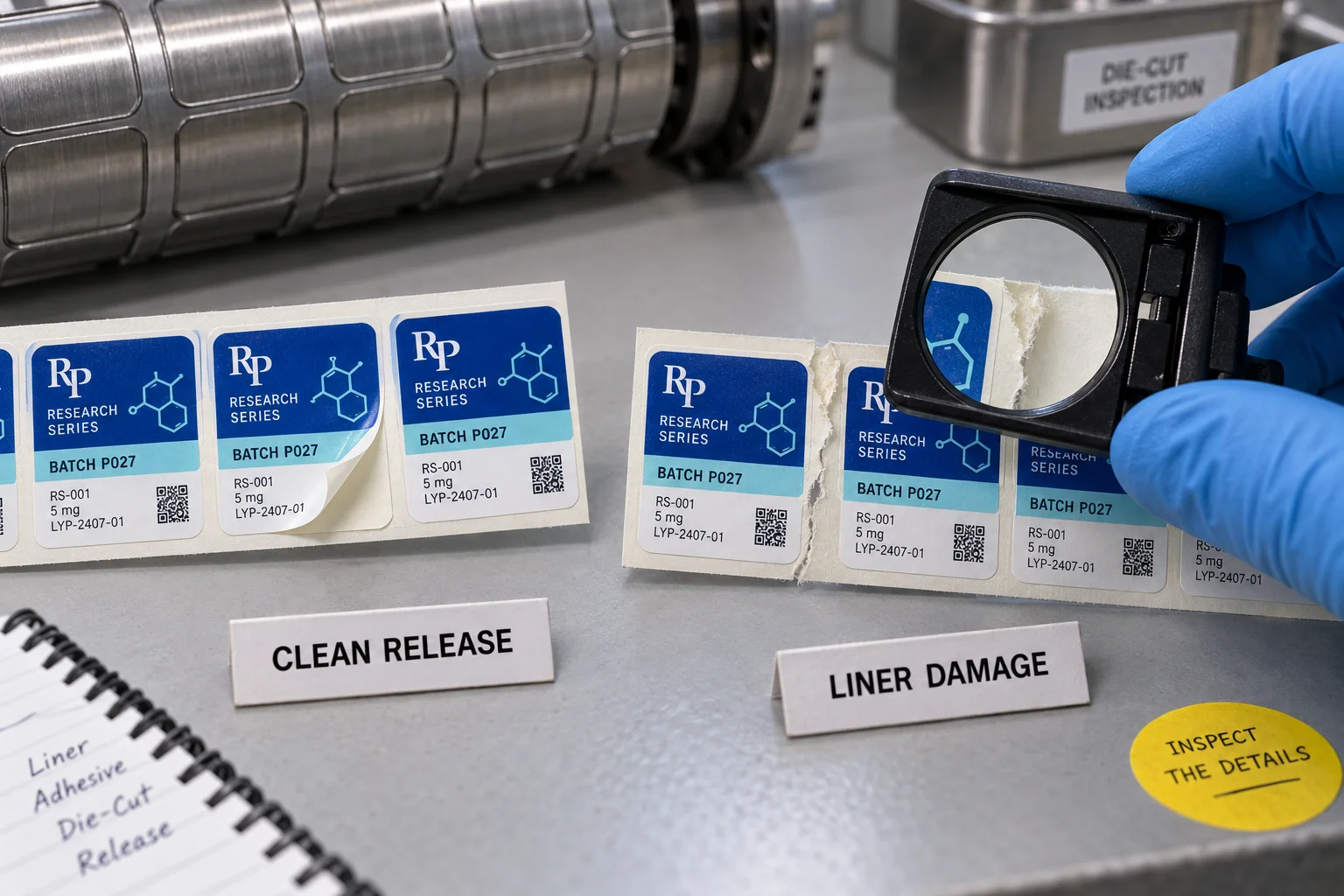
AI-generated packaging illustration. Fictional RP demonstration samples; not an actual order, completed test, authentication or approval record. Any displayed checks or codes are illustrative.
I would not approve a peptide vial label run from the front-facing print sample alone. The vial may be small, the artwork may be sharp, and the color may match perfectly. None of that tells the operator whether the next thousand labels will leave the liner cleanly.
Kiss cut is not through cut
For a conventional pressure-sensitive roll, the intended cut separates the label shape while preserving a usable release liner beneath it. A through cut is a different result, appropriate for some other products but not a substitute for a controlled kiss cut. Tooling suppliers distinguish these applications and match the tool to the construction. See Kocher+Beck's flexible-die overview.
The buyer does not need to specify a press adjustment in microns. The buyer does need to specify the output: clean separation, acceptable edges, intact backing and reliable dispensing on the agreed equipment. A tool setting belongs to the converter's process control, not to a guess in a purchasing email.
Four symptoms that should not share one diagnosis
| Observation | Investigation to request | Do not assume |
|---|---|---|
| Backing tears along a repeated label outline | Liner integrity and cutting-depth review | Every backing tear has the same cause |
| Label edge remains connected to surrounding waste | Cut completeness and matrix removal | More adhesive will fix it |
| Sticky strands or edge contamination | Adhesive, storage and tooling build-up review | The artwork file caused it |
| Labels stay on the liner at the peel plate | Release behaviour, label stiffness and dispenser setup | A deeper die cut is automatically required |
This is an investigation map, not a remote diagnosis chart. A repeated defect at one position may lead the converter toward a different check from random damage after transport. Keep the observation separate from the explanation until somebody has inspected the material.
Wink identifies thin PET liners as a specific die-cutting challenge, rather than an interchangeable replacement for any backing. ETI likewise describes pressure consistency as relevant to avoiding liner marks. Those are useful reasons to request a new trial after a construction change, not reasons to reject PET categorically. Wink's technical guidance; ETI's die-cutting overview.
The attractive shape that is expensive to run
Consider two proposed designs for the same small vial. One is a simple rounded rectangle. The other adds narrow projecting tabs and a decorative notch beside the code. These are hypothetical alternatives, not records of an RP customer order. Both may be possible. They should not be quoted as though the only difference is the outline on a PDF.
Ask the converter to evaluate how the shape will cut, strip and dispense on the chosen construction. If the custom outline solves a real packaging requirement, the additional trial may be justified. If it only adds a small visual flourish on a very small vial, the simpler shape may be the better purchase.
I would rather lose that flourish than ask a packing operator to rescue it one label at a time. That is a trade-off, not an argument that every label must be rectangular.
Keep evidence that the converter can use
When a problem appears, pause the affected roll and identify it. Keep its roll ID, material lot, artwork revision and the approximate point where the defect occurred. Save a continuous strip showing the transition between acceptable and affected labels, with the backing attached. A loose sticker photographed on a desk removes half the evidence.
Photograph front and back under useful lighting. Record the applicator model, operating speed and settings that were actually used, plus any recent change. If practical and permitted by the equipment procedure, capture a short video of the behaviour. Do not put hands near moving rollers or remove guards to obtain evidence.
A supplier-approved diagnostic test can help distinguish backing damage from release behaviour. Do not apply random solvents, stains or extreme pulling force and then treat the damaged sample as proof of how it arrived. Agree on the method first.
A feed trial is a purchasing tool
A hand-applied pilot order and a machine-applied production order have different acceptance needs. For hand application, ease of peeling and edge quality may dominate. For an automatic line, specify the equipment and agree on a representative trial before committing to the production roll format.
Define who selects the samples, which rolls or positions they represent, and what constitutes a hold. A trial across representative start, middle and end sections can be proposed as a practical check; it is not a universal statistical sampling standard or a guarantee about every label.
Connect that trial to the roll inspection record. Passing the cut-quality check does not establish the roll count, splice policy or winding quality. Keep those requirements separate so a pass in one area does not hide a failure in another.
Reorders still need change control
Ask the supplier to flag a change in face stock, laminate, adhesive, liner or cutting tool that could affect the approved result. Reusing the artwork filename does not make the physical label construction identical. See the paper versus PET liner comparison before approving a backing substitution.
Should I demand zero visible marks on every liner?
Agree on an inspection method and acceptance criteria with the converter. A visual impression alone is not the same as a tear or failed release. The requirement should protect actual liner integrity and dispensing performance.
Can a stronger adhesive cure a label that will not dispense?
Not as a general remedy. Separate adhesion to the bottle from release off the liner. Investigate the construction and machine setup together.
What should accompany a quote request?
Send the dieline, finished size, intended material, application method and equipment information. Include an existing acceptable strip if available. Ask for a production-representative sample, not just an artwork proof.
Send a complaint the converter can investigate
The worked evidence handoff, blank handoff and field guide distinguish a repeated backing tear from a release symptom. Each row asks for an identified continuous strip and actual setup information. Neither records an established cutting cause or permission to scrap a roll.
If an operator removes only the face label to send a photograph, the supplier loses the connected backing and defect interval. Preserve a representative strip with its roll identity and keep an acceptable reference when available. Describe what happened before adjusting the machine. Record any later adjustment separately; a changed setup should not silently replace the conditions in which the fault first appeared.
The buyer controls stock disposition through its own process. The converter investigates the cut and construction within its responsibilities. A replacement commitment, inspection interval or release decision needs an actual agreement; this article supplies none. A limited hand-applied job may need a different relevant check from an automatic feed route, and a useful local observation is not proof about every label on every roll.
Send RP Labels the evidence brief, dieline, quantities and available continuous strips or photographs. Ask for a focused review and identified sample scope rather than prescribing a deeper cut from a remote picture.