Label Material Documents: Ask for Evidence That Matches the Claim
“Please send the certificate” is an incomplete request when the purchase involves a supplement bottle label. The buyer may need evidence for cold handling, workplace chemical safety, a food-contact question or a restricted-substance requirement. Those are different questions. Name the claim and the proposed label construction first, then ask for the document that actually addresses it.
RP's supplement-label service lists compliance questions as matters to discuss for the project. That is a route to requesting evidence, not proof that every construction carries every declaration. A useful inquiry identifies the destination market, package, intended use and specific customer requirement.
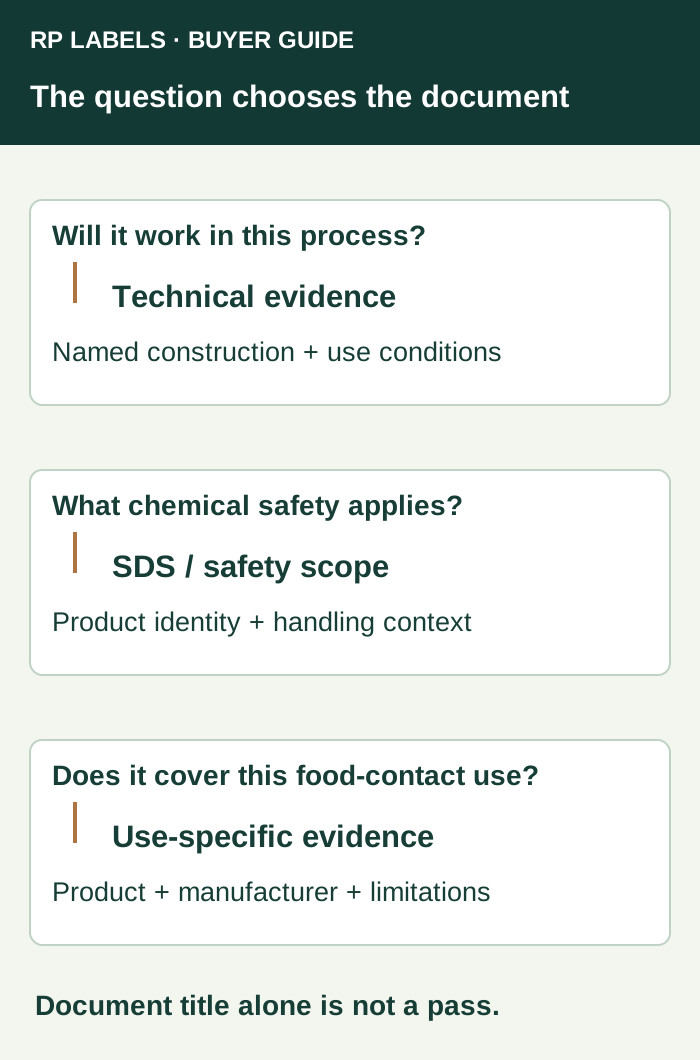
For material performance, start with the identified construction
Ask the converter to identify the proposed face material, adhesive, liner and protective finish, using product references it can trace to the order. Request the relevant technical data and any limits that affect the intended application. Keep the document revision and issuer visible.
A statement about an adhesive component does not automatically establish the performance of the printed, laminated label on your bottle. Check what the stated property describes: the component, a test specimen or the finished construction. Look for the test method and conditions behind a value instead of copying a prominent number into the purchase order.
For example, a buyer specifying a cold-handled vial needs to distinguish the condition at application from the later use cycle. A data sheet may be useful input, while the actual pack still needs the agreed application evidence. The cold-storage guide covers that separate trial decision. This document review makes sure the team is discussing the material actually quoted.
An SDS answers a chemical-safety question
A safety data sheet describes hazard and safe-handling information for the substance or mixture it identifies. It is not a label-adhesion report or a general food-contact approval. Check the product identifier, supplier, revision and intended scope before using it in a purchasing file.
For US workplaces, OSHA's Hazard Communication standard contains SDS requirements for hazardous chemicals and also defines an articles exemption under specified conditions. Do not assume that every finished label must have an SDS, or that an exemption automatically applies to your operation. Ask the responsible workplace-safety reviewer to resolve the classification and information needed for the actual supplied product and use.
If the document identifies a liquid printing ink while the purchase is a finished printed label, retain that distinction. It may be supporting component information, but it does not by itself identify the finished article's status or establish the buyer's application performance.
Food-contact evidence must match the intended use
Draw where the label sits relative to the supplement, container wall, closure and opening. State whether any label component is intended to contact the contents, the relevant storage or use conditions and the destination market. Give that description to the packaging or regulatory reviewer with the supplier's construction references.
FDA's component-status guidance explains that applicable authorization depends on the substance and intended use, and that an effective Food Contact Notification is specific to the identified manufacturer and conditions. A letter about a similar material from another manufacturer cannot simply be substituted for the quoted product.
Ask the supplier to identify the basis, product coverage and restrictions of any proposed US food-contact statement. The responsible reviewer decides whether it addresses the actual package and use. An outside-bottle location should be described accurately; it is not a reason to invent either a blanket approval or a blanket exemption. A request for evidence must not become an “FDA-approved label” marketing claim.
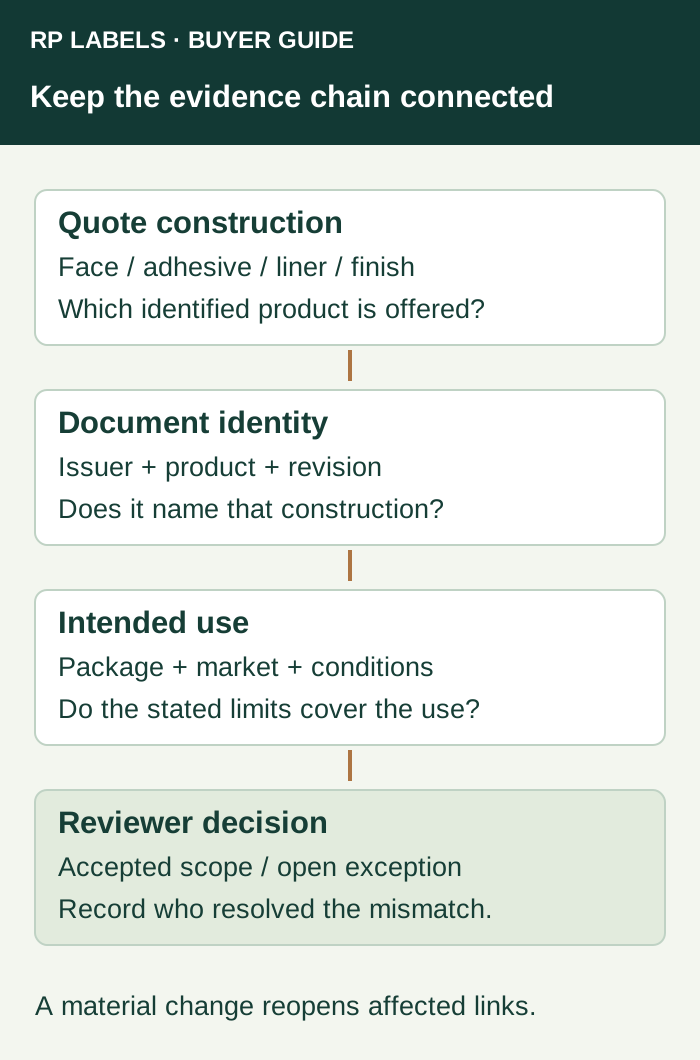
A worked document review with a useful outcome
Consider a fictional quote CONSTRUCTION-R2 for a supplement bottle label. The supplied performance sheet names adhesive AD-A. A separate statement names adhesive AD-B. The buyer should return the mismatch to the converter before relying on that statement. It may be a clerical error, an offered alternative or a genuine construction difference; the document names alone cannot decide which.
The converter can return a corrected reference or propose a different construction. Purchasing then asks whether cost, appearance, application evidence or timing changes. The designated reviewer records what the accepted evidence covers. A tidy folder containing both documents is not a resolved decision.
- Connect the supplier's quote revision to the construction and component identifiers.
- Record each document's issuer, date or revision and the product it names.
- Identify the claimed property or intended use and any stated restrictions.
- Assign mismatches to the converter and use-scope questions to the responsible reviewer.
- Record the accepted scope and reopen it when the material or use changes.
Reorders need the same connection
If the converter changes a component reference, obtain the applicable evidence for the replacement. An unchanged label design or familiar trade name does not prove the evidence still applies. Use the material-substitution review to connect the document change with any physical approval that must be revisited.
Prepare an RP inquiry with the actual bottle, artwork, quantity per design, proposed construction and the document question your reviewer needs answered. Request available evidence tied to that product and use. Keep workplace safety, application performance and market-specific packaging review with the people responsible for those decisions.