Label Material Substitution: Approve the Change Before the Reorder
Suppose your next bottle run is booked, but the printer cannot get the labelstock used last time. Another white film is available. The artwork will stay the same, the delivery date may still hold, and the proposed replacement looks close enough in a photograph.
This is a useful offer to investigate. It is also a new purchasing decision. Before accepting a label material substitution, establish exactly what changes, which previous approval still applies, and what evidence the replacement needs. “White BOPP, permanent adhesive” describes a broad direction. It does not identify the construction you already tested.
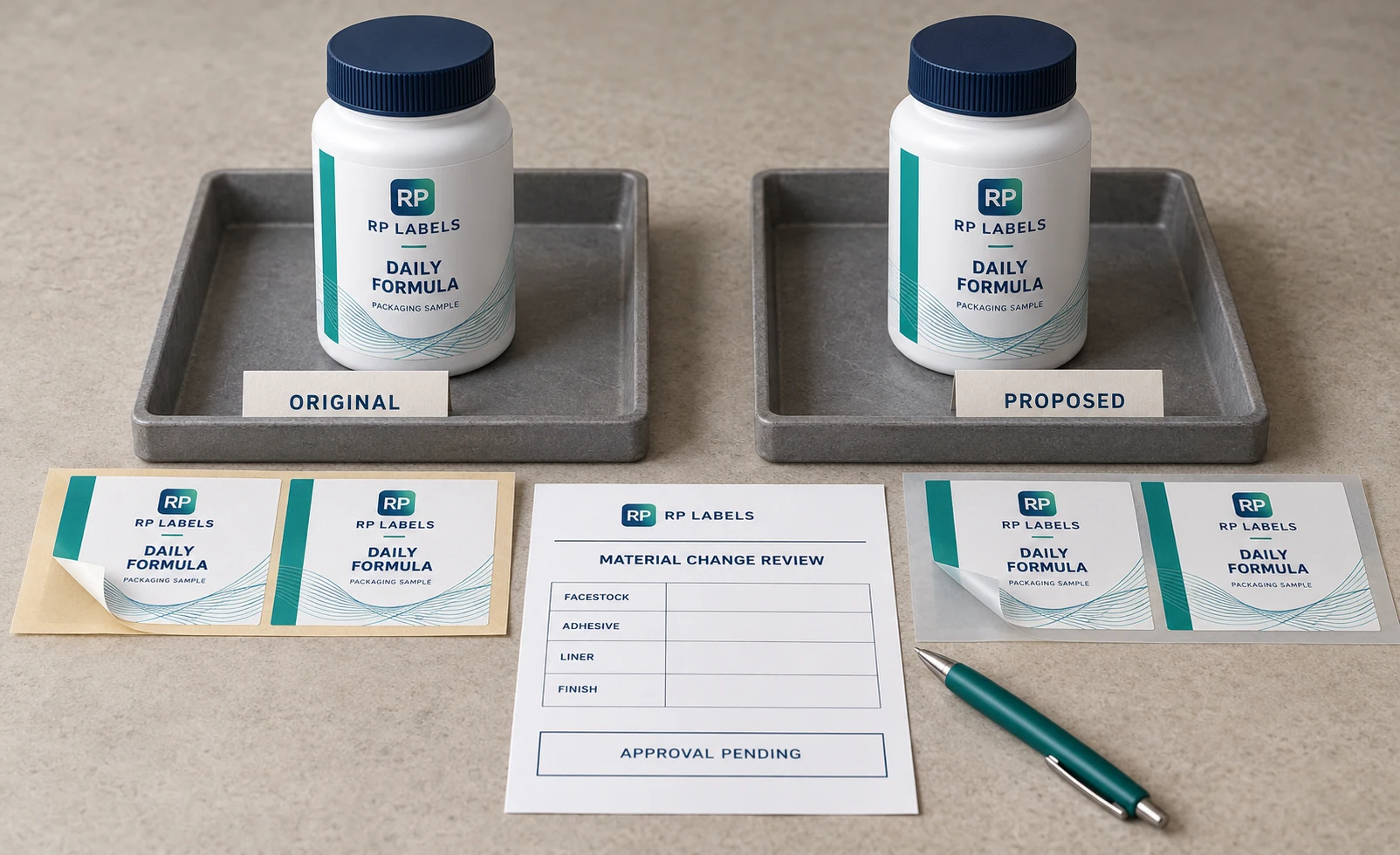
AI-generated packaging illustration. The two constructions are illustrative proposals, not tested equivalents or an approved RP production change.
Start with the change, not another artwork approval
Ask the printer to put the approved construction and proposed alternative side by side. Use the supplier's material references where available, supported by specifications that your packaging team can interpret. A labelstock code alone may not describe the added laminate, varnish or printing process.
The comparison should cover the facestock and its thickness, adhesive reference, release liner, print surface or coating, and finished protection. Include the proposed reason for substitution, availability, price effect and affected order. If part of the information is missing, mark it as unknown rather than filling the gap with “equivalent.”
Keep the bottle and artwork unchanged while assessing the material where practical. If the bottle supplier, label width and adhesive all change together, a failed trial leaves three explanations to untangle. The factory wants to keep its schedule. The packer wants to avoid a stopped line. Give both a comparison they can act on.
A new manufacturing lot of the same approved grade is different from an alternative grade or construction. Do not demand a complete qualification campaign merely because the lot number changed; follow the agreed incoming checks. When the construction changes, however, the old artwork approval does not settle its physical performance.
Similar fronts can hide different working parts
The face material is only part of a pressure-sensitive label. UPM's liner guidance explains that the face, adhesive and release liner work together, with the liner affecting converting and dispensing. A backing change deserves attention even though customers never see it on the bottle.
Likewise, an adhesive datasheet is useful evidence, but it is not an applied-bottle result. In Avery Dennison's discussion of application testing, its specialist explains why standard test surfaces do not predict every curved packaging application. That supports a practical buying rule: review the proposed construction against your container and process, rather than approving from a material family name.
Neither source establishes that a particular RP label construction works. The printer and buyer still need project-specific information. For an initial material choice, the supplement label materials guide is the starting point. This review concerns a replacement for something already approved.
Match the evidence to the part that changed
Keep a usable original label or retained applied sample for comparison. Ask for the proposed material in the form needed to answer the open question. A loose swatch can reveal surface appearance; it cannot demonstrate finished-roll dispensing.
| Proposed change | Evidence to discuss before release |
|---|---|
| Facestock or thickness | Finished-label fit, stiffness and edge behaviour on the actual bottle, plus appearance at the approved print size |
| Adhesive | Applied samples under the agreed surface preparation, application conditions, dwell and relevant handling or storage exposure |
| Liner | A suitable finished-roll trial with the packer, checking release, sensing and web handling on its equipment |
| Print coating, laminate or varnish | Representative finished print for colour, small text, code readability and the handling exposure that matters to the project |
Agree the method, observation times and acceptance criteria before the trial. There is no useful universal instruction to “wait a day” or “pull hard.” The relevant checks depend on the change and the consequence of failure. Record who tested what, on which container and under which conditions.
If only the liner changes, do not automatically repeat every decorative review. Concentrate on the changed functions while confirming that other specifications remain intact. The paper versus PET liner guide covers the line questions in more detail. A change to the adhesive, by contrast, needs attention at the bottle interface even when the front looks identical.
Let a qualified alternative earn the order
An alternative material can be the sensible choice. A packer may already have documented experience with that exact construction on the same bottle and line. If the relevant requirements are covered, that evidence can narrow the remaining review. Ask what is genuinely comparable and what still needs confirmation; do not force everyone to start from zero for appearances.
Consider two hypothetical situations. In the first, the proposed material is already an approved alternative for this package, with current records and a confirmed supply specification. Releasing the reorder can be straightforward after the agreed checks. In the second, the substitute shares only a white finish and generic adhesive description. The packing slot is close, but the comparison is incomplete. Booking the slot does not make the missing evidence appear.
Discuss the full choices: wait for the original stock, qualify the proposed construction, or ask another printer about the specified material. Compare credible production dates, sample work, freight and disruption alongside the label price. A supplier with the approved construction available may deserve the order even if its unit price is higher. A well-supported alternative may beat an unnecessary delay. Neither outcome should be decided by the word “urgent.”
Use the worked material-change request to see how component references, evidence and release scope stay separate. The blank request and filling guide are ready for your project. An empty approval field is intentional: a supplier proposal, a comparison and a released alternative are three different records.
Make a temporary release stay temporary
If you accept the substitute for one order, say so in the order record. Identify the material, affected SKUs, quantity or batch scope, artwork revision, evidence reviewed and approval owner. State whether it becomes an approved alternative for future orders or remains a limited exception.
Ask the printer to acknowledge that scope. Agree how the changed construction will be identified on roll or carton records so the receiving team can distinguish it from earlier stock. Keep those identifiers outside the consumer artwork unless there is a separate reason to change that artwork.
When the original stock returns, refer to the recorded arrangement before ordering again. “Same as last time” becomes ambiguous once the last two orders used different constructions. Retain the accepted sample and update the purchasing specification where appropriate. The useful result is a known alternative with a defined place in the supply plan, not an undocumented change that happens to have shipped.
For a custom supplement label reorder facing a material change, send RP Labels the original specification and proposed alternative, along with a bottle sample or exact reference, artwork revision, application method, relevant use conditions and required quantity. Request a comparison, the remaining sample or trial requirements, and a quotation based on the agreed release scope. Keep the delivery target on the brief. Keep the material decision there too.
Sources and scope
Demand layer: competitor and process pages linked here, including Avery, HERMA or OnlineLabels where cited, illustrate buyer language and process topics only. They do not supply RP minimum quantities, lead times, prices, certifications or materials. Authority layer: an RP number is backed only by a factory datasheet, a signed quote or proforma, confirmed product data, or a fact kept on the About page. The March 2026 proforma there is one production-run example, not a standing offer. RP shipping and planning pages describe what to confirm on a quote. Worked figures on this page are fictional unless an authority source is named for them.