Supplement Label Materials: Make the Two Quotes Comparable
The cheaper quote says “white film, matte finish.” The other identifies a face material, adhesive and liner, then adds a protective finish. In this hypothetical buying situation, the price gap is visible. The specification gap is easier to miss.
I would ask for a comparable construction before choosing either supplier. The detailed quote does not automatically describe the better label. The shorter quote does not automatically describe an unsuitable one. Procurement needs to discover whether both prices cover the same work on the same bottle.
A finish photograph can help the brand owner choose a direction. It cannot fill in the missing parts of the purchase specification.
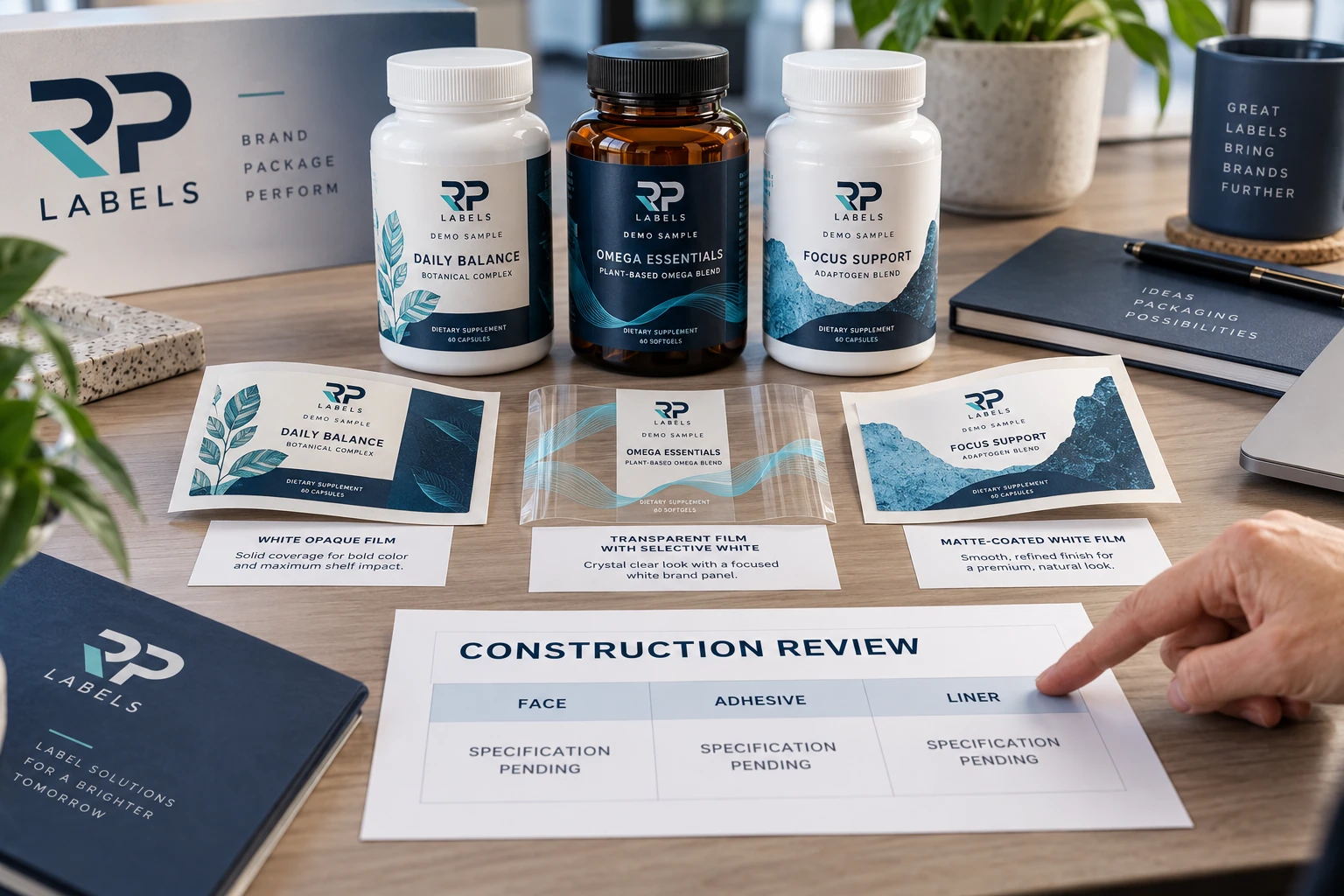
AI-generated packaging illustration. RP demonstration samples show proposed material directions, not tested constructions or a customer order.
Start with one bottle and one real use route
Give both suppliers the same bottle reference, artwork revision, dimensions and quantity per design. State whether the bottle is glass, PET, HDPE or another identified material, and include its color, texture and labelable shape. A photograph is useful; an actual production-equivalent bottle may be needed for physical questions.
Then describe when labeling happens and what follows. A dry bottle labeled before packing is a different brief from a chilled bottle arriving with condensation. Include the relevant application method, later marking, storage and handling. Do not add a chemical or cold exposure merely because a competitor mentions it.
These inputs stop one supplier pricing a dry retail display while another allows for a substantially different route. Unknown conditions should stay visible. Ask the packer to supply them rather than letting a sales description become a technical assumption.
Break the material description into working parts
Avery Dennison's pressure-sensitive label overview distinguishes the printable face, bonding adhesive and protective carrier liner. That explains why a face-material name alone leaves the specification incomplete. It does not establish which construction will work on your bottle.
Ask for an identifiable proposed face material, adhesive and liner, with available supplier references or specifications. Add the print surface and any varnish or laminate applied during conversion. If a clear label needs selective white ink to preserve readable information, put that scope beside the material description.
An available material code is useful only if the supplier can connect it to the proposal. A generic family name may be enough for an early discussion, but it should not quietly become approval of an unspecified finished construction. Equally, a supplier may need to propose a construction before providing a representative sample. That is a legitimate stage, provided the quote says what remains open.
Choose appearance without asking it to prove durability
White film can provide an opaque starting direction for identity, small text and color. Clear film can leave the container visible, but the bottle and contents become part of the visual background. Review what must stay opaque and what may show through. A dark or amber bottle deserves its own applied appearance review.
Paper remains a fair option where its texture contributes to the brand and the proposed construction meets the intended use. BOPP and PET describe film families; neither word guarantees adhesion, dispensing, chemical resistance or the behavior of the finished print. Use the paper versus BOPP comparison when that specific tradeoff is the unresolved decision.
Matte and gloss describe an appearance direction. They do not tell procurement whether protection comes from a separate laminate or a coating. The lamination versus varnish guide addresses that construction choice. Ask the supplier to name what its price includes before comparing the resulting surface.
Treat missing scope as a question, not a price adjustment
The worked quote record below contains fictional proposals. There are no prices or performance results because neither has been obtained for an actual project.
| Item | Proposal A | Proposal B | Action before comparison |
|---|---|---|---|
| Face | White film; grade not identified | Identified proposed white-film reference | Request A's reference or usable specification |
| Protective surface | Matte; construction unspecified | Matte laminate proposed | Ask whether A means coating or laminate |
| Adhesive and liner | Not stated | Proposed references supplied | Confirm both against bottle and application route |
| Later lot marking | Not addressed | Marking compatibility still open | Send exact marking method to both suppliers |
Proposal B is easier to review. It is not yet a winner. Its laminate may add a layer the job does not need, or its proposed marking surface may be unsuitable. Proposal A may become a sound alternative once the missing construction is explained.
Use the worked quote record, blank record and field guide. Record what was proposed, which input is missing, who supplies it and whether the reply changes scope or price. Do not enter “equivalent” in an empty reference field.
Ask each sample a question it can answer
An unprinted swatch may help with texture or transparency. A digital proof can show the proposed white areas and content layout. Neither is the same evidence as a representative printed label on the identified bottle.
If the question concerns application, discuss the relevant applied sample or finished-roll trial with the packer and converter. If the question concerns later lot marking, identify the exact marking equipment or writing tool and finished surface. Retain the construction and artwork references with each sample so the next reviewer knows what was examined.
Agree the method and acceptance conditions for the real project. This guide supplies no universal dwell time, rub count or adhesion threshold. A failed observation should lead back to the component or process question it raises; changing the film family without investigating the cause may leave the problem in place.
Let the simpler proposal win when it meets the brief
A stable dry-use label may not need every premium layer offered. If the identified simpler construction meets the appearance, handling and application requirements, the buyer has a reasonable basis to avoid unnecessary cost. A more protective proposal can earn its place when the relevant evidence supports the added work.
Compare the same dimensions, artwork versions, quantities, supply format, sample scope and delivery terms. Keep unquoted costs unknown. The decision is not whether one material sounds more technical; it is whether a defined proposal meets the requirements at an understood total scope.
Once approved, retain the complete reference for reorders. A later alternative belongs in the separate material-substitution review, rather than being accepted because the new quote repeats “white film.”
For a custom supplement label inquiry, send RP Labels the bottle reference and completed quote record, artwork, quantities, application route and later marking method. Ask for an identified proposed construction, unresolved sample questions and a quotation against that scope. That gives both sides something more useful than another finish adjective.
Sources and scope
Demand layer: competitor and process pages linked here, including Avery, HERMA or OnlineLabels where cited, illustrate buyer language and process topics only. They do not supply RP minimum quantities, lead times, prices, certifications or materials. Authority layer: an RP number is backed only by a factory datasheet, a signed quote or proforma, confirmed product data, or a fact kept on the About page. The March 2026 proforma there is one production-run example, not a standing offer. RP shipping and planning pages describe what to confirm on a quote. Worked figures on this page are fictional unless an authority source is named for them.