Label Printing Overruns and Underruns: Agree the Count Before the Bottle Run
Suppose you have 2,000 supplement bottles to fill. The artwork is approved, the labels are quoted, and the purchase order says 2,000 pieces. It feels settled.
Then a question worth asking before payment: does that number mean 2,000 usable labels delivered, or a production target that allows a short shipment?
For a brand with a fixed packing date, those are different purchases. Label printing overruns and underruns deserve the same attention as material and finish, because the last unlabeled bottle still needs a label even when the shipment falls within an agreed tolerance.
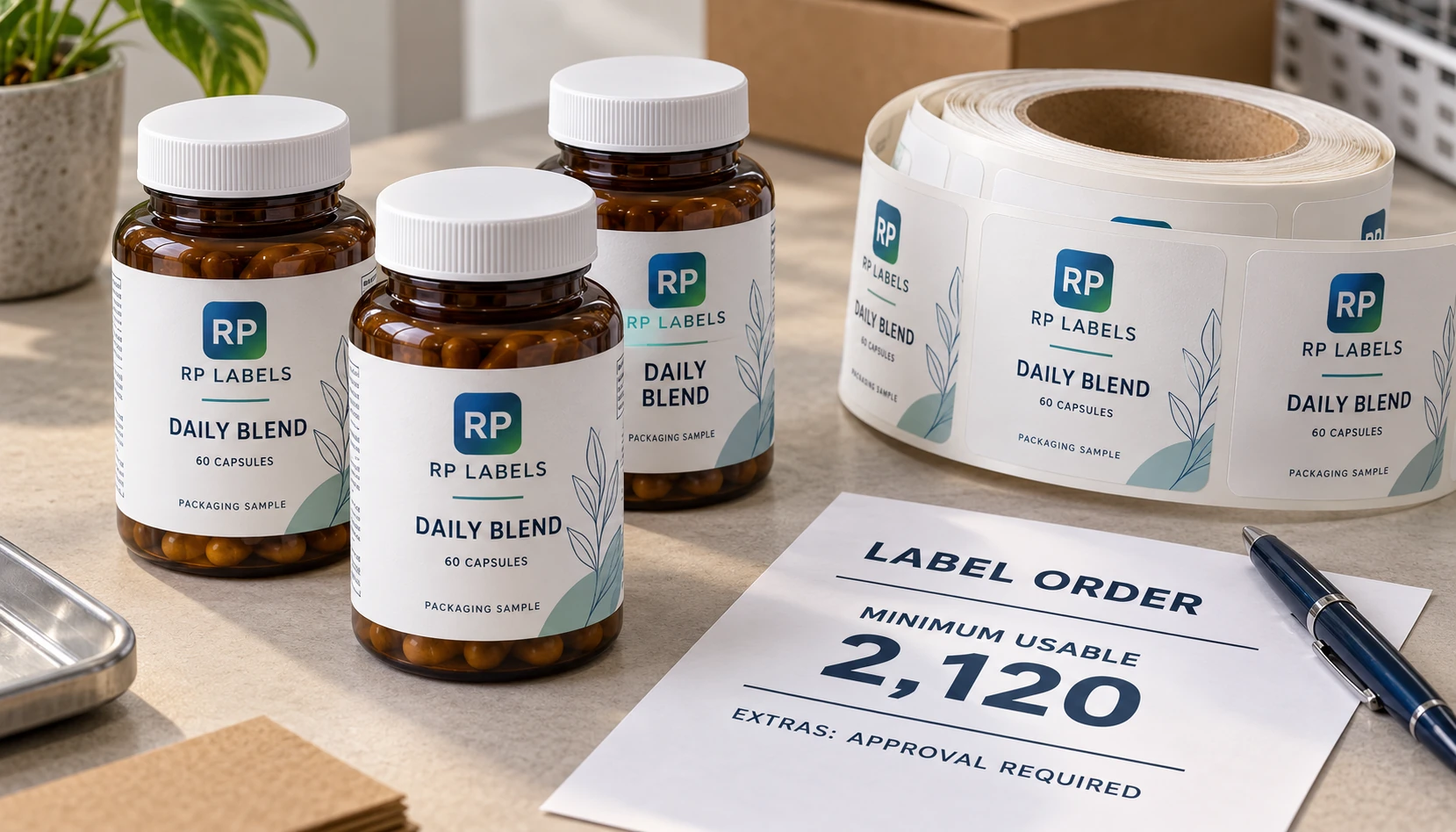
AI-generated packaging illustration. The RP Labels sample packaging and quantity sheet illustrate the planning example below; they are not a photograph of a customer order.
A quantity tolerance is not your application allowance
An overrun is delivery above the ordered quantity; an underrun is delivery below it. Whether either is permitted, how much variation is allowed, and what you pay depend on the supplier's accepted order terms.
This is a real quotation issue. MR Label's published terms describe a 10% overrun or underrun limit unless the quotation specifies otherwise, with billing for actual delivery within that tolerance. That is one printer's stated arrangement, not a universal rule or RP Labels' policy.
A printer's delivery tolerance and your packer's label consumption belong on separate lines. The former describes what may arrive. The latter covers labels consumed during setup, adjustment, inspection, or application. Using one allowance to stand in for the other can leave the production plan short.
Before comparing prices for custom supplement labels, ask each supplier the same question: what usable quantity does this quote commit to delivering for each artwork version?
Start with the bottles you must actually finish
Here is an illustrative planning example, not an industry waste standard or an RP production specification:
| Planning item | Labels |
|---|---|
| One body label for each of 2,000 bottles | 2,000 |
| Packer's estimated setup and adjustment use | 80 |
| Separate handling reserve | 40 |
| Required usable labels delivered | 2,120 |
The packer should supply or validate the allowances using the actual equipment, operator, and trial results. A hand-applied first run and a repeat job on a qualified applicator do not need the same assumption.
If you order 2,120 as a nominal quantity under a permitted 10% underrun, delivery could be 1,908. That is already 212 below the planned label pool, before anyone starts the applicator.
Simply asking for "some extras" does not resolve this. State the minimum usable delivery requirement first, then ask how the printer can quote it. The answer may involve a higher nominal run, a specific minimum commitment, or a different production option. Confirm the resulting quantity, price, and timing together.
For a short first order, the low-MOQ supplement label guide addresses a different decision: how much inventory to commit to while the pack and artwork are still being validated. Once a filling quantity is fixed, minimum delivered count becomes the next question.
Choose a minimum, an exact count, or a range
These requests solve different problems. Put the one you need in the quotation brief rather than assuming that the supplier interprets "quantity" the same way you do.
| Quantity request | When it can make sense | What to confirm |
|---|---|---|
| Minimum usable count per SKU | The filling batch cannot finish with fewer labels | Accepted minimum, extra charges, and treatment of excess pieces |
| Exact shipment count | Your receiving or reconciliation process requires a fixed count | Availability, counting method, price, and any schedule effect |
| Accepted quantity range | Demand and inventory can absorb variation | Lower and upper limits, billing basis, and maximum spend |
Exact count is not automatically the most disciplined option. A printer may offer a practical range at a better price, and a stable repeat SKU may use the extras soon. That supplier deserves consideration.
The same range can be a poor fit for launch artwork that may change after the first run. Extra labels then tie up cash in a version you might not use. The useful comparison is the cost of completing the planned batch and carrying the permitted surplus, not the lowest displayed unit price.
"No overruns" does not answer "no shortages"
An upper limit protects inventory and budget. A lower limit protects the packing plan. Write both where both matter.
Ask whether extras are included, charged at the quoted unit rate, or require approval before shipping. If billing follows actual quantity, request a clear maximum charge or an approval process for exceeding it. Include any associated freight change in that discussion.
For a family of products, agree the count by SKU and revision. A surplus of one flavor cannot fill a shortage of another, even if the combined shipment matches the purchase order total. Keep that quantity schedule separate from the visual consistency checks in your multi-SKU label design system.
I would rather compare two clearly scoped quotes than celebrate a cheaper one whose quantity line nobody has defined. A low price is useful. An unresolved minimum is work waiting for the packing team.
Send a quantity brief the printer can accept
For the illustrative 2,000-bottle project, a practical quotation request could say:
Please quote one approved artwork version, revision C. Our requirement is at least 2,120 usable finished labels delivered for this SKU, including our planned application allowance. Please confirm whether you can accept that minimum, the quantity basis of your quote, and any price or lead-time effect. State the permitted maximum delivery quantity, how extras would be charged, and how approval for additional cost will be obtained. Please identify the SKU, revision, and usable count on the packing information.
This is a request for confirmation. Get the resolved quantity conditions accepted in the quotation or order acknowledgement before production, rather than leaving them only in your outgoing email.
Also settle what is excluded from the usable count: blank liner, marked waste, rejected labels, or other nonproduction material. The count needs a shared meaning, not just a shared number.
The worked usable-quantity agreement keeps the 2,120 requirement separate from a hypothetical low delivery and the supplier’s accepted commitment. Use the blank agreement for your own SKU; the filling guide explains the arithmetic and who confirms each field. Keep the supplier acknowledgement beside the sheet so a request cannot quietly become an assumed promise.
Reconcile the shipment before booking the line
At receipt, compare the packing information with the accepted quantity schedule for each SKU. Keep the roll or carton identifiers. Confirm the artwork revision and investigate any visible count discrepancy or unusable material promptly under the agreed process.
Do not assume that a credit for missing labels solves a fixed-date filling problem. Ask before ordering how a shortage would be handled, including replacement timing and freight responsibility. A plan that works for a routine replenishment may not work for a booked launch run.
To prepare an RP Labels quote, send the bottle quantity, number of designs, artwork revisions, application method, and packer's estimated allowance. State whether your priority is a minimum usable delivery, an exact count, or a flexible range. Ask for the quantity conditions to be confirmed with the quotation.
The label you need most is often the last one. Make sure it is included in the number both sides have agreed.