Multi-SKU Supplement Labels: Approve the Exceptions Before the Family Master
Imagine the first supplement label is approved and the next three designs are waiting. Reusing the layout seems sensible until a longer product name collides with the fixed copy. A smaller bottle then needs another label size. The designer can make each file look tidy, but procurement still needs to know whether those files belong to one controlled family or several undocumented exceptions.
Approve the family rules and the difficult exceptions together. A short product name on the easiest bottle cannot establish that every future SKU fits. The useful master is a system somebody can extend without guessing which element is allowed to move.
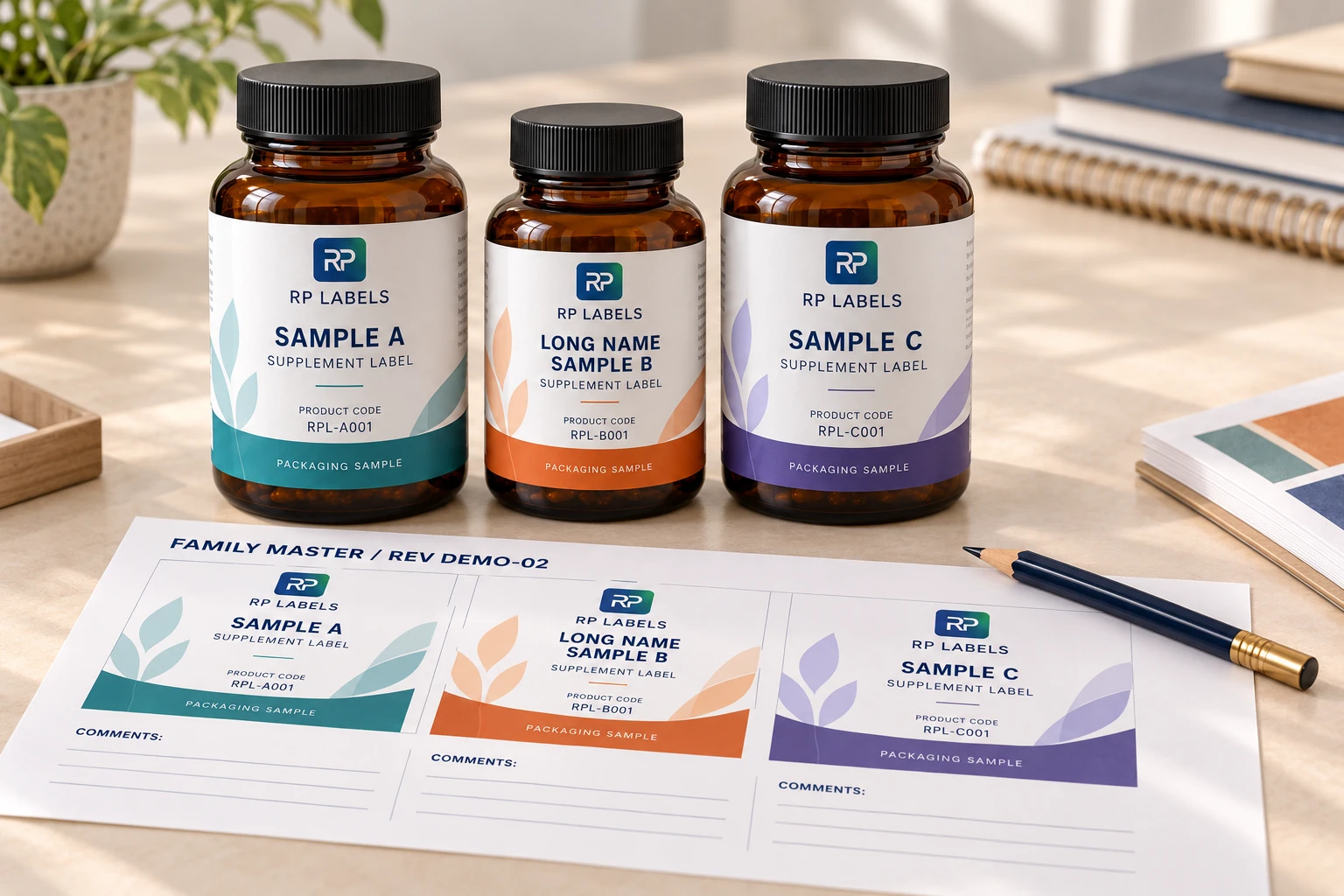
AI-generated packaging illustration. Fictional SAMPLE A, LONG NAME SAMPLE B and SAMPLE C demonstrate a layout review; the sheet is not an approved customer proof or a production record.
Start with the label most likely to break the layout
The first design is often the most convenient one to present. For this hypothetical project, reverse that order. Identify the longest approved product name, the most demanding fixed-copy block and the smallest relevant label panel. They may belong to different SKUs. Put those cases into the design review before calling the master finished.
This is not a request to squeeze every design into the smallest rectangle. Different bottle shapes and label dimensions can justify different masters. The question is whether the family relationship remains clear and each exception has a deliberate rule. Blindly reducing the artwork can change readable text, spacing and hierarchy in ways that a flat thumbnail conceals.
Ask the brand owner to identify which cues must remain consistent. Ask the responsible copy owner to supply the current approved text. Ask the packaging owner for the actual bottle and label dimensions. The designer should not invent missing copy or infer a new label panel from a photograph just to keep the artwork queue moving.
Separate fixed rules from controlled variables
A family can share the brand position, a naming hierarchy and the relationship between the product identity and supporting information. It can allow product names, approved variant text and secondary accents to vary within defined rules. The exact choices belong to the brand and its packaging requirements; this guide prescribes no universal font size or regulatory layout.
Use color as a supporting cue rather than the only definition of a SKU. In the illustration, the accent bands differ, but each sample also has its own visible name. A reorder file should identify the actual product and revision even when a proof is printed without color or somebody describes it in an email.
Consider a longer name. The family rule might allow an agreed two-line arrangement while keeping a defined relationship to the brand block. Another name may require a specific exception reviewed on its actual bottle. Both approaches can work. An undocumented reduction in type simply because the line became crowded is harder to control.
Likewise, a larger required-copy block may need more than moving the front-panel accent. The appropriate project reviewer should approve copy and suitability. Treat a design adjustment as a proposed layout change until the relevant owners release it; a family master does not authorize new health claims or legal copy.
Review the family together and the pack individually
Place the current candidate artworks side by side so the brand reviewer can assess the hierarchy across SKUs. Then inspect each at actual size and on the relevant bottle where physical placement matters. A coordinated family view can conceal a single label whose important text turns too far around the curve.
Compare the name, variant and other critical identification fields against the approved SKU list. Confirm that the proof set contains all intended designs and the correct revisions. A screenshot of three attractive bottles is not a controlled inventory of the files being ordered.
If the main issue is actual fit or a changed bottle, resolve that physical question through the appropriate label-size and sample review. If the issue is a quantity minimum across designs, use the multi-SKU MOQ comparison. Those decisions belong beside this one, but repeating their instructions inside a family master will not approve the design exceptions.
Give exceptions their own line in the handoff
The worked family exception matrix, blank matrix and field guide include three fictional designs. Standard-size A and C use the proposed shared hierarchy; B combines a longer name with a smaller bottle and needs a specific exception review. The rows identify the proposed exception and owner, with actual evidence and approval deliberately open.
This lets procurement see what “same family” includes. The standard design can refer to its identified master revision. The longer name points to its controlled layout exception. The smaller pack points to its own dimensions and physical review. Nobody has to infer approval from a filename containing the word final.
Suppose the brand decides the smaller bottle should have a separate master. That is a legitimate outcome if a shared layout would sacrifice the intended hierarchy. Keep the relationship between the two masters explicit and release the affected SKU files individually. Consistency does not require identical geometry at the expense of a usable pack.
The alternative also deserves a fair chance. A simple shared master can reduce unnecessary redesign where names, copy and dimensions genuinely fit its rules. Do not create exceptions merely to make each SKU feel unique. Every exception adds another decision that the next designer and purchaser must understand.
Freeze the file set without freezing future changes
Record the master revision, each SKU artwork revision, the actual dimensions and the approved exceptions in the quote handoff. Confirm which files belong to the order and who can authorize later changes. When one product changes its copy, review the affected rule rather than silently updating every design or assuming no other design is affected.
Keep old-stock eligibility separate from new artwork approval. The artwork changeover guide illustrates that stock-control distinction for vial packaging; apply only the relevant principle through your own supplement release process. Approval of a new master does not automatically authorize using or discarding earlier labels.
Send RP Labels the family matrix, complete artwork set, bottle references, quantities per SKU and the proposed exceptions. Ask for a quote tied to those identified files and dimensions. That gives the printer a defined scope and gives the buyer a family that can grow without turning each reorder into another layout argument.