Missing Labels on a Roll: Agree What the Applicator and Packer Will Do
If your bottle labels will run on an automatic applicator, ask whether the finished roll may contain empty label positions and how the packer will handle them. Some lines can accommodate an agreed exception. On a line that cannot reliably identify and contain the affected product, ask the converter to quote a roll with no missing positions in its usable section and explain how that requirement will be checked.
Mark the empty position on the roll drawing
A normal gap separates two labels. A missing position is an expected label that is absent from an otherwise continuous liner. On an evenly spaced web, that can leave a span of bare liner longer than the normal gap. A splice is a joint in the web. Specify both conditions when they matter because a sound joint can still sit beside an empty position, and an empty position can occur on a liner with no joint.
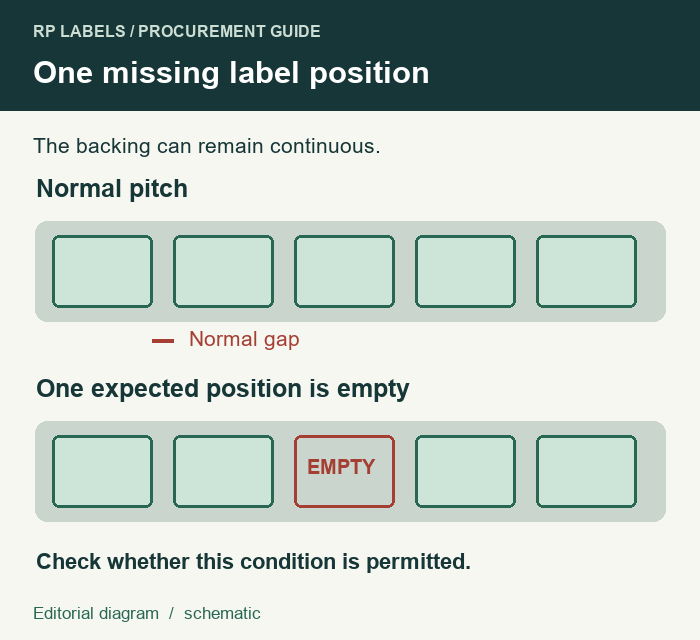
Give the converter a drawing or sample that identifies normal pitch, normal gap, web direction and usable start and end. If the quote allows empty positions, specify which positions may be empty, whether they may be consecutive and how they are reported or marked. Have the packer confirm any proposed mark before it is added to the web. Read the roll-splice guide for the separate joint requirement.
Decide what happens to the bottle at that point
Have the packer name the applicator model, installed configuration, operator response and downstream inspection. HERMA's model 500 documentation describes configuration-dependent responses to a missing position, including advancing to another label or acting on a missing-label signal. The company's 452E material describes a separate check for labels on products. These are examples from identified equipment. The line owner should verify the behavior and options of the machine actually being used. HERMA 500 parameter documentation and HERMA 452E product documentation.
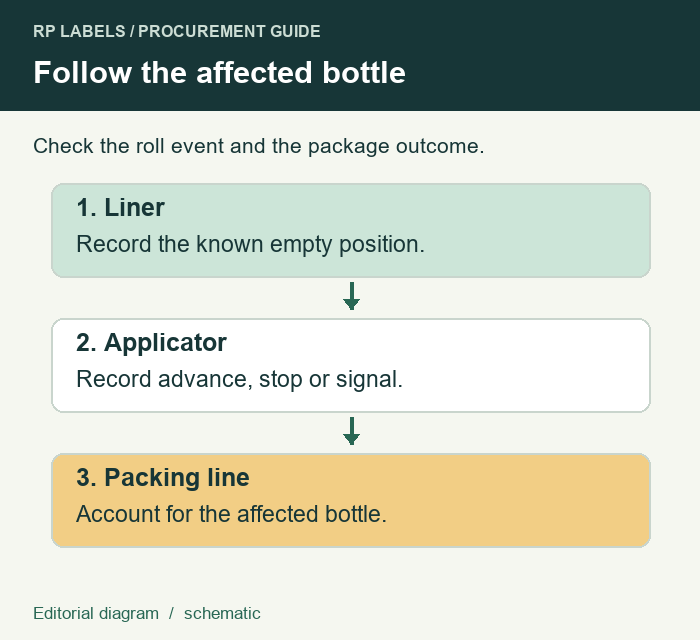
If an operator loads the rolls and can stop and account for the affected pack, the buyer may consider a marked exception after the packer accepts the handling procedure. If products move past the applicator without manual supervision, require evidence of which bottle is held, stopped or rejected, and how the line confirms that response. A web event by itself leaves the status of the bottle open.
Agree a trial and count before approving the quote
Ask the converter and packer to identify a representative trial roll. Where the line owner can run an authorized challenge, use a known absent position and track the expected label, the signal and the affected bottle through the line. Have the line owner establish any speed, spacing or restart conditions. For preprinted variable data, record how rejected or skipped items stay tied to the corresponding label data. If the team cannot reconcile that mapping, pause the release and investigate the workflow.
On a hypothetical roll with 1,000 nominal positions and three empty positions, there are at most 997 physical labels before any further setup losses or rejects. Agree whether the purchase quantity means nominal positions, physical labels or usable labels under the agreed inspection. Specify how a shortfall is handled. Keep the actual line confirmation with the order and see the finished roll specification guide for the full handoff.
Ask RP to quote the roll condition
Include the packer model, reference roll or drawing, quantities per design, usable-count basis, splice requirement and whether missing positions are prohibited or conditionally permitted. Prepare an RP Labels inquiry with the accepted trial or the person who will approve it. Ask the converter to identify how it can document the condition and where it needs clarification before quoting.