Label Roll Splices: Agree the Handoff Before the Applicator Starts
The rolls arrive before the packing slot. The artwork is right and the cartons are intact. A side flag on one roll marks a splice, but the packer cannot find an agreed instruction for handling it.
That is a hypothetical receiving problem worth solving before dispatch. A splice may be acceptable to the line, may need a planned stop, or may fall outside the agreed supply specification. The flag alone cannot decide which applies.
I would settle the finished-roll handoff with the converter and packer before releasing the order. Asking for “good quality rolls” leaves the application team to negotiate an avoidable uncertainty beside a loaded machine.
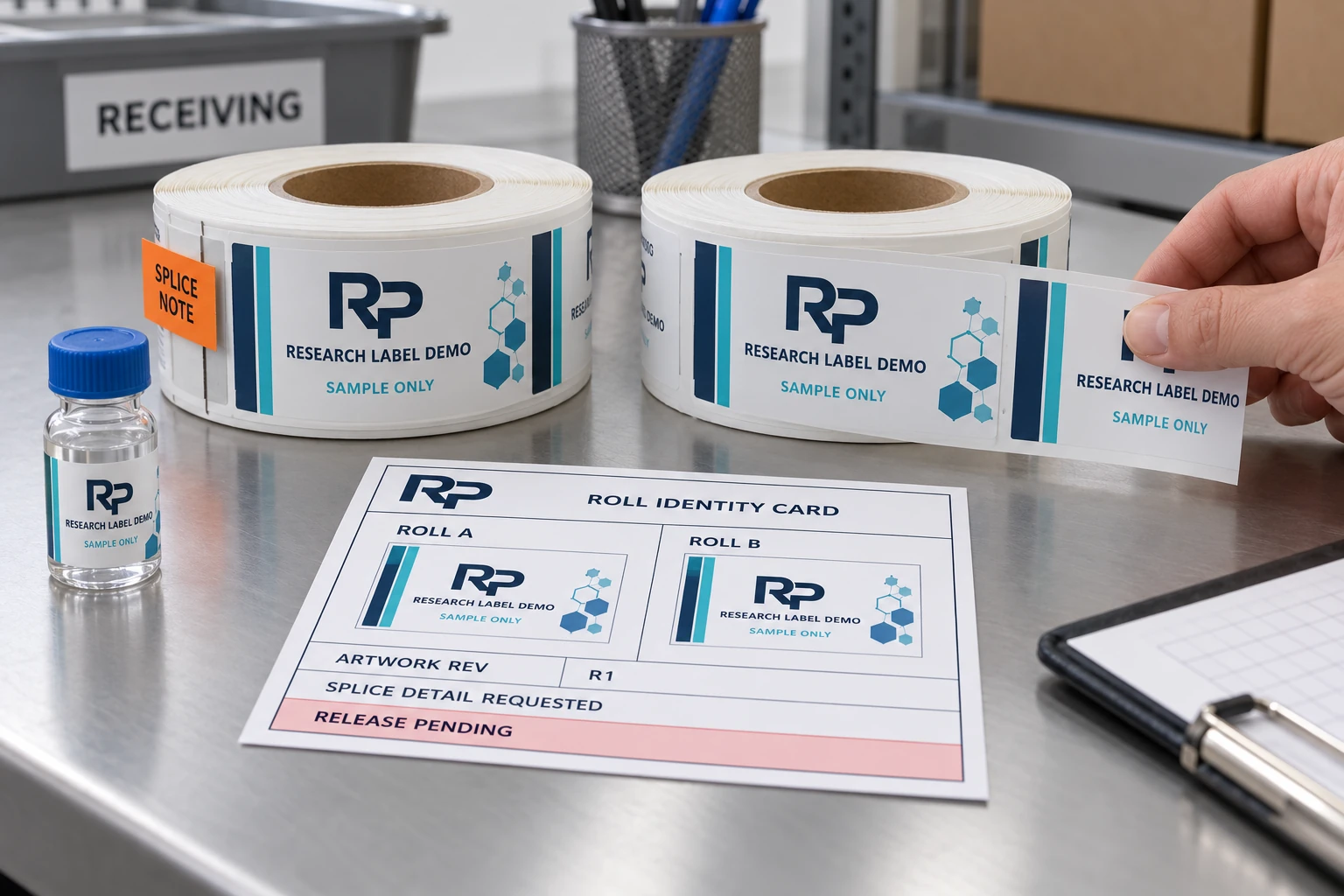
AI-generated packaging illustration. RP demonstration rolls show a proposed receiving record, not a counted shipment, factory inspection or successful machine trial.
Begin with what the actual line can accept
Ask the packer to identify the applicator or later printer, operating arrangement and relevant restrictions. Find out whether a joint can travel through that path, whether it needs a stop or removal, and who handles the affected labels. A hand-applied job and an unattended roll-fed line can reasonably make different purchases.
Do not invent a universal splice allowance. The converter needs to know the line requirement before confirming the finished-roll specification. If a joint-free roll is essential, ask whether that requirement can be supplied and what it changes in price, roll length, setup or timing. Obtain the supplier's acceptance rather than leaving it only in an outgoing request.
For a small manual project, accepting an identified joint under an agreed handling method may be sensible. Paying to exclude every splice can add work without solving a real problem. For another project, the consequences at a critical dispensing or inspection point may justify tighter conditions. The choice belongs to the actual process.
Do not copy a raw-material policy into a finished-label order
Mactac's published splice specification, dated November 2017, distinguishes its product groups and describes splice limits and identification. It shows that a supplier may define these conditions explicitly. Its limits concern its stated material products; they are not an RP finished-label allowance or a universal rule for your applicator.
Converting and finishing create the rolls the buyer receives. Ask the label printer to state the applicable finished-roll conditions, including how joints are identified and which material around them is intended for use or removal. The packer then confirms how that arrangement fits its equipment and procedure.
This separates three records that often get collapsed: the material supplier's policy, the converter's accepted delivery specification, and the packer's operating instruction. Keeping all three visible is more useful than debating whether a splice is generally normal.
Make the roll identity survive the opened carton
Connect each roll to the SKU, artwork revision and an individual roll reference. Agree where that identification appears and how it stays available when the outer carton has gone. The receiving team should not need to unroll a large section merely to discover which version is on the core.
Ask how the converter communicates the stated splice information. Depending on the actual arrangement, that may involve a roll record, side identification or another agreed method. Do not specify an improvised flag that interferes with the web or sensors. The packer should confirm how the notification will be noticed and handled safely in its process.
Include the relevant rewind direction, core, outer diameter and roll format in the specification. Those are separate physical conditions covered in the roll-direction guide and core and diameter guide. A correctly marked joint cannot rescue a roll that does not fit the machine.
Use a receiving record that leads to an action
The worked handoff contains two fictional rolls. It supplies no permitted splice count and no completed inspection. Roll A has a supplier note but no agreed line response. Roll B has no splice information in the received record. Neither absence proves that a roll is suitable or unsuitable.
| Receiving item | What is known | Next action |
|---|---|---|
| DEMO-A | Joint note supplied; handling instruction unresolved | Ask converter and line owner to resolve the applicable route before release |
| DEMO-B | Finished-roll splice information not supplied | Obtain the agreed supplier record; do not infer zero joints from a blank field |
The worked handoff CSV, blank CSV and field guide link the order specification, roll identity, received information, discrepancy owner and disposition. The sample state remains PENDING.
Compare what arrived with what the supplier accepted. If the information differs, retain the roll and carton references, describe the discrepancy and contact the responsible supplier and line owner. Avoid writing “passed” because the outside looks neat. Do not turn a receiving observation into an instruction to run an unresolved joint through equipment.
Keep the usable quantity question on its own line
A roll's stated quantity needs a shared basis. Ask how blank leader, liner around a joint, identified rejects or other nonproduction material are treated in the delivered count. Record the agreed basis and any handling that consumes additional labels.
This is different from a commercial overrun or underrun. The usable-quantity agreement guide covers the minimum or range the printer accepts for the order. This handoff connects physical roll information to the packing plan; it does not replace that commercial commitment.
Likewise, a rewind counter reading is not a substitute for the buyer's required evidence. Discuss the counting or inspection service, its scope and its record with the converter. Keep unavailable measurements unknown. A declared count, an observed condition and an accepted quantity requirement should remain distinguishable.
Release an agreed route, not an unexplained exception
Once the discrepancy is resolved, record the decision and the owner authorized to make it. The result might be acceptance under an agreed handling instruction, further review, rework or replacement, depending on the actual order and equipment. This guide promises none of those remedies in advance.
If the packer changes equipment or the converter changes the finished-roll arrangement, revisit the affected requirement. A previous run on another line is useful context, not automatic approval of the new path.
For custom vial labels, send RP Labels the packer's roll requirements and handoff record, artwork revision, quantity per design and actual application method. Ask the converter to confirm the finished-roll splice, identification and count scope before production. The packing team should receive an answer it can use while the machine is still waiting to be loaded.