Multi-SKU Peptide Vial Labels: What a Visual Inspection Must Catch
Color helps an operator find a vial quickly. It cannot be the only proof that the right label went onto the right SKU.
A color bar is a useful signal, not a product identity system. When several small vials are packed on the same bench, a green stripe can help an operator reach for the right tray. It cannot prove that the printed name, lot field and carton all belong together.
I would decide what needs to be caught before buying a more elaborate inspection camera. Possible faults include a roll from the previous SKU left on the machine, a label placed too far around the bottle, an unreadable variable field or a correct vial placed in the wrong carton. These do not all have the same detection method.
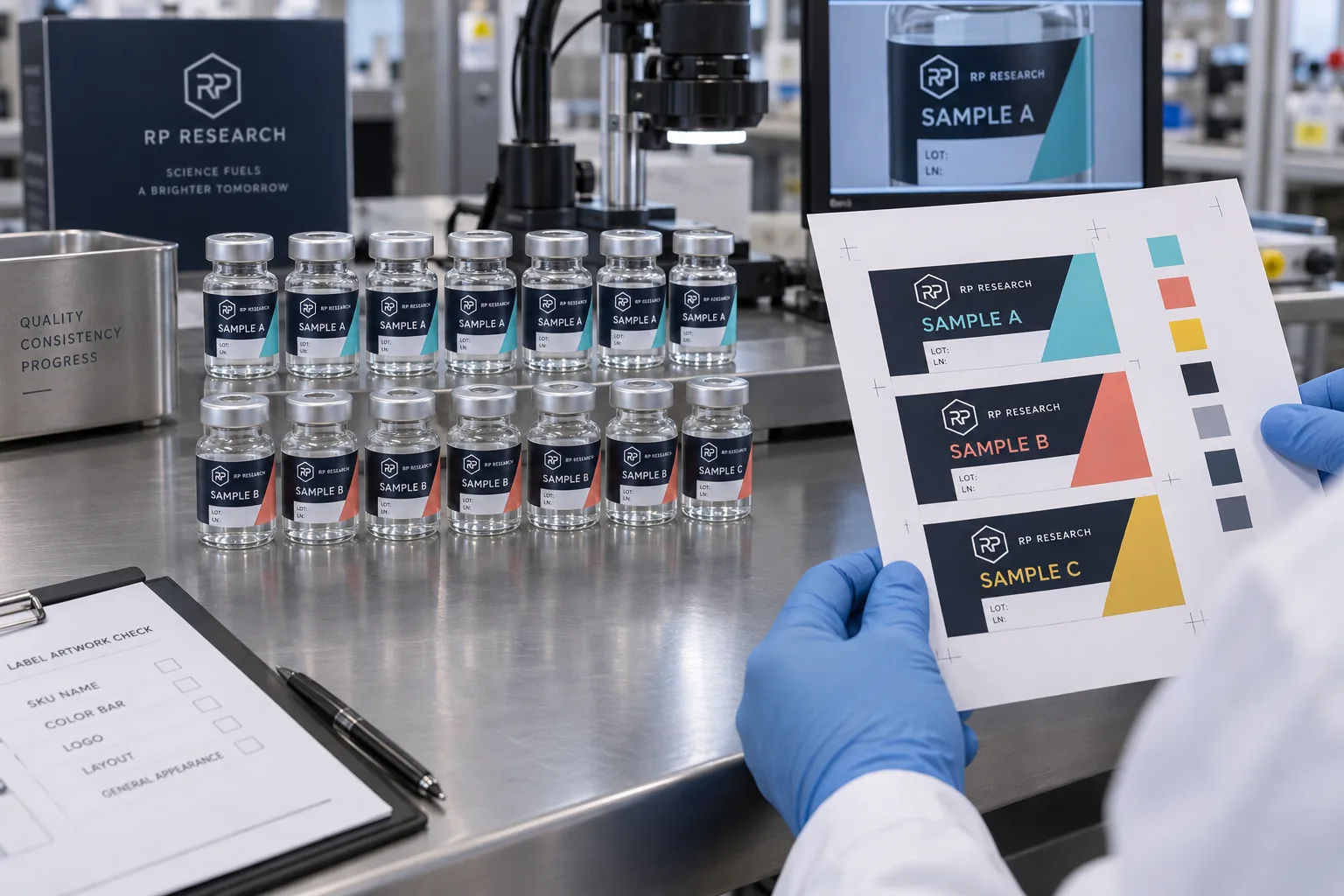
AI-generated inspection scenario, not an RP production line, validated vision setup or proof of inspection performance. Sample names are fictional.
Separate artwork approval from applied-pack inspection
The artwork proof confirms that the approved file contains the right elements. It cannot show how the label sits on a curved glass vial. An applied-pack check compares the finished vial with the approved reference: product name, version, color, lot location, orientation, adhesion and any paired outer-box identity. Keep one signed reference for each SKU instead of relying on memory.
For a three-SKU family, I would put the fixed product name in the same position across all three and let a secondary color distinguish them. The color-coding guide explains why color should aid recognition without carrying the entire meaning. A black-and-white photograph of the sample is a useful quick challenge: if two SKUs become indistinguishable without color, the names need stronger hierarchy.
Know what the camera can and cannot prove
Machine vision can be appropriate when volumes or mix risk justify it, but the pass/fail rule needs a specific target. Cognex describes optical character verification as comparing imaged characters with those configured as expected, including lot and date fields. That is different from merely detecting that a dark patch exists. A camera trained only to see a label can miss the wrong label.
HERMA describes equipment that can register a missing, misplaced or wrong label and send rejected products to a separate path. Those are capabilities of a particular configuration, not proof that any installed line does so. Ask an integrator to demonstrate the failure cases on your vials with your approved artwork, speed and lighting. Record which fault is detected by a sensor, which by vision, and which still needs an operator.
Build deliberate challenge samples
Set aside a correct vial for each SKU and a small controlled set of wrong examples: wrong SKU label, shifted label, crooked label, missing label and a lot field that cannot be read. Run these against the proposed inspection method before accepting it. Never let deliberate challenge samples return to saleable or releasable stock. A detected fault is only useful if the reject can be traced and kept separate.
Small batches may be better served by a disciplined manual check than a poorly configured camera. Check the first finished vial after every roll and SKU change, then at a frequency your own risk assessment supports. Where lots are printed later, link this check to the variable-data release process; visual resemblance does not prove a field is correct.
Write the fault before asking for a demonstration
The worked challenge plan, blank plan and field guide include three proposed faults: the wrong SKU label, an incorrect or unreadable lot field, and a missing label. The expected response is defined, while actual detection and reject evidence remain blank. Nothing in the example has been run on a production line.
For the wrong-SKU challenge, the reviewer needs an independently approved expected identity. A system configured from the wrong master can agree perfectly with the wrong label. For the lot challenge, distinguish finding a printed area from comparing the expected characters. For the missing-label challenge, follow the unit beyond the detection message and establish where it actually goes. Detection and segregation are separate observations.
Ask the operator or integrator to identify the relevant view, settings, speed and lighting used in the demonstration. A clear image from a stopped flat sample does not settle performance on the moving curved pack. Record any limitation and determine which faults still require an operator or another check. The buyer's own assessment must set the coverage and frequency appropriate to the process; this article supplies no universal acceptance rate.
Control the deliberate wrong specimens. Give them clear identities, keep them segregated and account for them at the end. Do not let a successful demonstration put an intentionally wrong vial into accepted stock. A documented manual method can be a better choice for a short run than an automated setup whose claimed faults have never been demonstrated. Automation deserves to win when the actual configured process supplies the required evidence and controlled handling.
Ask for an inspection-ready label, not a camera promise
For a quote, send the complete SKU matrix, reference artwork, vial size, proposed application method and what must be machine-readable. Ask whether the roll layout and label surface preserve the name and lot in a visible zone on the actual curved vial. If a vision system will be used, share its camera view and approved field positions before the print die is locked.
My buying rule is plain: define the identity and data that must remain visible on the actual vial, and require the proposed inspection method to demonstrate the agreed faults. Ask the print quotation to confirm artwork and supply scope; the packing team owns applied-pack release criteria.
Send RP Labels the challenge plan, approved SKU matrix, vial reference and proposed visible field positions. Ask the print quote to identify relevant artwork and supply requirements; obtain inspection-system performance evidence from the actual configured process.
Sources and scope
Demand layer: competitor and process pages linked here, including Avery, HERMA or OnlineLabels where cited, illustrate buyer language and process topics only. They do not supply RP minimum quantities, lead times, prices, certifications or materials. Authority layer: an RP number is backed only by a factory datasheet, a signed quote or proforma, confirmed product data, or a fact kept on the About page. The March 2026 proforma there is one production-run example, not a standing offer. RP shipping and planning pages describe what to confirm on a quote. Worked figures on this page are fictional unless an authority source is named for them.