Oil-Resistant Softgel Labels: Test the Face and Edge Separately
The oil wipes off the front and the artwork still looks clean. That is reassuring, but it leaves another question open: what happened where the liquid met the label edge and the later-printed batch field?
The short answer: start with a compatible film facestock, adhesive and protective finish, then test the complete label on the actual softgel bottle using the real oil exposure. Oil resistance is a package result, not a single material checkbox.
We can produce labels for essential oil bottles that are specified to resist oil drip and edge lift. Film constructions such as BOPP, PP, or PET with a suitable adhesive are typically used for this application. Material names on this site are not a certified oil-proof construction list. We confirm the construction after reviewing your bottle and oil, and we recommend a practical wipe or drip test before mass production.
Waterproof and oil-resistant are not the same performance. We can specify labels for cosmetic creams and similar products, but resistance depends on the formula, container, and how the pack is handled. We recommend testing with your product, not assuming a water-resistant label is oil-resistant.
When buyers ask for “waterproof,” they often mean the label should survive everything liquid. Water, alcohol and oil do not attack a construction in the same way. A glossy face can wipe clean while oil quietly enters a die-cut edge and softens the adhesive underneath.
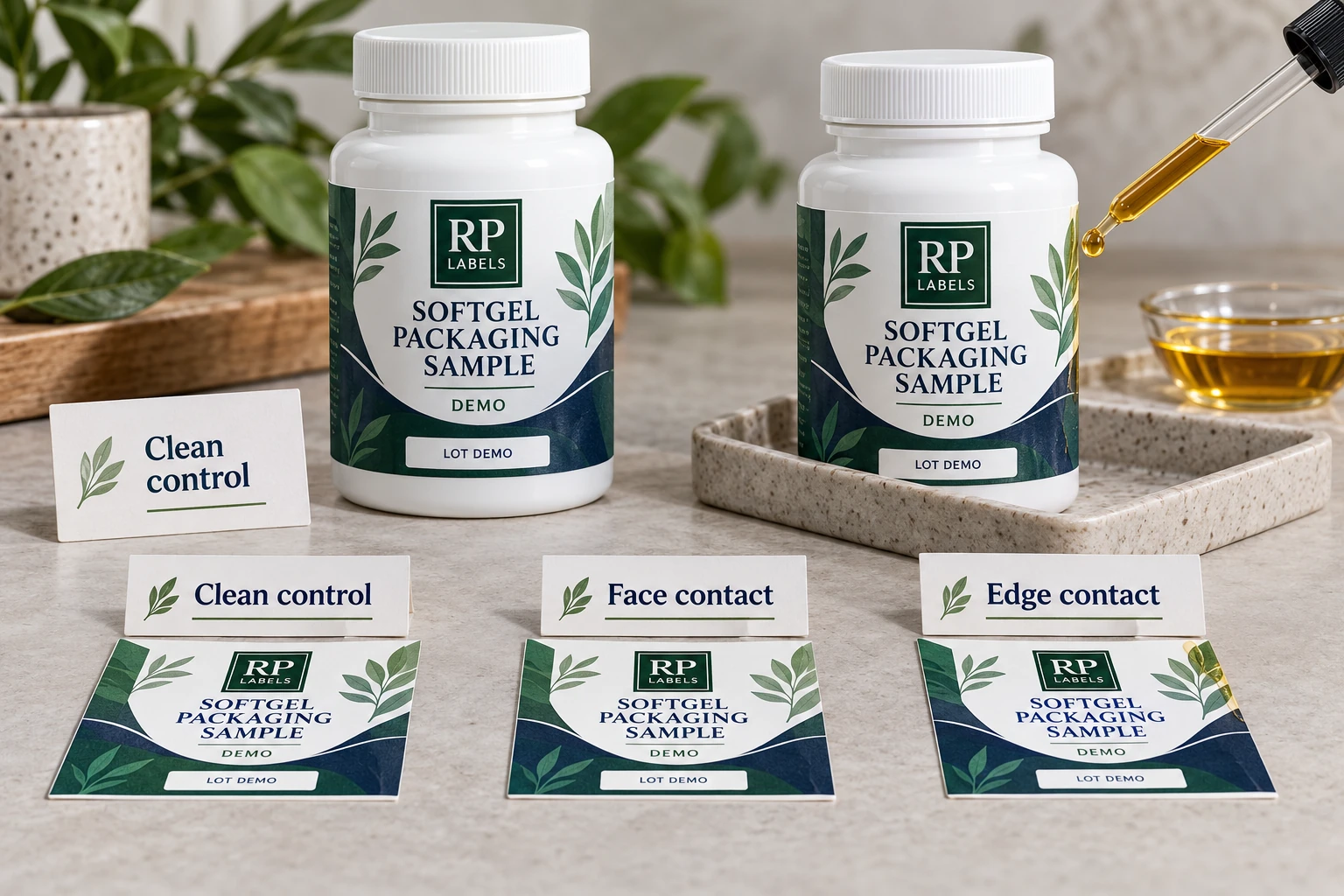
Keep the control, face contact and edge contact as different samples
If the credible route is an occasional oily glove, start there. If residue can collect near the cap and reach the top edge, identify that route separately. Neither should be replaced by a dramatic immersion simply because it makes a stronger photograph. Ask the package owner to describe the substance, contact location, duration and subsequent storage that are actually plausible.
The example plan separates an untouched control, contact on the printed face and contact at an exposed edge. Use production-size applied labels and an agreed safe handling method. Keep the bottle reference, construction and application conditions recorded for each sample. This is a proposed comparison structure, not a standardized resistance method or permission to claim the whole package is oil-proof.
After the agreed contact and observation period, describe what changed. Record any staining, softening, transfer, movement or edge lift by location. A face that wipes clean does not close an edge observation. An unchanged edge does not demonstrate that later thermal-transfer or inkjet marking will stay readable; add the actual marking combination to that review.
If the clean control already lifts, stop attributing the problem to oil. Investigate the original application, geometry and construction before changing the resistance claim. If a contact sample changes while the control does not, preserve both and ask the supplier to examine the difference. The comparison narrows the question without establishing a chemical cause by itself.
A construction for incidental fingerprints may be adequate for a dry, controlled packing route. More frequent residue may justify another finish or construction after evaluation. The worksheet records which route the buyer needs and which remains untested. Send RP the actual bottle, oil identity and contact description, label size, final artwork and later-print method. Keep any unreviewed exposure outside the approval instead of stretching the word 'waterproof' to cover it.
Download the worked example CSV · Open the working CSV · Read the field guide. The entries are planning examples, not completed results.
Find out how oil reaches the label
There is a large difference between an occasional oily fingerprint and repeated liquid contact from a leaking capsule. Map the realistic route: filling-line residue, cap threads, induction-seal handling, warehouse heat, consumer hands or a damaged softgel inside the bottle.
Then decide what failure matters. A faint cosmetic stain may be unacceptable for a premium brand. For another product, the real risk is missing batch data, a lifting seam or a barcode that can no longer scan.
Film usually gives a wider working window than paper
BOPP and PET film constructions do not absorb oil like unprotected paper and are often sensible starting points for supplement bottles. Paper can still deliver a tactile natural appearance, but it needs a realistic barrier finish and more careful edge evaluation.
Film alone is not a guarantee. The ink system, white layer, adhesive and finish still need to stay stable. A rigid film on a small bottle can spring back at the seam even before oil reaches it.
Buying rule: choose the construction around the worst credible contact point, not the clean sample shown during artwork approval.
Lamination protects the face, not every entry point
A well-selected laminate can improve scuff, moisture and oil resistance across the printed surface. The exposed perimeter remains a route into the construction. The overlap seam, a nicked edge or an unsealed variable-print window may be the first place to change.
Varnish can be lighter and more economical, and it may suit limited incidental contact. Coverage and chemistry vary, so “UV varnish” should not be treated as one fixed level of protection. Ask what was tested and on which substrate.
The bottle surface can be the hidden variable
HDPE and PP have lower surface energy than glass and can be less forgiving for pressure-sensitive adhesives. Release agents, dust and oil residue make the situation harder. Labels should be applied to clean, dry bottles at the recommended temperature with firm, even pressure.
Do not put vulnerable information in the highest-contact zone
Keep LOT, EXP, barcode and QR fields away from the overlap, cap drip path and the area operators grip most often. If variable data is added after printing, verify that the ribbon or ink remains legible after oil contact. A durable laminate around the panel cannot protect weak overprint sitting on top of it.
Run an honest finished-package test
Apply labels using the intended method and allow normal adhesive dwell. Expose separate samples to a controlled fingerprint, a wiped film and a small liquid contact. Store them for the relevant period and temperature, then inspect against an untouched control.
Record stain, swelling, edge darkening, ink transfer, laminate tunneling, adhesive ooze and seam lift. Do not rely on a dramatic one-minute soak if the real risk is slow edge exposure over weeks; the test should resemble the product route.
Oil-resistance approval checklist
- Identify the actual oil and how it can reach the label
- Use the production bottle resin and surface finish
- Apply labels under realistic temperature and pressure
- Test the printed face, cut edge, seam and variable-data area
- Compare laminate and varnish when both are being considered
- Inspect barcode and QR scan performance after exposure
- Include storage time, heat and handling in the protocol
- Keep a control sample and record the exact construction
Bring the decision into your print brief
Use the identified references and open items in the worked record when discussing your custom print project. Include the actual package, artwork revision, quantity per design and the conditions explained above; leave unknown inputs marked for confirmation. Review the relevant custom-label service, then send the project details to RP Labels.
Related buying decisions
- Lamination vs Varnish: Approve the Finished Bottle Label
- Amber Dropper Bottle Labels: Proof Oil Residue and Shoulder Clearance
- Supplement Labels with Lot and Best-By Codes: Reserve the Print Zone
Sources and scope
Reviewed October 25, 2026. Primary supplier or official reference supports the identified production concept. Procurement comparisons and worksheets are editorial guidance. Conditional examples are not customer records, completed tests, regulatory approval or universal acceptance standards. Confirm the actual proposed construction and process with the responsible supplier and buyer. Demand layer: competitor and process pages linked here, including Avery, HERMA or OnlineLabels where cited, illustrate buyer language and process topics only. They do not supply RP minimum quantities, lead times, prices, certifications or materials. Authority layer: an RP number is backed only by a factory datasheet, a signed quote or proforma, confirmed product data, or a fact kept on the About page. The March 2026 proforma there is one production-run example, not a standing offer. RP shipping and planning pages describe what to confirm on a quote. Worked figures on this page are fictional unless an authority source is named for them.