Vial and Carton Artwork: Approve the Identity That Remains After Unboxing
The carton and vial look like the same brand in a presentation. Then the carton is set aside and the vial's remaining abbreviation is no longer clear. A coordinated packaging system has to survive that ordinary change in context. Matching colors are useful, but they cannot carry every identity field.
The box has room to make the brand look composed. The vial has to keep doing its job after that box is discarded. I would review the little label on its own before celebrating the matching set. Giving it a shorter layout can be sensible; leaving it dependent on a color remembered from the carton is a different choice.
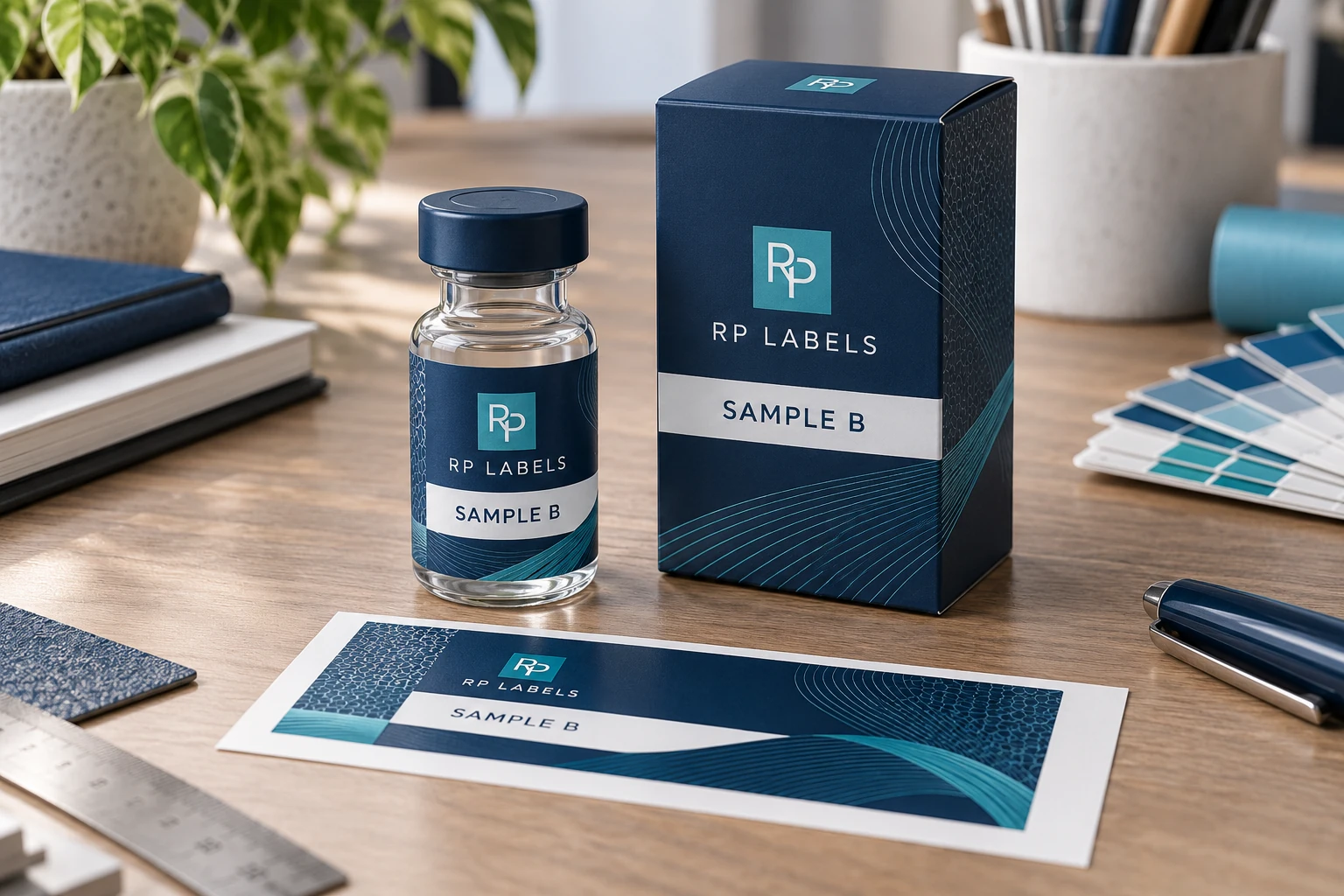
AI-generated packaging illustration. Fictional RP samples show the proposed decision; no physical test or customer order is documented.
Walk the proof through three viewing states
Review the closed carton, the opened pack and the vial on its own. For each state, identify what the intended user must recognize and which approved printed fields provide that information. The worked identity record keeps the stable product code separate from a decorative color cue. Where an abbreviation is used, the buyer should define how it maps to the full name.
Place the actual-size vial and carton proofs beside each other. Compare product identity, permitted descriptive fields and variable-data logic using the approved sources. Do not make a long carton line fit the vial by indiscriminately shrinking it. The layout may adapt while the controlled identity remains the same.
Record exceptions at SKU level. A long name, another container size or a different approved field may need a specific layout rule. That exception should be visible in the system rather than arriving as an unexplained local adjustment by one designer. Color matching has its own physical reference; it does not prove content matching.
A simple vial identity paired with a more detailed carton can work where the approved information plan supports it. Where the vial will be handled independently, relying on the outer box alone may leave the operational task unresolved. The responsible product and compliance owners decide the actual content requirements; the designer and printer implement that decision.
Send RP Labels the two component dielines, approved identity map, longest names, variable fields and quantities. Ask for an actual-size paired proof with the viewing states identified. The buying decision is whether the system remains understandable when the package is used, not whether the vial is a miniature copy of the box.
Decide what must match
Logo construction, core typography, SKU color, product naming and the order of critical information should remain consistent. Decorative patterns, long copy, certifications and secondary instructions can move or disappear on the vial.
The front of the vial normally needs product identity, strength and one or two high-value cues. The carton can support longer descriptions, handling information, larger codes and additional panels. Consistency comes from repeated rules, not identical geometry.
Build the SKU logic before polishing one product
A single beautiful label is easy. A family of twelve is where the system shows its weaknesses. Product names change length. Strengths use different units. One carton needs more text. Another SKU gets a darker color that reduces code contrast.
Create a test sheet with the shortest and longest realistic names, the lightest and darkest colors, and the smallest strength field. If the layout survives those extremes, it has a better chance of surviving the product line.
Buying rule: color should help a trained person find the right SKU, but text must still identify it when the color is poorly lit, printed differently or viewed by someone with limited color perception.
Match color by process, not by screen
A carton and a vial label rarely use the same substrate. Coated paperboard reflects light differently from white film, clear film or metallized material. The same CMYK values can therefore look different even when both printers hit their targets.
Define the important brand colors, share physical references where possible and approve the two components together under the same light. A digital proof confirms placement. It cannot fully predict how ink, white layers, laminate and paperboard change the final color.
Plan variable data as part of the design
Batch, expiry and serial information is not leftover text. It needs a reserved area, sufficient contrast and a coding method that works on each surface. The carton may use inkjet or laser coding while the vial label may arrive preprinted or receive a separate overprint.
Do not place the variable field across a carton fold or near a vial seam. Confirm the longest possible data string, not the shortest example used in the artwork.
QR codes need separate real-size tests
A QR code that works on the carton may fail after being reduced for the vial. Curvature, gloss, quiet zone and print gain all change the scan. Keep the same destination when that makes sense, but size and position each code for its package.
There is also no prize for putting a QR code everywhere. If the vial surface is too small, a readable carton code and clear vial identity may be the better system.
Proof the unboxing sequence
Review what the buyer sees before opening, after opening and after the carton is discarded. The carton carries the first impression. The vial may carry the long-term identification. If the two disagree on strength, color or batch, the polished design becomes a liability.
Worked vial carton pair record
The rows below are hypothetical planning examples. Empty observation or commercial fields must be completed from the actual project; no sample has been tested for this article. Use the worked CSV and blank worksheet with the field guide. Keep the example references separate from production records.
| sku reference | viewing state | identity required by buyer | approved field source | layout reference | observed conflict | owner | decision |
|---|---|---|---|---|---|---|---|
| DEMO-B | Closed carton | Buyer-defined identity | Actual approved source | Carton R1 | Product owner | PENDING | |
| DEMO-B | Standalone vial | Buyer-defined durable identity | Same controlled identity map | Vial R2 | Product owner | PENDING |
Bring this decision into the print inquiry
Contact RP Labels with the completed vial carton pair record, the actual packaging reference, approved artwork and quantity per design. State which fields remain unresolved so the print specification and any relevant sample scope can be discussed against the same decision.
Related buying guidance: Custom peptide vial labels; Pantone vs CMYK color matching; QR and batch layout; Digital proof vs physical sample.